Where is Our Class?

Many teachers have a system to keep track of which students are out of the classroom. Some use a sign in/out sheet, others have a pass that sits on the student’s desk, etc. Lots of teachers also have something to indicate where the class is when they’re not in the classroom. Many have door hangers, signs, etc. Here’s an idea that works great if you’ve got a metal door (magnetic):

This teacher found huge magnets (dry erase calendars) at the dollar store and bought 4. Here’s what she did with them:

1. Label this one “classroom” (you could just use tape or something to designate this section of the door if you only wanted to buy 3).

2. Cut it up into small pieces so each student has one (name, number on it). These start in one section of the door each day. The kids move them to the “classroom” section as they come in first thing in the morning and then move to a location when the student leaves the classroom (to go to the nurse, for example).

3.  Divide it into different sections to represent where a few students might go at a time (nurse, office, bathroom, literature lab, speech, etc.)

4.  Cut it up into small signs to put on the front of your door when your entire class goes somewhere (recess, art, computers, library, etc). Assign one student to move all the magnets to their proper place at the end of the day and to be responsible for moving the appropriate magnet to the outside of the door when the whole class goes somewhere.

You can spend time making yours cuter if you want. This teacher made this last-minute and has just kept it…

Know of another good system? Comment below!

Quiet Signals

Here are some quiet signals I’ve heard over the years:

Practice Map Directions.  Teacher: “Point North” (students point). “Point East” (students point)… in different orders so the students learn the directions needed for using maps.

Eyes On Me. Teacher: “1 2 3 eyes on me.” Students: “1 2 eyes on you”

Counting Down. Teacher starts counting backwards from 5, getting quieter and quieter with each number.

Do This. Teacher does simple actions such as touching nose, folding arms, etc. while quietly saying “do this” with each action. Soon students are looking around for the source of the directions their friends are following and it gives the kids something to do until everyone is ready.

Claps. Teacher claps out a rhythm and students must copy. Some students have a specific rhythm they use (teacher claps the first part and students finish the rhythm).

What signal do you use? Please share your ideas by commenting!

Classroom Library Organization

Gallery

This gallery contains 11 photos.

Keeping classroom library books organized can be a really big challenge. Most systems that organize books (and KEEP them organized) take some effort up front. There are many ways to organize your books (author, reading level), but one of the … Continue reading

Rate this:

Do I Have to Read 20 Minutes Each Night!? Yes. And Here’s Why…

By the end of 6th grade, a student who reads 20 minutes each night will have read the equivalent of 60 whole school days. By the end of 6th grade, a student who reads 5 minutes each night will have read the equivalent of only 12 whole school days. Which do you think will have a better vocabulary? Which do you expect will be more successful in life?

Click to see the handout: reading 20 min each night

Green Table, Blue Table: Labeling Student Desks

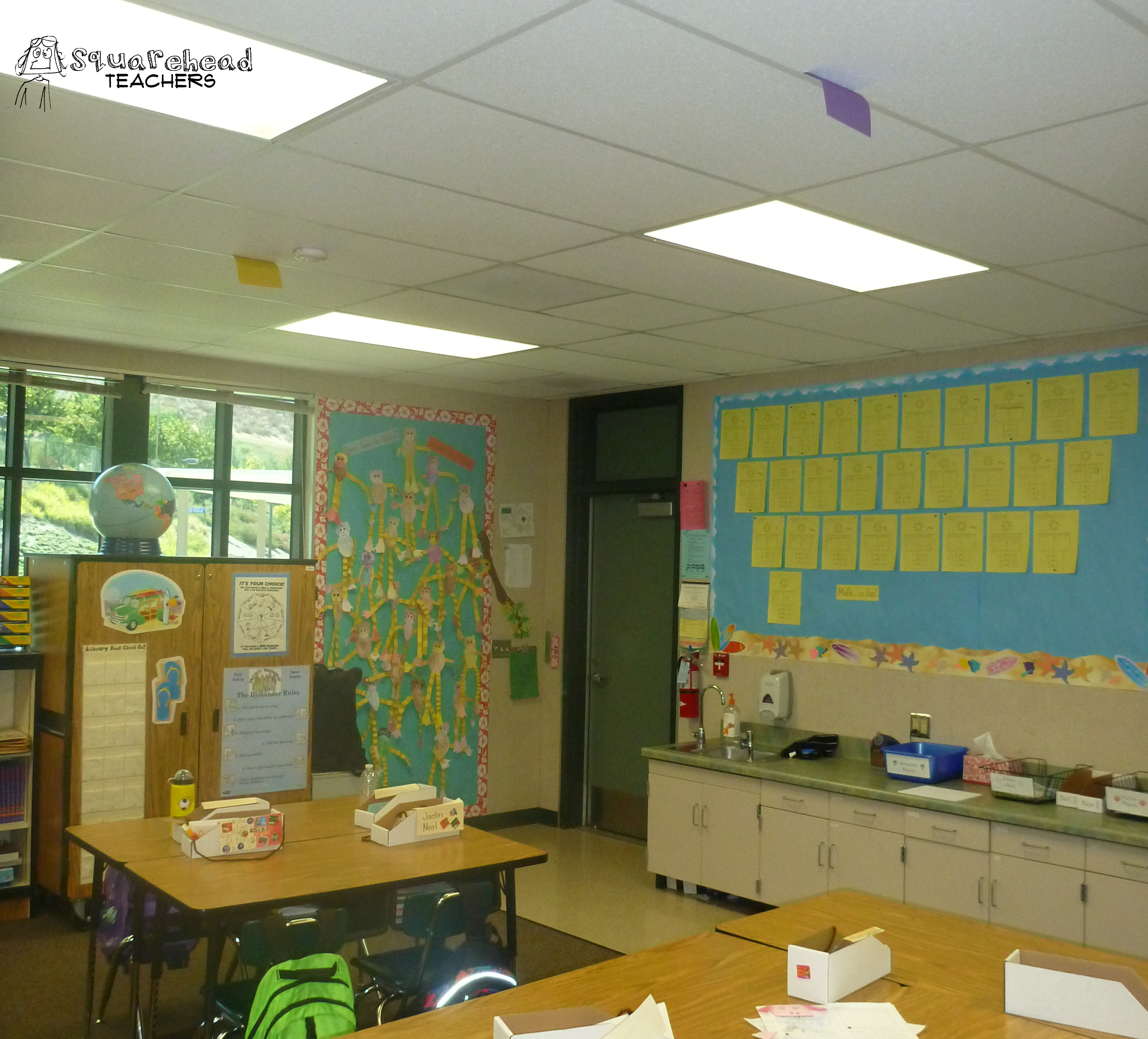
When teachers arrange their desks in groups, they need an easy way to label each group. Many teachers number them, or gang things from the ceiling using string, but the following idea was the easiest to set up and most easily recognizable table identification system I’ve ever seen. It’s so easy that it blows everything else out of the water. Take a solid piece of construction paper or cardstock and fold it in half. Then tuck one end in the metal bar between ceiling tiles. Done. Anyone with half a brain who walks into the room will know what color goes with each group of desks and it’ll take you 2 minutes flat to put up all the papers. Just make sure your school doesn’t have any fire codes you’d be violating if you attach anything to the ceiling…

6 Traits Writing Posters

Easy to read, simple 6 traits writing posters for your classroom!

click here to get the PDFs: 6 traits writing posters

(I don’t remember where I got these, and they don’t have a copyright on them, so I guess they’re fine to share.)

Homework Coupons

One of my mistakes my first year was putting all the prizes in the treasure box in the beginning of the year. Then, once everything in there had gotten uninteresting to the students, I had already spent the little money I was given and couldn’t replenish it. These became one of the most popular items in my treasure box, because, let’s face it- kids just don’t like homework.

I made sure to write the student’s name on it and sign them when a student won a homework coupon because they weren’t valid without my signature. In addition, I would require my students to staple the coupon to the corner of the assignment when turning it in, so I couldn’t lose it (since it was 1/8 sheet) and it was clear to me which assignment the student wanted the coupon to count for. When I graded the assignment, I would only tear off half of the coupon, so the student would have “proof” that I had seen their coupon and there was no way for students to try to use it again. I chose bright color paper to run these off on, so I could always identify them easily in a pile. I made it clear to my students that I would not replace lost coupons. Since they had a student’s name on them written in my handwriting, there seemed to be no incentive to try to steal them, so that worked out nicely as well.

Just because I’m nice, I gave each student one coupon at the beginning of school, and because teachers have no money nowadays, this was their birthday present also. The kids seemed pretty excited to have the option to skip homework on their birthday.

Click to download the homework coupons.

Fun Group Game: Animal Sounds

Animal Sounds-After we played this game with my 6th graders, we talked about how this might relate to friendship or success in school. My students actually found some really good connections! We also played this in preparation for our Shakespeare play and discussed how, in this game, you have to be confident to get the job done, vocal so people can hear you, and enjoy what you’re doing even if you may feel a bit goofy. Although I played this with my 6th grade class, 4th and 5th graders can play this game successfully too.
Players close their eyes, and then a teacher moves among them whispering the name of an animal to each person. The challenge is to find all the other animals of one’s own kind, and the first group to be completed wins. No one can talk; players can only make animal sounds. Loud chaos ensues, and gradually order and unity emerge as animals find one another. Be prepared to shepherd people from danger, though usually the game is very safe. Many do not move much, but rather focus on listening and calling out to others. animals (aim to have the same number of each animal—around three of each) might include wolf, cat, pig, kangaroo, snake, lion, crow, monkey, frog, elephant, and others. It was fun to make it more challenging at the end, but throwing in choo choo train, pirate, leaky faucet, race car and other wacky sounds like that.