3D Snowflakes! (Easy Step-by-Step Directions)

You’ve probably seen those really cool 3D snowflakes. Maybe you thought they looked really complicated. Not true!! Here are my simple, step-by-step directions: click here.

Lesson Plan: Inventions (& Airplanes)

I took a phenomenal class about drama in the classroom. Here’s my lesson plan from the class. It’s about inventions and it’s geared towards upper grades. Enjoy!

Lesson plan PDF

Guided Reading Lesson Template

Here’s a guided reading lesson template if you’re looking for something quick to help you jot down notes as you prepare. You can print some off and hand-write on them or just do it on your computer.

Click to get the template: Template

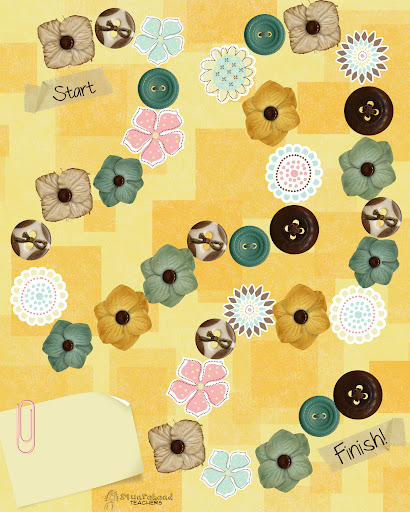
Game Boards: Sunshine!

Can you tell I’m into the color yellow today? Enjoy!

To get these game boards: right click on the picture, choose “save as” or “save image as” and save it to your computer. Then you’re free to resize it and print as desired. Enjoy!

Intro to Fractions: PowerPoint & Worksheet

Many teachers have heard of the Hershey’s Chocolate Bar book that introduces fractions. Sometimes teachers don’t have space in their room to have the kids sit on the floor when you read a book (I was one of those teachers). But I had a doc camera and a projector! I made a PowerPoint that works in conjunction with the book to introduce fractions. I also used different colored leaves from outside on our school grounds and had kids use the color of the leaves to make fractions.

Click here to get this stuff: PowerPoint & Worksheet

*2021 UPDATE: GoogleDocs has updated some things that have made it hard to share some of my oldest files. I’m trying my best to go through this blog and re-upload my oldest files, but I haven’t gotten to all of them yet. Thanks for your patience.

LOVE Drama (Lesson 6)

­­­­Six Drama/Theatre Lessons
Drama /Theatre Specialist
Fullerton School District
All the Arts for All the Kids
Storytelling:
This set of lessons explores dramatic work as one learns to express a story.  Since drama can be defined as “an actor with a conflict”  and, in most theatre, drama is contained and expressed through  story, story literature and character archetypes from six different cultures are explored.
The lessons are linked both to theatre arts standards and history/social science and language arts curriculum standards.
Emphasis is placed on expressional fluency, critical thinking, divergent thinking, cooperative learning, creating solutions to problems, and comparing and contrasting cultures and style. 
Students participate in acting exercises, games and playmaking.
April 2002

Lesson Six
Title:  Storytelling is Performance
Overview: 
Lesson Six is part Two of Lesson Five
Note:  It is very important that you, as the teacher, are able to retell the story, without using notes, in your own words.  Know the characters, what they say, what happens next, etc.  If you falter, the energy of the story will falter, and the students will begin to fall out of the game of acting out the story.  So, know the story cold!
Objective:
Students will dramatize  a story using props and costumes, responding to cues, and making creative choices appropriate to their character and the story.
Materials:
·        Everything used in Lesson Five
Vocabulary:
Same as Lesson Five.  Add “cue.”
Background:
Remind the students how the storyteller needs the audience and the audience needs the storyteller.
Procedure:
1.    Review the choices the class made last lesson.
2.    Make sure the students know that a cue is. (A signal to do something)  Tell them that we are going to use cues today in order for everyone to know when to play their parts.
3.    Divide the room into distinct acting areas.  You will need :
·        The Gate into the city
·        Han’s hut
·        The Mandarin’s Palace, with chairs for the Council and Mandarin.
·        An area in which the Wild Horseman can sit.  (The Horseman never really need to leave this place.  They can do all their acting from a space rather near the gate, and just get louder as more mean as they get “closer.”
·        A faraway place, from where the old wanderer comes, and where the messenger rests  until it is time for his part.
4.      Instruct the students that you will still help them tell the story.  When you are standing near a student it is their cue to act the story.  Everyone else in the class is the audience at that point.  If you go  stand near the Wild Horsemen then they will act as the Horsemen (review their cues.)
5.    Review who is audience and who are actively acting (by you physically keeping the focus), until  everyone knows what is expected.
6.    Announce “And now, for the first time anywhere on Earth, Ms.——————class presents their version of the story Everyone Knows What a Dragon Looks Like.  Once upon a time, (moving toward Han)there was a .boy named Han.  Han was an orphan boy who swept the gate of the city.  He but he was a happy boy and waved to everyone coming through the gate.”
7.     This is where your finesse as teacher, will come into play.  For many children you can cue  “So the Mandarin said……” and the child act the appropriate part of the story.  For some children you will need to say  “And so the Mandarin told him to come over by the throne…”  You leave a pause and the child will say “Come over here by the throne!”  Sometimes you will need to say “And the Mandarin said ‘Come over here by the throne’.  And the child will repeat exactly what you say, and how you said it. 
8.    Try your best to not tell or show the child how to do his/her part.  They know the story.  Just urge them on with your story narration, giving them more and more clues as to what the character is to do or say next.  You will find all levels of ability regarding understanding and accomplishing of jumping into the drama. 
9.    You may have to remind students when they are to stop acting and become audience members, but insist on it.  You can keep focus by telling the story with energy and showing the students where to look (wherever you are!)
10.At the end of the story, give each child a chance to receive applause for their work.  Praise their storytelling abilities.
11.Repeat if desired, changing parts.  A student can take your part at this point.
12. As this is your last lesson, direct students’ attention to the Storytelling Tree.  Review all the ornaments,  and the associative stories and concepts.  Use as much vocabulary as possible, as a review. 
13. Direct student’s attention to the present ornament.  Remind them   you still feel sharing a story is like giving someone a present.  Challenge each of your new storytellers to tell one of the stories they’ve learned, or a new story they make up, to someone in their family.  Assure your students  it will be a wonderful gift, because they have become wonderful storytellers.
 Assessment:
·        Did students  dramatize  a story using props and costumes, responding to cues, and making creative choices appropriate to their character and the story?
Integration/Correlation/Extension/Modification
·        It is important  not to put students in front of an audience until they have gained confidence communicating all aspects of their story.  That means being able to stay in character, remember the sequences without cues, projecting  voice and character and being comfortable with props and costumes.  If you and your class want to continue working on these skills…Wonderful!  But please don’t put students in front of an audience before they are truly ready.  It will be a bad experience for everyone if they go on unprepared.
·        Ask students if they would like to act out other stories.  Use no more than three-four students in a group.  Make sure all are familiar with the story.  Have them use the same technique  you used to help the students act out the story.
·        In story telling, one generally uses few props and costumes.  But designing such is an excellent activity.  Have students choose a story and design the costumes and props.  They may need to research the country or culture of the story, or a chosen time period. Have them make a design portfolio.

LOVE Drama (Lesson 5)

­­­­Six Drama/Theatre Lessons
Drama /Theatre Specialist
Fullerton School District
All the Arts for All the Kids
Storytelling:
This set of lessons explores dramatic work as one learns to express a story.  Since drama can be defined as “an actor with a conflict”  and, in most theatre, drama is contained and expressed through  story, story literature and character archetypes from six different cultures are explored.
The lessons are linked both to theatre arts standards and history/social science and language arts curriculum standards.
Emphasis is placed on expressional fluency, critical thinking, divergent thinking, cooperative learning, creating solutions to problems, and comparing and contrasting cultures and style. 
Students participate in acting exercises, games and playmaking.
April 2002


Lesson Five
Title:  Storytellers Make Choices
Overview:  In the past four lessons, the storyteller has modeled making choices of dramatic story telling technique, and invited the students to make  choices too.  Also, the past three lessons have covered literary character archetypes.  Now it is time to use the students’ experience and knowledge to help them tell a story as a performance.
This performance is for the class only.  The emphasis is on making creative choices.  The lesson  is designed to give the students experience  dramatizing a story.  But the audience is comprised of their own classmates, as are the performers.
Don’t worry!  The students will love to perform just for themselves.  It will seem a natural   extension of the storytelling techniques you have been teaching, and they have been discovering. 
If you are tempted to let them share their stories, as a performance, with another audience,   please see the “Integration…etc.” section at the end of this lesson.
Note:  This lesson is in two parts.  This lesson involves making many preparatory choices.  The next lesson is the actual performance.
Objectives:
·        Students will make creative dramatic choices when they, in partnership, portray a dragon, of their own design.
·        Students will identify the character archetypes of Hero, Villain, and Fool.
·        Students will identify the Who, What, When, Where, and Why of the story.
·        Students will identify the moral of the story.
Materials Needed:
·        Poster depicting dragons in various times, cultures and countries.
·         Everyone Knows What a Dragon Looks Like——————————————–
—–or other story , teacher’s choice.
·        Props and costume pieces for the characters in the story.  If you use Everyone Knows What a Dragon Looks Like,  here are some suggested props:
(Headware is not included because of lice problems.  If your class is absolutely free of such problems, hats are the most easy and  inexpensive items one can use to designate character)
For Han, the Hero:  A child sized broom
For the Mandarin and his Council, the Fools: For the Mandarin, a Chinese style robe 
Wise Man, a book;  General, faux armor; Merchant, moneybag; Workman, sweat rag around neck;  Messenger/Spy:  A sash or strip of cloth, tied diagonally across the chest (quasi military style).
For the Wild Horsemen, the Villains:  Strips of faux tiger skin to tie on arms, or legs, or as headbands.
Dragon, The Magical Solution: Child sized staff, or walking stick.
·        White board and markers or prepared word  strips of Who, What, When, Where, Why,  andMoral of Story, Magical Solution
·        If you are using a Storytelling Tree, a small broom ornament, or a dragon ornament would be appropriate.
Vocabulary:  ( grade appropriate)
mandarin, hut, jade, merchant, dragon, courtesy, wanderer, China, orphan, solution,
magic, cast
Background or Motivation:
Place the ornament on the tree.  Review all the stories the students have learned using the ornaments as prompts.  Tell the students that the new ornament will be in the story for today.  They should look for it and raise their hands when they see it in the story.  (Don’t forget to acknowledge them when they do this.)
Displaying  the poster of the dragon illustrations is a good way to begin the discussion regarding dragon imagery being found in many countries and culture.  Discuss the various dragons’ demeanor (angry, sad, mean, goofy etc.)  Identify for the students the origins of the dragons.( “This dragon is from Chinese stories, this one is Japanese.  This one is from an English story, “St.  George and the Dragon.”  This dragon was created by a Disney artist for the movie Sleeping Beauty…”etc.)
Procedure:
1.    Move the dragon poster out of sight.
2.    Divide the students into pairs.  Three students may also work together if there is
not an even number of students in the class.
3.  Tell the students that their assignment is to make one dragon, using both or their   bodies.  (“Two kids make one dragon.) 
4.  Give the students about five minutes to talk over their project.  When they begin to look as if they need to get on their feet, give them permission to do so and “practice” making their dragon.
5.  Ask all students to get into a small ball next to their partner.  Tell them you will start counting.  They are to begin forming their dragon on “1” and “freeze” their dragon on “10.” 
6.   Count and let the students make their dragons.  Give them feedback as they “freeze” for you to gaze upon their work.  Try to make a positive comment about each partnership.  (“Wow!  This one has two heads!  This dragon is so long!…”)
7.   Note for the children that even though they are all making dragons, everyone’s dragon is different from the other dragon.
8.   (“Isn’t that interesting!  Everyone thinks they know what a dragon looks like.” )  Show the students the title of the book.
9.   Read and/or tell the story.
10. Help the students generate the 5 W’s and the Hero, Villains and Fools.  (Introduce the idea of a Magical Solution, when the students identify the Dragon instead of Han as the Hero. Help them identify the Moral of the story (Did the story, teach, warn and/or entertain?”)
11. Announce the students that they are going to be able to act out the whole story with costumes and props. (“Costumes help us know who’s who.  Props are anything an actor holds in his hand that helps him tell the story.”)  They will be excited about his.  Warn them that today we are getting ready to tell our story, but we won’t perform it until next lesson.  (Actors need to understand the story and get ready.  That’s what we’ve been doing today. “
12. Warn the students that everyone will have a part to play.  But not everyone will get to play the part they want to play the most.  (“Will we be able to tell our story if we have one Han and nineteen dragons?”)  But everyone will have a part.
13. Proceed to cast the parts as makes most sense for your class.  You can choose, or the children can volunteer. Whatever way you decide, remain firm, and brook no objections (There is reason the Director in  Theatre is called “Director,” not “President,” or “Teacher.”)  Invite each student to cast to the front of the class, and have them put on the costume or hold the prop. 
14. Note:  Actors, as a general rule, love to play villains . You can stifle many objections by making the Wild Horsemen—which will be “everyone else” who has not a named part—seem the most exciting part to play.  Give them cues to make the sound so hoof beats.  Give them a cue to wave their swords, and growl.  Give them a cue to shoot their bows and arrows.  Pretty soon, everyone will want to be a Wild Horseman.
15.  Before students sit down, review who they are, reemphasizing vocabulary and terms (“And the Hero is…?  And the Merchant has a …well yes, it’s a little bag, but what do we call something the actor holds in his hand to help tell the story…? …That’s right, a prop.”)
16. Note:  You really don’t need to write down a cast list.  The students will remember as long as they have had contact with props and costumes.)
Assessment:
·        Did students attempt to create dragons?
·        Were students able to identify the elements of the story and the archetypes.
Integration/Correlation/Extension/Modification
See Lesson Six 

LOVE Drama (Lesson 4)

­­­­Six Drama/Theatre Lessons

Drama /Theatre Specialist
Fullerton School District
All the Arts for All the Kids
Storytelling:
This set of lessons explores dramatic work as one learns to express a story.  Since drama can be defined as “an actor with a conflict”  and, in most theatre, drama is contained and expressed through  story, story literature and character archetypes from six different cultures are explored.
The lessons are linked both to theatre arts standards and history/social science and language arts curriculum standards.
Emphasis is placed on expressional fluency, critical thinking, divergent thinking, cooperative learning, creating solutions to problems, and comparing and contrasting cultures and style. 
Students participate in acting exercises, games and playmaking.

April 2002

Lesson Four
Title:  Laughing Helps Us Learn:  The Fool Story
Overview: 
Fool stories delight us for so many reasons.  One way these stories delight us seems especially relevant to children.  This is when the Fool is more lazy, more clueless and more out of control of his life than we are. 
Adding physical comedy to storytelling helps captivate the audience.
Objectives:
·        Students will exaggerate physical movements in order to create humor.
·        Students will begin to identify the who, what, when, where, why of a story.
·        Students will identify a moral to the story.
Materials Needed:
·        World Map
·        Poster of classic fool characters from folk and fairy tales, and popular culture.
·        small artificial of head of lettuce (You could use real baby lettuce.)
·        “Buried Treasure, a Story from Italy,” Usborne Stories from Around the World,  Retold by Heather Amery, Usborne Publishing Ltd., London, 2000; or other Fool story, teacher’s choice.
·        A folk nonsense song, grade appropriate,  such as “John Jacob Jingle Heimer Schmit,”  “I Know an Old Lady Who Swallowed a Fly,”  “There’s a Hole in the Bucket,”  etc.
Vocabulary:
Noodlehead,, numbskull, bumpkin, silly, bobo, fool.  Younger students may also need to know:  hammock, fertilizer, merchant.
Background:
If you are using the Storytelling Tree, note the ornaments to review the stories that have already been told, and the character archetypes  represented.
Tell the students that since they have learned so well  about  “good guys”, (heroes, protagonists,) and “bad guys” , (villains, antagonists), now they going to have a little fun.  But first!  A song!
Sing a nonsense song the students enjoy, such as John Jacob Jingle Hiemer Schmidt.  Enjoy yourself too. This lesson needs a light touch, and a bit of silliness. The song and singing can set a nice atmosphere for fun. As the saying goes, comedy Is hard, but it should also be fun!
Procedure:
1.    Display the poster of fool characters, along with the vocabulary words.  Have the students read aloud all the vocabulary wards. Note for them that there are many ways to describe the “funny guys”  in a story.
2.    Ask the students to identify the various characters.  Briefly discuss them. (For example: “That’s right!  That’s Daffy Duck.  Daffy never does seem to learn his lesson does he?  He’s always as silly at the end of the story as at the beginning.” )  Whatever  Fools you choose, the discussion can cover how Fools make us laugh,  how sometimes they seem wiser than their more clever, meaner cohorts, how sometimes they actually  wise up by the end of the story, etc.  Mostly, this discussion should get the students actually thinking about the role of humorous characters, 
3.    Write on the white board Who, What, When, Where, Why.  Ask the students to keep in mind these words  as you share with them the next story.
4.    Share “Buried Treasure.”  Instead of  “manure”  you may want to say “fertilizer.”  Keep the lettuce concealed until the last minute, so that the students discover the lettuce at the same moment as Mario. (Place the artificial lettuce as an ornament on the story telling tree.)  If the students are young, you may add sound and motions as you did in the other lessons. 
5.    Ask the students to identify the 5 W’s.  This should be brief.
6.    As in lesson three, ask students to find a space in which they can work, in the classroom.  They need to be near no one else and not near equipment, furniture, etc.  Ask them to get into a “small ball.”  Ask them to make a picture in their brains of Mario pulling weeds.  And they should remember that Mario has never pulled weeds before, so he probably didn’t know how and wasn’t very good at it.  He probably looked pretty funny.
7.    Instruct students to “grow”  into Mario pulling weeds  and to pull the weeds in slow motion.  Count as before.  After “10,”  say “Freeze!”  Be amused, at their efforts.
8.    Encourage them to go beyond their first efforts, by  being specific in their pantomime, and exaggerating their movements.  (For example, demonstrating as you talk:  “  You all looked pretty funny, but I bet you could be even funnier.  First, be really precise in your movement.  A better choice than just pulling  the weeds kind of fast, would be to exactly use your fingers to pull one weed.  Only, it seems to be  a really long weed. Now, exaggerate this motion as you become more and more amazed at how tough this little weed is to get out of the ground, and then suddenly, Bump!–you’re sitting flat on your behind!”)
9.    Try the techniques with pulling weeds, digging up a cloud of dust, spraying water and spreading fertilizer.  Each time, encourage students to first, be specific in their pantomime, and then exaggerate the motion to make it funny.
10.Last of all, let the students show you how Mario looked the first time he saw all those rows of lettuce appear as if by magic.
11.For a cool down, ask students to lay down on the floor, as if they were laying in Mario’s hammock, in the warm sun.  Have them breathe as was described in Lesson Three.
12.Before students return to seats, ask them to think about what the story was meant to teach.  Focus students’ thinking on what Mario has learned.  Write the word moral on the white board.  Remind the students that stories tend to Teach Warn and Entertain. (See Lesson One.) Have a quick discussion on the purpose of this story.
Note:   Steps  #3 and #12 should be brief.  They  serve only as introductions to the concepts.  Follow up occurs in the next two lessons.  
Assessment:
·        Did the students exaggerate their specific pantomime, achieving humor in their work?  (Did they make you laugh?  Each other laugh?)
·        Did students identify  the 5 W’s and the moral of the story?
Integration/Correlation/Extension/Modification
Note:  Discretion must be used to make sure that a discussion on “Fool’ characters does not give students the impression that it is in any way  acceptable to make fun of “slow thinkers”  or the less experienced among us.  Always   ask, “Did the story teach, warn or entertain us?” , and ask the students to note the moral of the story.  This should keep the discussion on the right track.
·        Invite students to find a “fool story” from at least three different countries or cultures.  You may direct them to the “Jean Sot” stories of the American South,   “Bobo” stories from Mexico,  “Chelm” stories of European Jewish culture,  etc.  Fool characters also co-exist with “Trickster” characters  such as Navajo “Coyote” stories, African “Anansi” stories,  and from the American South, Brer Rabbit stories .  Modern examples include the picture book series featuring The Stupids. Even the Amelia Bedelia  stories are gentle “Fool” stories.  Encourage students to retell the stories to the class.
·        The Grimm’s fairy tale “Jack and the Golden Goose”  (it goes under many titles) is a classic Fool story.  The bumpkin character of Jack is endearing, and the other characters in the story end up appearing much more foolish than Jack.  Read the story to children.  Encourage them to act out the part where the towns people who try to steal the goose end up sticking to each other.  Remind them to be specific and then exaggerate in order to create the humor.
·        U. S.  Television cartoons very often use the fool character.  Have the students make a list of these.  (The list might include Daffy Duck, Shaggy in Scooby Do, Pinkie in Pinkie and the Brain,  Disney’s  Goofy and Donald Duck.)  Have students identify why the characters are enjoyable to watch. (“They are funny!”  is not a specific enough answer!)