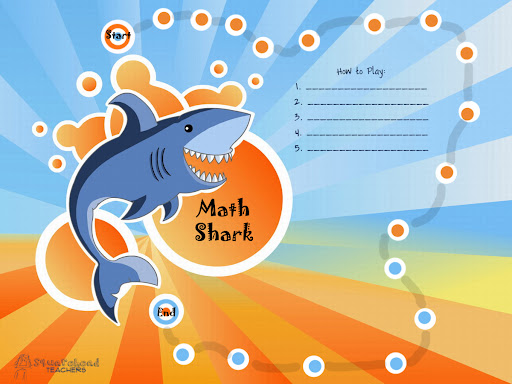
Game Board: Shark (Math)

This one has space for you to write in directions for your game. To get this game board, just right-click, “save as” and save this image to your computer. Resize the image to fit the paper you’re printing it on. Ta-da!

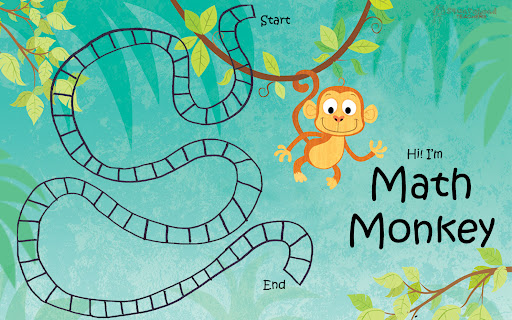
Game Board: Math Monkey!

This one’s cute. A bit casual, this has been a successful  game board for practicing math. I use questions from previous math benchmark tests (distributed by our district) to make sure my students won’t forget what we’ve already learned. Here’s one way to play: If you answer the math question correctly, you get to roll the die to see how many spaces it was worth. If you get it wrong, you don’t get to roll.

To get this game board, just right-click, “save as” and save this image to your computer. Resize the image to fit the paper you’re printing it on. Ta-da!

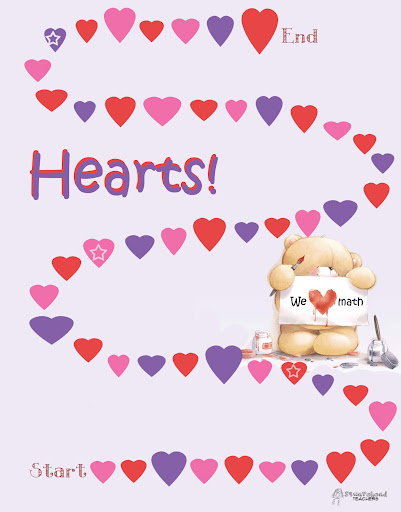
Game Board: Hearts (Math)

We heart math practice! To get this game board, just right-click, “save as” and save this image to your computer. Resize the image to fit the paper you’re printing it on. Ta-da!

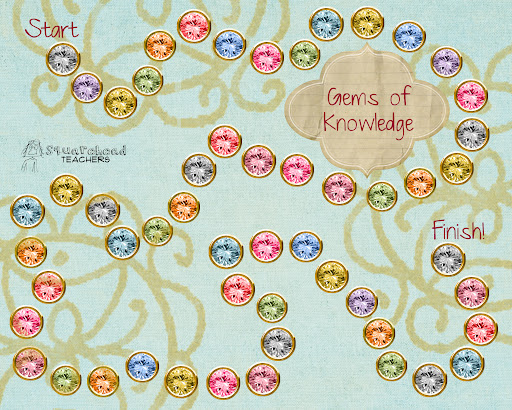
Game Board: Gems

Another fun game board! All you need is markers, dice, and a set of review questions (I print mine on cards) and you’ve got a great, review game for math facts, vocabulary, spelling or… anything!

To get this game board, just right-click, “save as” and save this image to your computer. Resize the image to fit the paper you’re printing it on. Ta-da!

Game Board: Festival

Add your own title or directions, and use this game board to review basically anything- math, phonics, review for a test. Use paper clips, buttons or pieces of colored paper as markers.
To get this game board, just right-click, “save as” and save this image to your computer. Resize the image to fit the paper you’re printing it on. Ta-da!

Game Board: Barefoot Fun

I always use blank game boards for review and practice of a concept (anything from math facts to phonics practice). This one’s really cute and you can throw your own title, directions or comments on the tag at the bottom right.

To get this game board, just right-click, “save as” and save this image to your computer. Resize the image to fit the paper you’re printing it on. Ta-da!

Contractions (Lesson Plan)

 I really enjoyed this game. The kids get to get out of their seats and can practice contractions at the same time! I’ve done this game successfully with third graders and sixth graders, so it can pretty much work with any group who needs a review of contractions (helpful for ELL students).
Context
Name: XXXXXXX                            Date: March 18, 2009                         Grade level: 6th – 3rd 
Subject/topic: Contractions                 Length/minutes: 20-30 minutes          Group size: whole class
Sequence: ongoing
Purpose
Standard/core: Standard 8, objective 4, indicator a
Standard 8 Writing-Students write daily to communicate effectively for a variety of purposes and audiences.
Objective 4. Edit written draft for conventions.
a.Edit writing for correct capitalization and punctuation (i.e., capitals in holidays, titles, dates, greetings and closings of letters, personal titles, contractions, abbreviations).
Learning goal: Students will understand how to form contractions with the word not.
Major concepts:
Contraction: a shortened form of two words; making two words into one
Apostrophe: shows where letters have been taken out (in most contractions with not, it takes the place of O.)
Contractions:  is not – isn’t
                              are not – aren’t
                              was not – wasn’t
                              were not – weren’t
                              have not – haven’t
                              has not – hasn’t
                              had not – hadn’t
                              do not – don’t
                              does not – doesn’t
                              did not – didn’t
                              will not – won’t   apostrophe takes out two letters: n and o.
                              cannot – can’t      apostrophe- three letters disappear an the o changes position
Assessment
Given a worksheet, students will be able to write the correct contraction form of the word with 80% accuracy.
Management
Self starter: none
Expectations: Sit and raise hands (no calling out) even when on the carpet; Students will focus on the topic; No sharpening pencils, getting out of seats going to the bathroom during the lesson.
Procedures: work with your table buddy; raise hands to speak.
Fast finisher: write a story using contractions on the back of your paper.
Instructional Strategies

Attitude Orientation:You probably already use contractions more than you realize. What are some common phrases that use contractions? (example: Don’t do that!)

Tell objective: “Today, are going to see how many contractions we can make. At the end, you’ll have to be able to tell me the contractions that go with a set of words, so pay attention!”
Schema Orientation:
There are times when we do not want to say two whole words, so we shorten them and make a contraction.
Explain definition of contraction (making two words into one).
Explain that an apostrophe (takes the place of missing letters) is used to shorten the words.
Let’s go over some of the most common contractions and see what they mean. Place word card pairs on the board. State two words and see if students can name the contraction before you put the card on the board.
Now let’s see if we can find some in this paragraph. Read the paragraph out loud (taking turns reading aloud) and have students raise their hands when they think they see/hear a contraction.
Please come sit on the carpet up front. We have a game to play after we write some of our own contraction sentences. Please do not talk to your neighbor so we will have time to play our game.   As a class, use interactive writing to construct sentences or a story using contractions. Have students take turns writing the sentences. Teacher can write parts of the sentence to help speed up process, but be sure that students are writing the contractions. Be sure to point out apostrophe placement in each contraction and double check spelling of contractions so students can see which letters are left out of the contraction.
Example: Let’s write a story using the following prompt: “Don’t do that,” Jimmy’s mother yelled.
    Discuss what Jimmy’s mom could be warning him not to do, then let students write a story while sharing the pen. Have students help contribute ideas. Try to engage every student and use ideas form many students to write the story.
Now we have a game to play. Contraction Bases: Place signs with contractions around the room. Use the word cards from the beginning of the lesson to help you choose bases.
Activity:
Model/Explain: Now that we understand contractions, let’s play our game. I have put contraction signs up around the room. By the time I count to 5, find a contraction base to stand by. Don’t move until I start counting. You must be frozen at a base by the time I’m done counting.  (This game is similar to the classroom game “corners”.)
            Check for understanding:
            As you call out words that form contractions (to get student out of the game), check to make sure students know the corresponding contraction. Have students point to the contraction that goes with the set of words.
Then play the game ! Have students who are out sit at their desks and be “Freeze Police” that make sure everyone is at a base when you get to 5. You can also have students help choose the base. Start over after calling a few bases to let everyone participate. When students get out, they can help you choose a contraction to call.
Independent practice:
Have students go back to their worksheet and ask students to write the contraction that goes with each set of words. Remind them about the fast finisher (write a story using contractions on the back of your paper).
Closure: Lead a class discussion about why people use contractions. When would you choose to use a contraction over a formal set of words?
Accommodations
            Visual learners- word cards
            Kinesthetic learners- active game
            ELL students- word cards with oral language
Resources
Word cards
Large writing paper
Markers
Easel
Signs for game
Worksheet
Reflection
Step 1: (Instruction and Management) What went well? What should be improved?
Step 2: (Student Learning) What did the children learn? How do you know?

Fractions are Everywhere! (Lesson Plan)

This lesson was kinda fun. It shows students that you can find fractions everywhere… even in Hershey’s chocolate bars.  I wish I had been rich and could give each student their own chocolate bar to give the lesson extra punch, but alas, I am a teacher… 
 
Context
Name: XXXXXX                         Date: March 12, 2009                         Grade level: 3rd
Subject/topic: Fractions                Length/minutes: 20-30 minutes          Group size: whole class
Sequence: ongoing
Purpose
Standard/core: UtahStandard 1, objective 2, indicator b
Standard 1
Students will understand the base-ten numeration system, place value concepts, simple fractions and perform operations with whole numbers.
Objective 2
Use fractions to communicate and compare parts of the whole.
a.   Identify the denominator of a fraction as the number of equal parts of the unit whole and the numerator of a fraction as the number of equal parts being considered.
b.  Define regions and sets of objects as a whole and divide the whole into equal parts using a variety of objects, models, and illustrations.
Learning goal: Students will understand that they can make fractions out of anything.
Major concepts:
Fraction- part or portion of a whole
Denominator- bottom number of a fraction; the number of pieces in the whole  
            Numerator- top number of a fraction; number of pieces we are looking at
            Equivalent fractions- same size; equal fractions; fractions with the same portion of the whole shaded
Assessment
Given a worksheet, students will be able to draw a fraction (illustrated with objects of their choice).
Management
Self starter: none
Expectations: Sit and raise hands (no calling out); Students will focus on the topic; No sharpening pencils, getting out of seats going to the bathroom during the lesson.
Procedures: work with your table buddy; raise hands to speak.
Fast finisher: Color your picture if you finish early.
Instructional Strategies

Attitude Orientation: You probably already use fractions more than you realize. Name some ways you personally have used fractions…

Tell objective: “Today, are going to see how many things we can make fractions out of.”
Schema Orientation:
Using a Power Point Slide, show pages from The Hershey’s Fraction Book that illustrate common fractions. Use the following outline to help move through the Power Point. Italics indicate speech.
Slide 2: Picture of a Hershey’s candy bar. The candy bar is the whole.
Slide 3: How many pieces make the whole? Wait and let students count the pieces in the bar.
Slide 4:Point out each piece. 12 pieces make up the whole.
Slide 5: How do we write this as a fraction?
Slide 6: Since we just counted 12 pieces, that’s how big each piece is, 1/12 of the total. The total number of pieces goes at the bottom. Remember how we used the cubes yesterday during centers? The denominator told us which size piece we had. That’s our denominator, which goes on the bottom of the fraction. (Write it on the board). Now for the top of the fraction. How many do we have? We just counted 12, so that’s the numerator. (Write it on the board).
We can use this candy bar to make more than one fraction.
Slide 7: If we eat one piece, what fraction of the bar is left?
Slide 8: Let’s see. There are still 12 pieces total, so that’s our denominator. (Write it on the board). But our numerator has changed. Now how many are there? There are 11 left. So what’s the fraction left? 11/12.
Slide 9: Can we make fractions out of other things?
Slide 10: discuss how there are 5 cows on the page, and one of them is brown. 1/5 of the cows are brown.
Slide 11: Is there anything else that we can make into a fraction?
Slide 12: Cacao beans. Explain how 1/8 of the beans are falling out of the tree.
Slide 13: So, you can make fractions out of anything!
Activity:
Model how to use manipulative:
For example, if I found these leaves on the ground, I can make a fraction out of them. Put them on the board and show how to make a fraction. Model finding the total, and then the number that are different (example: 3 of the 9 leaves are orange). Give students the thought process behind finding a hidden fraction in a set of objects.
Since we just learned that we can make fractions out of anything, let’s try to make some.
(Pass out bags of objects- one per student).
 Slide 13:Find the hidden fraction in your set of things.  Teacher may want to suggest ways to look at fractions (by color, by type of object, etc.)
            Check for understanding:
            As students make their hidden fractions, walk around the room and see if students are understanding the concept.
Independent practice:
Slide 14: Draw a picture of the fractions on your worksheet.
Pass out worksheet and ask students to draw objects of their choice to illustrate the fractions.
Closure: Lead a class discussion about the importance of fractions and the ways we see them in everyday life. So now that you know how to make anything a fraction, see how many fractions you can find around you every day! 
Accommodations
            Visual learners- Power Point visuals, charts, drawing assessment
            ELL students- Modeling, pictures to match the words, hands-on activities
Resources
Power Point presentation
Projector
Computer
Manipulatives
Worksheet
Reflection
Step 1: (Instruction and Management) What went well? What should be improved?
Step 2: (Student Learning) What did the children learn? How do you know?
What have you found helpful when teaching fractions?