Art can be a great way to incorporate culture into a classroom. Check out this lesson that you can incorporate a bit of Polynesian culture into your classroom…
Movement Maps
Lesson Overview:
Students learn to make connections between visual art and movement. They will learn about basic art distinctions of line, create guided movement that simulates different types of lines, create gesture drawings, and make movement maps based on their gesture drawings.
Length of Lesson:
Three 45-minute class periods
Notes:
This lesson is particularly suitable for Grade 5, but can be used with some adaptation for Grades 3-4.
Instructional Objectives:
Students will:
- learn about line as an element of art.
- learn about line as an element of form and movement.
- create gesture drawings using different types of lines.
- create movement maps, based upon their gesture drawings, that use a combination of lines and different levels.
- perform their movement maps in small groups.
Supplies:
- Pencils
- 18″ x 12″ newsprint paper
- Chalk board and chalk
- Paper
- Video of traditional hula dancing
Instructional Plan:
Warm Up
Draw a straight line on the board. Ask for examples of things that move in a straight line (sidewalks, streets, skateboards, cars, bicycles, etc.). Draw a curvy line and ask students for examples of things that move in a curving manner (sea shells, jet skis, waves, trick planes, roller coasters, etc.) Engage students in discussion about different types of lines – straight, curved, angular, etc. Point out straight and curved lines in the space. (Not necessarily inside a classroom).
Guided Activity:
Have students stand and move in straight, curved, and angular pathways as you call out, using music (5 minutes). Add changing directions (forward, sideways, backwards). Tell students that there should be clear contrasts between straight, curved, and angular pathways. Students should be aware of how much space they are using. Engage students in brief discussion about their movement pathways.
Explain the meaning of “gesture drawing” to students. Basically, gesture drawing is a method of training the hand to capture overall form, not the details; a quick (only 15-30 seconds), focused approach is best. Explain to students that erasing is not allowed; it breaks focus and is a waste of time. Distribute 3-4 sheets of 18″ X 12″ newsprint paper and pencils to each student. Explain to students that they will do several brief exercises about gesture drawing.
Exercise #1: Straight Lines
- Have students fill one 18″ x 12″ paper with straight lines only. The lines can be horizontal, vertical, or diagonal. Encourage students to fill the entire piece of paper.
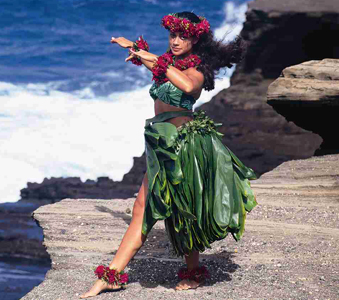
- Play 1 minutes of traditional hula dancing. Have students look for straight lines the dancer makes with her body. Ask students to demonstrate the straight lines with their own bodies and explain to a partner how there are straight lines in the movements.
Exercise #2: Curved Lines
- Have students fill one paper with curved lines only. The lines can be positioned vertically, horizontally, or diagonally. Encourage students to fill the entire sheet of paper.
- Play 1 minutes of traditional hula dancing. Have students look for straight lines the dancer makes with her body. Ask students to demonstrate the curved lines with their own bodies and explain to a partner how there are curved lines in the movements.
Independent Activity
Have students display their drawings in front of them. Ask students what types of lines they see in their drawings – broken or intermittent, zig-zag, spiral, etc.? Are some lines thick, while others are thin? Explain to students that they will now create a drawing, using straight and curved lines, that will be a design for their next activity, a “movement map”. As students work, walk around the room offering feedback and suggestions. Encourage students to incorporate types of lines previously discussed in class.
Once students have completed their movement maps, put them in small groups of 4-6 students each. Students in each group should share their maps with the group. Ask each group to use their maps to move through the space. Give each group about 5 minutes to try their maps.
Explain to students that they will now add levels – high, middle, and low – to their maps. Encourage them to discuss within their groups the logistics of performing their maps with levels. Allow students some time to decide on what level to use, and to discuss their maps with their group. Give each group about 5 minutes to try out their movement maps.
Closure:
Have each student label their map with their name, and collect the maps. Engage students in discussion about the connections between the element of line in art and the element of line in movement. Ask students about their movement maps – what levels were more difficult to travel through? Did the type of lines in a map affect the level of movement? Why or why not? Did they discover some ways to travel with their bodies that they had not discovered before?
Assessment:
You may use the Assessment Rubric to evaluate student learning. Evaluation in movement curriculum is primarily based on participation. You may wish to evaluate students’ attitude and participation as separate areas.










 Squarehead Teachers