Finding Parts of Speech in Reading Books

Here’s a really simple (and quick) worksheet for kids to use during their independent reading time or as a homework assignment to help reinforce parts of speech. Although it may seem repetitive (identifying 15 of the same part of speech), this is what some students need to catch on to the idea. For the students who already understand parts of speech, it’s PAINLESS and can be accomplished in a matter of minutes.


Click here to download the worksheets:

Verbs in My Reading Book worksheet
Nouns in My Reading Book worksheet
Adjectives in My Reading Book worksheet
Prepositions in My Reading Book worksheet

*You can modify these worksheets on Microsoft Word so they focus on other grammar concepts your class may struggle with.

End of the Year Writing: Yearbook

So many of the important assessments students face nowadays require competent writing. I used the end of the year as a chance to reinforce basic paragraph construction with this yearbook. I created pages on Microsoft Word (feel free to change the pages or add your own) that focused on specific aspects of our school year. For example, we had a grade-level Olympics in conjunction with our study of ancient civilizations, so I included a page that focused on this fun event. This was a great way to help students review the things they’d learned during the year. This would be very easy to modify for younger grades.

As a class, we made a checklist of the tasks required to complete the yearbook (each student copied down the list). Each student was required to write a rough draft on regular notebook paper, and have a peer edit it before they could go on to the final draft. Once the checklists were made, the students were free to work on whatever page they wanted. Each student completed the entire list, but could choose which page to work on each time we started working. This entire project took my 6th graders about 2.5 – 3 weeks to complete (45 min- 1 hour a day). One parent had taken pictures of school events (like track & field day and our Shakespeare play) and generously printed some of them for us. Each student ended up with 2-3 pictures from the year to glue into their book. I suppose you could encourage students to bring in a picture or two to glue in if they wanted. The students especially enjoyed signing each others’ yearbooks once they were all completed (we added a few blank pages at the end for autographs and messages).

Here are the Word files if you want to download them:
Yearbook Cover
Shakespeare Play page
Mathematics page
Medieval Day page
Guided reading page
Olympics page
Favorite Things page
Project Requirements
Writing page
Science page
Teachers page
Lunch & Recess page
Friends page

*When I uploaded these files, my cute fonts, didn’t get uploaded, so you might want to change them on your own computer to make them more interesting.

2022 Note: I’ve had some people message me that some of the pages aren’t downloading from Google Drive where they’re uploaded. I’m sorry, and I’ll do my best to figure out the issue.

What are some of your favorite end of the year projects/activities?

Words Their Way- New Teacher Survival Outline

When I first started teaching, I was very overwhelmed with all the word study programs I was expected to run. Each week, we had 30 spelling words, 10 root-based vocab words and the Words Their Way program. Like all new teachers, I had to start small with each program to be able to do them all at once. So I made this small, very simple outline to get me started. 

Words Their Way: WEEK OUTLINE
Monday– introduce
cut, name on chips
lay & say
sort
write down sort
Tuesday– lay & say
sort
write down sort
game: memory
Wednesday– lay & say
Sort
game: zoom around (each has 7, play same category until you can’t)
Thursday– lay & say
Sort
Game: Slap Jack (war)
Friday– lay & say
Sort as a review
Test (choose a few words and they must sort them by category as they spell them)
MIX UP GAMES AS DESIRED.


Reviewing Punctuation… The Fun Way

From a 2nd grade teacher friend:

We are studying statements, commands, exclamations, and questions.  I say a sentence.  If it is a question they stand up and curve their arm over their head like a question mark.  If it is a statement, they put their head on their desk like a period.  If it is an exclamation they stand up straight with both hands over their head like an exclamation mark.  My kids loved it!


Sending Home Papers & Getting Them Back: Boomerang Folders

So you’ve heard of a boomerang, right? You throw it and it comes back to you. This is the basic idea of  Boomerang Folders. You choose one day (or two days) a week and let parents know that the Boomerang Folder will be coming home. STICK WITH THAT SAME DAY OF THE WEEK (unless you notify parents ahead of time). Put all the important papers in that folder and send it home. The expectation is for the folder to come back (with certain signed papers, with a signature on a tracking sheet or whatever your system is). In order for this to work, it’s helpful to teach your class about boomerangs at the start of the year. The best thing is for each kid to have a chance throwing a boomerang. This has been successful in my third grade and second grade classrooms, so I hope it helps you too!

Remember, right click the image below. Choose “save image as” and save it to your computer. Then you can choose the size to print it and glue (or laminate) it to the front of your take-home folders.

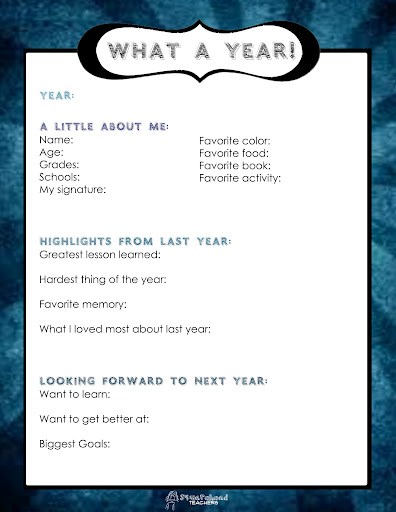
Year-In-Review (Easy Writing Page)

At the end of the year, it’s tempting to do activities that just fill time. Great teachers still use end-of-the year activities as a chance to teach thinking skills (like self-evaluating) and academic skills (like writing). This simple activity does both.  (This form can also be used as an assignment to complete at home with the family as a review for a calendar year rather than an academic year).

Click here for the printable PDFs:
Year in Review form – blue paint splatter           Year in Review form- Boys 1
Year in Review form- Girls 1                               Year in Review form- kids 1


Come on Over! (Dance Instructions)

So many teachers are intimidated by teaching dance or movement activities to their students. Here’s a pretty easy dance I came up with using simple movements most people already know or can pick up easily. The sequence repeats, giving kids a chance to learn it and progress throughout the song. Remember that it’s helpful to call out the actions ahead of time. I have listed the words you can day (C) and the actions you do (D). I’d suggest calling out the actions a few times by yourself before you try to teach it. Good luck and have fun!

SONG: Come On Over
ARTIST: Christina Aguilera
 
CHORUS/CONGA LINE                                                                                  COME ON OVER
Formation: Chorus Line/Conga Line                                           Rhythm: 4/4
Position: hand in low V/hands on shoulders                           Measure: 8
Footwork: all start left                                                                       Music: Come On Over (Christina Aguilera)
Grade Level: 5th/6th

INSTRUCTIONS

Grapevine– Step side L, cross R ft behind L, step side L, R ft touch next to L ft. Repeat grapevine to R. On second grapevine, place hands on shoulders of dancer in front of you in the conga line. On third grapevine, hands in low V. Repeat, switching hands each time.

Walk– Take 4 walking steps forward starting with L ft (LRLR). Walk back starts with L ft also.

Shoot– Similar to the two step. Start L to make the L unit. Step L ft diagonally left, R ft close to L ft, step L ft diagonally left. Repeat with R side for R unit. Hands in pointing the in the shape of pistols, doing same as feet.

Paddle– With weight on L ft, turn L 1 full turn as pushing R ft around at side to create momentum un 4 cts. Repeat R paddle.

Quarter Turn– Step L ft forward, touch R ft while turning to L, cross R ft over L, touch L foot. On repeat, formation becomes a conga line. On second repeat, formation changes back to chorus line.

MEAS             CALL

Intro     grapevine left do it now

1          (C) grapevine right do it now

(D) side behind side touch

2           (C) walk forward do it now

(D) side behind side touch

3         (C) shoot forward do it now

(D) walk walk walk walk

4          (C) walk back do it now

(D) step together step, step together step

5         (C) paddle left do it now

(D) walk, walk, walk, walk

6          (C) paddle right do it now

(D) paddle, paddle, paddle, paddle

7          (C) quarter turn do it now

(D) paddle, paddle, paddle, paddle

8         (C) grapevine left do it now

(D) step point, step point

Story Maps

Story maps help kids learn summarizing, sequencing, and gobs of other reading skills. I used the fabulous old kids’ book, How Fletcher Was Watched, to teach my kids to use story maps. 


You could teach sequencing by giving students cards with story events and asking them to put them in the correct order.

You could teach both skills together by having students create the event cards and then give the cards to a partner to put in the correct order.        

It would be really easy to do this activity with events in history as a social studies activity also.

Here’s an example…