Quick & Easy Formative Assessments UPDATED

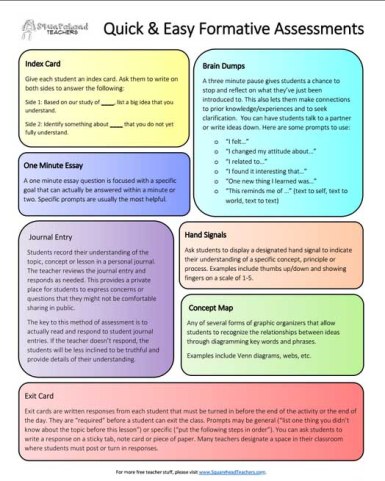
Quick and Easy Formative Assessments- LARGE

Sometimes it feels crazy overwhelming to keep assessing students and know exactly what they do/don’t understand. That’s where these quick and easy formative assessment ideas comes in!

My school district sent us a monthly newsletter from the GATE department. This was a particularly helpful chart, so I kept it. But the image was too small, so I’ve remade it into an easier to read version (see below).

Formative Assessments - New STICKERClick here to download the above new version (PDF): Formative Assessments

In case you’re still thirsty for more formative assessment ideas, check out these ideas:
Formative Assessment Ideas on eHow.com
Examples of Formative Assessment from West Virginia Department of Education
A Sampling of Types of Formative Assessment on isbe.net
Formative Assessment Ideas from the Wake County Public School System
21 Ways to Investigate What Students Are Learning by STEMresources.com

Homework Coupons

One of my mistakes my first year was putting all the prizes in the treasure box in the beginning of the year. Then, once everything in there had gotten uninteresting to the students, I had already spent the little money I was given and couldn’t replenish it. These became one of the most popular items in my treasure box, because, let’s face it- kids just don’t like homework.

I made sure to write the student’s name on it and sign them when a student won a homework coupon because they weren’t valid without my signature. In addition, I would require my students to staple the coupon to the corner of the assignment when turning it in, so I couldn’t lose it (since it was 1/8 sheet) and it was clear to me which assignment the student wanted the coupon to count for. When I graded the assignment, I would only tear off half of the coupon, so the student would have “proof” that I had seen their coupon and there was no way for students to try to use it again. I chose bright color paper to run these off on, so I could always identify them easily in a pile. I made it clear to my students that I would not replace lost coupons. Since they had a student’s name on them written in my handwriting, there seemed to be no incentive to try to steal them, so that worked out nicely as well.

Just because I’m nice, I gave each student one coupon at the beginning of school, and because teachers have no money nowadays, this was their birthday present also. The kids seemed pretty excited to have the option to skip homework on their birthday.

Click to download the homework coupons.

Book Review Prewriting Sheet

Sometimes students are asked to write about literature. May of my students didn’t really know where to start, or what was included in a book review. After looking at some reviews written by kids (click here to browse one of many child-authored book review sites), I used this book review prewriting sheet to help my students know some things they could include in their book review.

Click to download the Literature Review Prewriting sheet.

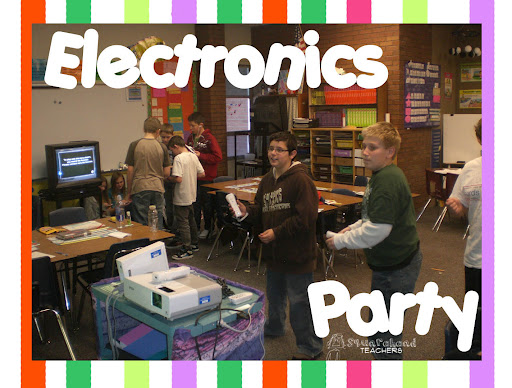
Electronics Party

When I taught 6th grade, I had a hard time finding whole class incentives that my kids would get jazzed about. One day, I was brainstorming ideas with some other teachers and came up with the idea for an electronics party. Students would be able to bring in approved electronic devices for use during a specified time on the day of our party. After getting approval from my principal (don’t forget this step!), I brought the idea to my class. They LOVED it! We discussed what electronics would and would not be allowed (I had discussed this list with the principal).

One of the main concerns for the party was students electronic devices getting stolen. In order to deal with this, I required the following permission slip/letter signed and returned before any student could bring any electronics.

{copy and paste the letter below if you need a permission slip like this for an electronics party. Please review it with your principle before going ahead with it!!!}
Please Sign and Return To School
Dear Parents,
As a class reward winning the weekly Road To Success reading minutes competition, our class has earned an “Electronics Party.” Our party will take place after lunch on Friday afternoon. Students may bring their own personal hand-held game player (PSP, GameBoy, etc.), MP3 player (with headphones) or other electronic games. Please do not send laptops, game systems (Xbox, Wii, etc.), games for those systems or other expensive electronics with your student. Any electronics brought to school are the responsibility and liability of the student. They are to be left in backpacks until after lunch.  Please indicate below if you give your permission for your student to bring an electronic device.
Thank you,
{my name}
 I give my student, ________________________, permission to bring _______________ _________________________ to school for the electronics party on Friday, January 7, and I understand that my student is responsible for it.
Parent signature_________________________        date_________________________

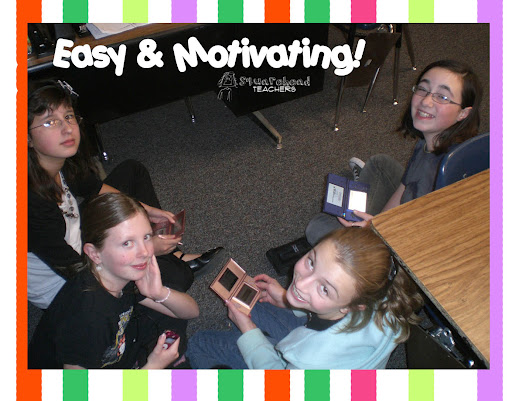
On the day of the party, I wheeled in the 2 Wii game systems our school had the party for about an hour. 2 of the 3 6th grade classes at our school tried this and loved it. The only work for me as the teacher was communication with parents before the party and setting up the Wii systems (during my lunch break). The kids loved it, and it pretty effortless on my part. Best of all, it motivated them!!!

Fun Group Game- "Rock, Paper, Scissors" Train

“Rock, Paper, Scissors” Train- Fun twist on the classic game. You could maybe incorporate probability into this game for upper grades (probability or winning 2 games in a row, etc). 
Each player finds a partner, and then each partnership plays “rock, paper, scissors” until one person wins two out of three games. The winner becomes the “engine” of a train, and the loser must join the train by placing his or her hands on the engine’s shoulders. The engine then plays “rock, paper, scissors” with another engine. The losers of that game must place their hands on the shoulders of the last person in the winning train.  This pattern continues until all participants are on the same train. The complete train then takes a victory lap by running in a small circle (staying in your area). This game is over quickly and may be played multiple times.

Fun Group Games: Gotcha!

Gotcha! -This is most definitely one of my all-time-favorite games! Fun to play and to watch!
Players stand in a circle, arms out to the side. Their left palm is up with their right index finger pointing down, touching their neighbor’s outstretched palm. When the teacher says “go,” the players in the circle attempt to both grab the finger of the person on their left hand and prevent their right finger from being grabbed by pulling it away (good to demonstrate this first or do a practice round). The teacher counts, saying “1  . . . 2  . . . 3  . . . (add suspense) . . . go!” If their finger is grabbed, they are out. If a player grabs a finger at the same time their finger is grabbed, they are neutral and get to stay in the game. Repeat several times until only two people are remaining (at the same time, the other players can start a new circle). The trick is in building up suspense before “go!” because many players will jump the gun, adding to the fun. 

Fun Group Game: Animal Sounds

Animal Sounds-After we played this game with my 6th graders, we talked about how this might relate to friendship or success in school. My students actually found some really good connections! We also played this in preparation for our Shakespeare play and discussed how, in this game, you have to be confident to get the job done, vocal so people can hear you, and enjoy what you’re doing even if you may feel a bit goofy. Although I played this with my 6th grade class, 4th and 5th graders can play this game successfully too.
Players close their eyes, and then a teacher moves among them whispering the name of an animal to each person. The challenge is to find all the other animals of one’s own kind, and the first group to be completed wins. No one can talk; players can only make animal sounds. Loud chaos ensues, and gradually order and unity emerge as animals find one another. Be prepared to shepherd people from danger, though usually the game is very safe. Many do not move much, but rather focus on listening and calling out to others. animals (aim to have the same number of each animal—around three of each) might include wolf, cat, pig, kangaroo, snake, lion, crow, monkey, frog, elephant, and others. It was fun to make it more challenging at the end, but throwing in choo choo train, pirate, leaky faucet, race car and other wacky sounds like that.

Fun Group Game: I’m Going Hunting

I’m Going Hunting- This one is good memory practice and reinforces the alphabet. You could vary the game, but choosing a theme (things in your bedroom, a classroom, etc.). It may be helpful to modify this for younger kids by drawing a picture for each item, only choosing words from your word wall, etc.
This game is played in a circle. One person in the circle starts the game by saying, “I’m going hunting and I’m taking a(n) __________ (item that begins with the letter “a,” e.g., arrow).” The next person has to repeat what the person next to him or her said and then add something new from the next letter in the alphabet (e.g., “I’m going hunting, and I’m taking an arrow and a bow”). Keep this going around the circle until someone cannot remember everything he or she is to take. That person is out [or you start over, so no students are the loser]; see if the next person can complete the phrase. You do not necessarily have to choose something that you would normally take hunting—it can be funny. This game can also be called something else; you do not necessarily have to go “hunting.” You could call it “I’m going to [name of your school] . . . ,” for example.