I’m proud to announce the winner of my first giveaway! And the winner is…
Khadijah J.!
Thank you so much to all my readers and supporters! Stay tuned for another giveaway sometime in the near future. 🙂


I’m proud to announce the winner of my first giveaway! And the winner is…
Khadijah J.!
Thank you so much to all my readers and supporters! Stay tuned for another giveaway sometime in the near future. 🙂
 I’m lame. I’ll just admit it. I usually forget to plan something cool for April Fool’s. I’m the one looking for a last-minute joke to play so I don’t expose myself as a lame-wad. So here are some of my favorite last minute April Fool’s Day pranks for teachers to play on their students:
Last Minute Pranks (No prep required)
Some prep required
More prep required
Click here for more April Fool’s Day ideas.
 The California science standards for 1st grade require students to:
1-ESS1-1. Use observations of the sun, moon, and stars to describe patterns that can be predicted. [Clarification Statement: Examples of patterns could include that the sun and moon appear to rise in one part of the sky, move across the sky, and set; and stars other than our sun are visible at night but not during the day.] [Assessment Boundary: Assessment of star patterns is limited to stars being seen at night and not during the day.]
1-ESS1-2. Make observations at different times of year to relate the amount of daylight to the time of year. [Clarification Statement: Emphasis is on relative comparisons of the amount of daylight in the winter to the amount in the spring or fall.] [Assessment Boundary: Assessment is limited to relative amounts of daylight, not quantifying the hours or time of daylight.]
This graphic organizer is one way to start teaching these concepts. Click here to get the free printable PDF: Earth’s Place in the Universe graphic organizer
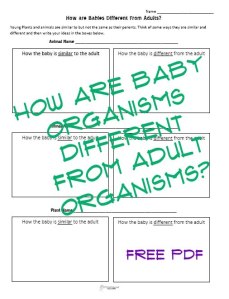 The California Science Standard for 1st grade (1-LS3-1) says “Make observations to construct an evidence-based account that young plants and animals are like, but not exactly like, their parents. [Clarification Statement: Examples of patterns could include features plants or animals share. Examples of observations could include leaves from the same kind of plant are the same shape but can differ in size; and, a particular breed of dog looks like its parents but is not exactly the same.] [Assessment Boundary: Assessment does not include inheritance or animals that undergo metamorphosis or hybrids.]”
This seemed like a perfect concept to make a graphic organizer for! I’ve also uploaded the pictures you can use to help your students think of examples.
Click here for the free printable PDF: How are Babies Different From Adults Graphic Organizer
Click here for the example pictures: Plants and Animals – baby and adult pictures
 Yay for graphic organizers! I’m getting good at them. I’m finding that the key is to make them simple so that the format doesn’t distract kids. Anyway, here’s my newest social studies graphic organizer. It’s about the causes of World War 1. It’s similar to the other social studies graphic organizers I’ve made.
Click here for the free printable PDF: Causes of World War 1 graphic organizer
 I’ve got another graphic organizer for you! This is my second graphic organizer on states of matter. It would be effective to teach students with one graphic organizer and then test them with another (since they cover the same content). Using a second graphic organizer could be a good review right before an exam/state test also.
Click here for the free printable PDF: States of Matter graphic organizer
Don’t forget that today’s the last day of my first giveaway!
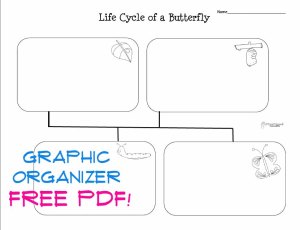
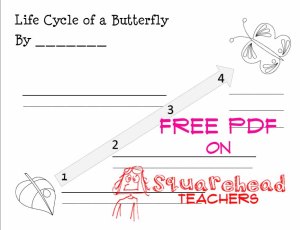
Last week, I posted a blank life cycle graphic organizer. This week, I’ve made another one specifically for butterflies. It includes a space for writing, but not for drawing, because I found some super cute pictures of each butterfly stage. I also made a second one to illustrate everything a different way.
Click here for the free printable PDFs: Butterfly Life Cycle- Graphic Organizer 1
Be sure to check out my first giveaway!
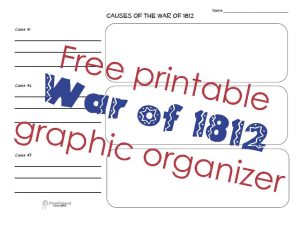 I’ve had the most success teaching social studies when I let my students take notes and draw pictures of the event we’re learning about. I’ve made a simple graphic organizer to teach/summarize causes of the War of 1812 (just like I made a graphic organizer of the causes of the American Revolutionary War). This time I’m going to have my students find the answers from the textbook in groups.
Click here for the free printable PDF: Causes of the War of 1812 graphic organizer
Be sure to check out my first giveaway!

