Here’s a worksheet I made for practicing recognizing even and odd numbers. Enjoy!

To get this worksheet, right click on it and select “save as.” After you’ve saved it, you can resize it to be half sheet or full sheet according to your preference.

Here’s a worksheet I made for practicing recognizing even and odd numbers. Enjoy!
To get this worksheet, right click on it and select “save as.” After you’ve saved it, you can resize it to be half sheet or full sheet according to your preference.
 One thing I found challenging as a teacher was to constantly change the student work on display in my classroom and on the bulletin board in the hallway. The trick is to make your system quick to swap out work.
There are a variety of ways to do this, but one popular way is to staple laminated construction paper to the bulletin board and clip a clothes pin to the top of the paper. This makes it super quick, and you don’t have to keep poking holes in your bulletin board with push pins. In addition, attaching names to the papers (or on the clothes pin if you’re not going to reuse them) is an easy more permanent way of identifying the creator of the displayed project.
Another way I’ve seen also starts with stapling laminated construction paper to your bulletin board. However, instead of using a clothes pin to attach work, you use paper fasteners (like you see inside manila folders). Obviously, it would be easiest to attach the fasteners before you put up the paper. Again, labeling the paper with a student’s name makes it easier for you to show which projects belong to each student. In addition, at the end of the year, all you have to do is detach the entire construction paper packet and you’ve got a nice collection of student work to present to the student! (just make sure you don’t let the packets get too heavy or they might fall off the bulletin board).
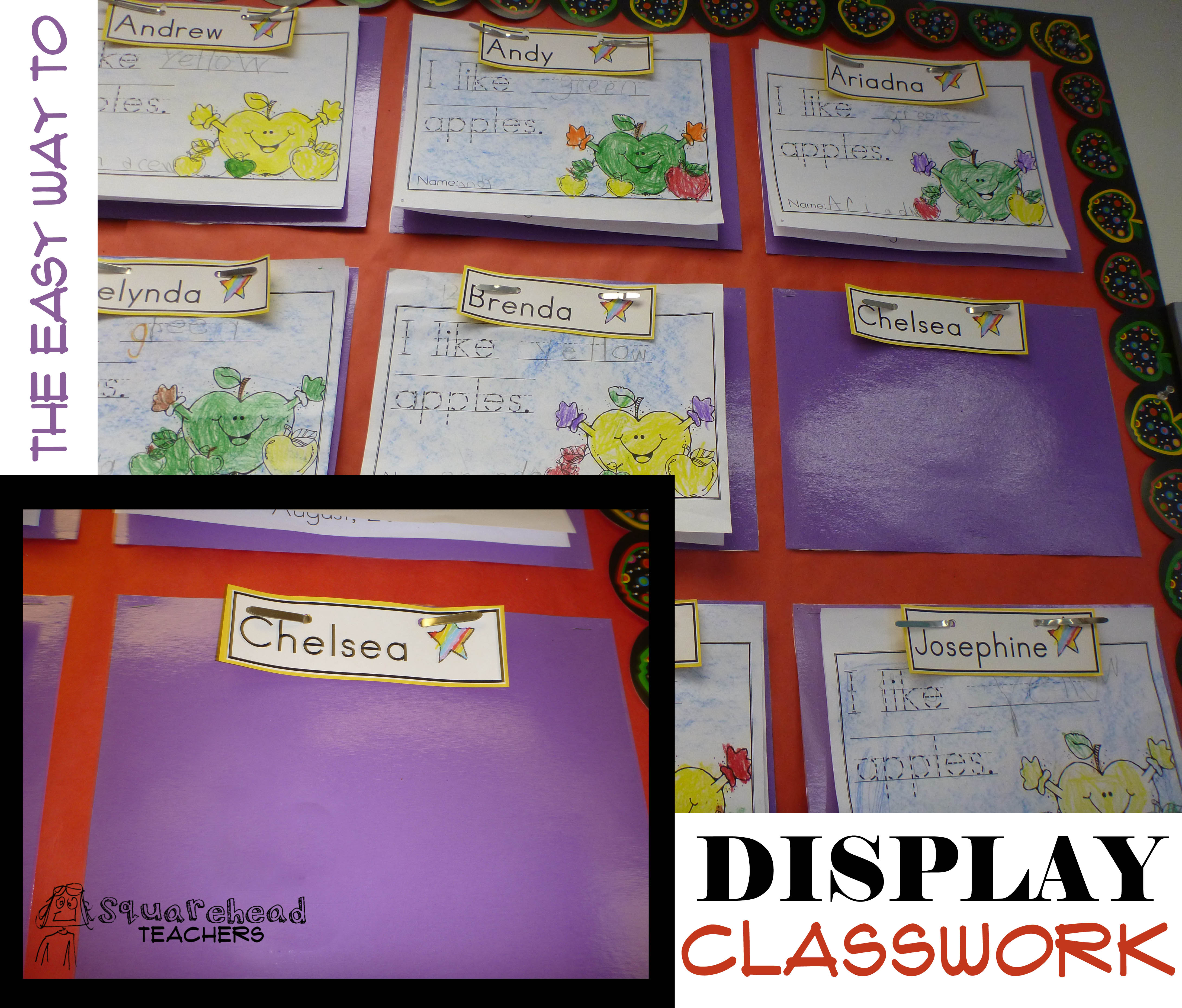 There are many other ways to display student work. Click here to see a simple system in which your students manage their own display!

Every teacher has to send papers home. It’s just part of life. But what’s the most effective way to do it? Many schools designate one day of the week when the office sends home school newsletters, fliers, etc. so the parents aren’t bombarded daily with papers. Some teachers choose to only send papers home on this same day. Here are some thoughts about only sending papers home once a week:
PROS
CONS
Personally, I sent things home everyday (when I taught 6th grade). My policy was that I would return to the students any papers that got a grade. That way, they could check the papers against the progress reports I sent home and make sure that they got credit for the work they had done. It was super easy for me: I would put graded papers (things that weren’t super important) in a yellow mailbox, and students would help me deliver the papers to mailboxes at the back of the room when they were done with their work. The mailboxes were cardboard magazine boxes with a student-decorated name tag on the front. One of the classroom jobs was mailman. This person was allowed to deliver papers during read aloud and was responsible for making sure the mailboxes got emptied at the end of the day.

Regardless of when you choose to send home papers, it’s important to have an effective system that doesn’t take too much time and effort for you. One teacher used a crate with files for each student. She would select only the most important work to be sent home, as well as anything from the office. Here’s what her crate looked like:

I also heard a cool idea from a fellow teacher that I might also add: Proud Book. In the beginning of the year, have a book bound with blank construction paper for each week of the school year for each student. Then each week, students pick their assignment they are most proud of to glue into the book. They write a couple of sentences on the opposite page about why they are proud of it.
 Teachers do a lot of filing. A lot. I file everything, in my classroom and at home. It gets expensive to keep buying manila folders, and sometimes I want to have a file in a file to make a subcategory. But what to do? As far as I know, there aren’t any folders out there that fit well into other folders. So, like many teachers, I make them. Recently, I helped out with a project in the school office that required me to make a bunch of sub folders for each student’s cumulative file. I cut 18″ x 12″ construction paper down to 17.5″ x 11.5″. Then I folded the sheet in half (with about 1/3 inch bigger on one side so I could label it). These fit perfectly into regular, purchased folders but weren’t thick enough to be awkward in the original manila folder. We color coded the subfiles by making them out of different colored paper (orange for GATE subfile, tan for health subfile, etc.). It really didn’t take very long on the paper cutter, and it was a cheap solution to an important organization need.
I thought this was a great idea for lower grade classrooms where the students are still learning how to tell time on an analog clock. These leaves were laminated so they’d last longer and they’re kinda cute. Depending on the age of your students, you could consider taking down leaves as the year progresses, so they can learn to tell the minutes on the clock by themselves.
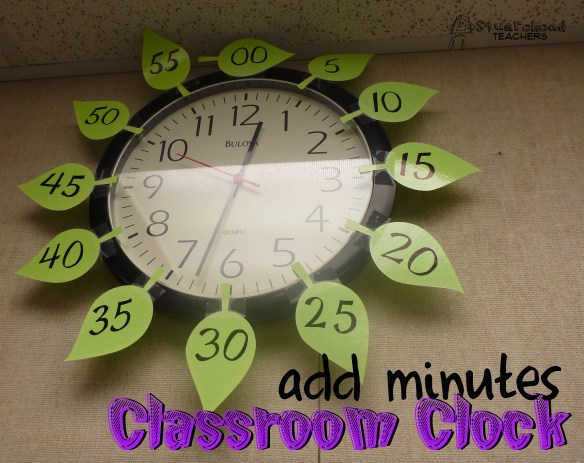
Have other good ideas like this? Please comment!
Some teachers like to use hand symbols with their class and swear that they’re one of the best management tools they’ve got. (I’m not one of them, because I always forget what the symbols mean). Here were the signs for the symbols a 2nd grade teacher used, and her class did fairly well with them. They’re posted on the wall for students to refer to if they forget…


I was in a 2nd grade classroom recently, and saw this interesting way to remember numbers. 6 – 9 have rings around the dots, which counts as 2 dots. I don’t know very much about this teaching system, but it looked interesting. If you know anything about it, please comment!


Easy to read, simple 6 traits writing posters for your classroom!
click here to get the PDFs: 6 traits writing posters
(I don’t remember where I got these, and they don’t have a copyright on them, so I guess they’re fine to share.)

