Best Ever Games to Review in Any Content Area!

Teachers dread the end of the year tests. Their kids are ready for summer, but it’s the test that reflects the work of the teacher. When I taught 6th grade, this was especially difficult, since my kids thought they were practically in junior high already and were way over the elementary school tests. So I came up with a plan that ROCKED MY WORLD! Here it is:

1. I printed copies of all the unit tests (given to us by the district) in any content area (I used math and science).

2. I cut the tests into pieces with 1 question per piece and put all of them into an envelope along with the answer key to the test.

3. I prepared for the games below and planned to do 1 game using 1 set of questions each day for the 3 weeks leading up to the state tests.

4. Execution was simple! My kids loved these games and the kids were reviewing all the content areas without even realizing it! Some of these got a little wild, but that’s part of the disguise of the review (for some reason kids thing reviewing for tests always has to be ultra boring). Some of these games were so awesome that my kids would even request their favorite game instead of learning a new one!

I’ve still got to write up the rest of the games we used, but I’ll post them when they’re written up. I’ve played them with kids 3rd grade – college and they’ve always been a hit. Here are the games:

*DART BOARD: set up throwing lines different distances from the dart board. Show a question. Teams try to solve it. The team that gets the answer right first may throw from the first line, team 2 gets to throw from 2nd line, etc. Team with the most points wins.

*DICE GAME: Divide into teams. number on the dice represents the number of points for the question solved. Most points wins.

*HUMAN TIC TAC TOE: Set up – 9 chairs in the center of the class in a tic tac toe formation.

XXX
XXX
XXX


Divide into two teams (x’s and o’s). Everyone on each team gets a number (We had 8 on each team so numbered them from 1-8).
Object – your team makes a tic tac toe before the other team.
The teams stand to the sides, x’s on one side of the room and o’s on the other. Call out 3 numbers, (i.e. 1, 5 and 8)(Thus making 6 players, three x’s and three o’s). People with those numbers have to find the SM that I start reading. Once they solve it (you may choose to have them come to you and show you the answer) and run to a chair to start making a tic tac toe. The others join them as they solve it, trying to block the other team and jumping up and moving to try and get their own team into a straight line (3 in a row) (they can switch chairs as they please). Whoever gets the straight line first gets a point. They then go back to the side. Second round starts by calling out another 3 numbers and gives a new question. (keep track of who I had called so that everyone would get a few turns) It took about 20 minutes for everyone to have 4 turns. I let them help each other find the scriptures on the team. My non participators really got into it. Really gets the blood going. I had to make a rule that they couldn’t push someone off of a chair, but after that they were good!

* MOVE ONE GAME: Give each team a set of 10 colored squares (2 of each color, so 5 colors). Place all of the game cards on the board in pairs (either one above the other or side-by-side).  None of the card pairs should be matching colors. Read/show a question. The team that gets the question right first gets to switch 2 color cards (eventually making all color pairs match).

*RACE TO THE CHAIRS. Set up 4 chairs (or one for each team) in the front of the room. Label each chair with a point value (20, 15, 10, 5). Show a question, and have the teams solve it. Once a team has solved it, a player from that team must write down the answer, run up to the chairs and sit in the highest point value chair. Once each team has a player in a chair, show the answers. If correct, the team earns the value of the chair; if incorrect, the team loses the value of the chair. Most points wins. This one was an absolute favorite! I even played this with my students in China and it was a hit!

*CAT’S CLAW:  Prepare 5 cards (3X5 cards work well) each with a different point value (100, 75, 50, 25, &10). (You may also wish to laminate them or do something to make sure they can’t see through the cards.)
• Divide players into several teams (5 teams if possible).
• Physically separate the teams and place a small table in the middle of the room.
• Place these 5 point cards face up on the table.
• Select one player from each team to be the team’s runner for that round.
• The Clue Giver begins by giving a question.
• As soon as the team knows the answer, the team runner must write it down then quickly move to the table and take one of the point cards and return to their team.
The Round ends when all five teams have a point card or forfeit if they don’t know the answer.  The teacher checks to see that answers are correct on each team.
• Points are scored based on the card selected by the team’s runner. (Or subtracted if they lgot the question wrong.)
• The Teacher returns all cards to the table, selects new runners, and begins a new round.
• (Variation: You may choose to play with the point cards placed face down—the first one you touch is your point value)
Sending Home Progress Reports

It’s important to keep parents informed about their student’s progress in the classroom. But whose job is it?

I was confused about this question my first year (when I taught 6th grade). I sent home progress reports every quarter and expected my students to return them with a parent signature. However, I had a few students who just wouldn’t bring them back. They said they’d been lost, ruined, etc. so I’d print them another one and give them a consequence if it wasn’t brought back signed the next day. This process kept happening and soon I was missing my lunch and afternoon break to keep students in from recess at lunch and in the afternoon. This was really getting to me. Finally, I brought up the issue with the principal. She reminded me that it wasn’t my job to make sure the parents saw the progress report. It was the PARENT’s responsibility. She suggested that I send home a note detailing the days that parents can expect a progress report from their student and ask them to get it from their student. Signed reports would get something extra, but I wouldn’t have to police the students who wanted to deceive their parents.

Here’s the letter I sent home:

Dear Parents,
            This letter is to inform you that I will send home a midterm progress report with your student on Monday, May 2.  A signed, returned progress report will be worth 5 bonus points but is not required. If you would like to see your student’s grades and missing assignments, please log on to Skyward anytime using your family’s account. Your student should know their log-in information as we have checked grades before during our computer time. If you need additional information about your log-in information, the front office is more than willing to assist you.
Thanks,
[my name]
Feel free to copy/paste/edit this letter. Make sure it’s ok with your principal before you send home letters to parents. Good luck!

Best Ever Customizable Teacher Planner

I’m all about planning. I fall asleep planning, can’t go anywhere without my planner and some unglued if my planner gets lost. So naturally, I needed a really, really good teacher planner. I needed one that had each day as a column, different sized boxes that fit the needs of my different sized time blocks, I didn’t want to have to hand write in things that happened daily or weekly, and I needed space for notes/to-do lists.
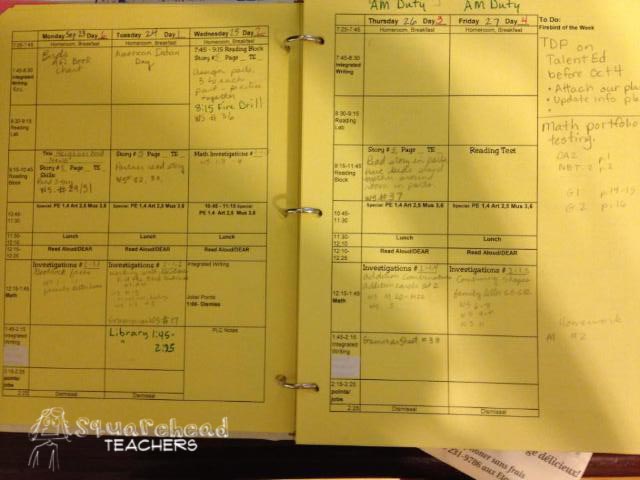

Where did I find that kind of planner? I didn’t. I made it. And it was absolutely perfect for me. It was so nice to be able to customize this to fit my schedule and I could change it whenever I needed, since I had the file. I also printed this for the other teachers on my team, which helped in planning. I ran mine of on card stock (so I could erase a few times without ruining the paper) and put it in a 1/2 inch 3-ring binder, along with any other really important papers, like my seating chart, school schedule, etc.

Another teacher on my team printed it on regular paper and had it spiral bound. This didn’t work as well when we needed to change out schedule part way through the year. But whatever floats your boat…

I have shared this file (Mircosoft Excel) with a few other teachers who were able to change it to fit their schedules. It will take some time to tweak it to fit your personal needs, but having a perfectly-tailored, visual planner makes all the difference all year long!

To download this file, click here: Best Ever Teacher Planner. If for some reason, this file doesn’t download right, email me at squareheadteachers at gmail dot com and I’ll send you the file again. Happy planning!

Improving Student Motivation

I once had a parent tell me she was having a hard time motivating her child to do homework, etc. and asked if there were any things I could do in the classroom to help. I tried to find something at school, but outside our classroom that might be motivating to the student, (who was on student council) and I tried to find a few things inside the classroom that I could personally be in control of that might help with motivation. Here’s what I wrote to her:

Hi [parent name],

            As far as motivation/consequences for turning in assignments goes, there are a few options that come to mind.
1.      Student council- student council reps must be in high behavioral and academic standing or they’ll be dismissed. I don’t think that will happen, but it might help with motivation…
2.      I use tickets in my classroom and sometimes homework passes. If she’s motivated by that kind of thing, I can use more of them with her.
3.      Also, I could let her choose her classroom job for the following week if she turns everything in on Friday (some kids care what job they have and others don’t)…
I’ll keep thinking about that and let you know if anything better comes to mind.
[My name]


What are other ideas you’ve seen/heard of that have been effective in motivating students? Please comment!


Partnering Students: Neighbors!

Here’s an idea I loved from a classroom in Utah:

The teacher had a sign posted in the front of the room that had the following words on it – “Neighbors: Front door, Back door, Side door, Diagonal.” This sign reminded her to use her established “random” partnering system (when factors like academic level are not needed to pair students). Neighbors was her way of partnering students (they sat in groups of 4 desks). The kids knew who was their front door neighbor, side neighbor, and so on, so all she had to do was call out a neighbor and the kids would instantly pair up. This saved her lots of time paring up, and she changed seats enough that the kids never got too bored with one partner. When she called “meet a new neighbor”, the kids were free to work with any class member. Sometimes, she’d call “block party,” and the entire table would work together. I thought this was a great way to partner students and build community.

Classroom Library Book Check-Out

One thing teachers always worry about when building a classroom library is the possibility that books will get lost, stolen, damaged, eaten, etc. There’s no fool-proof way to protect your books if you put them in a classroom library, but you can try to help students be more responsible with books, and let your students know that you value your books. Here’s a really basic sheet I made for keeping track of books. This sheet was mainly the responsibility of the student with the librarian job for the week.

Click to download the Classroom Library Book Checkout sheet.

If there are other things you’d like to keep track of that aren’t on this sheet, feel free to modify it to fit your needs.

Classroom Jobs

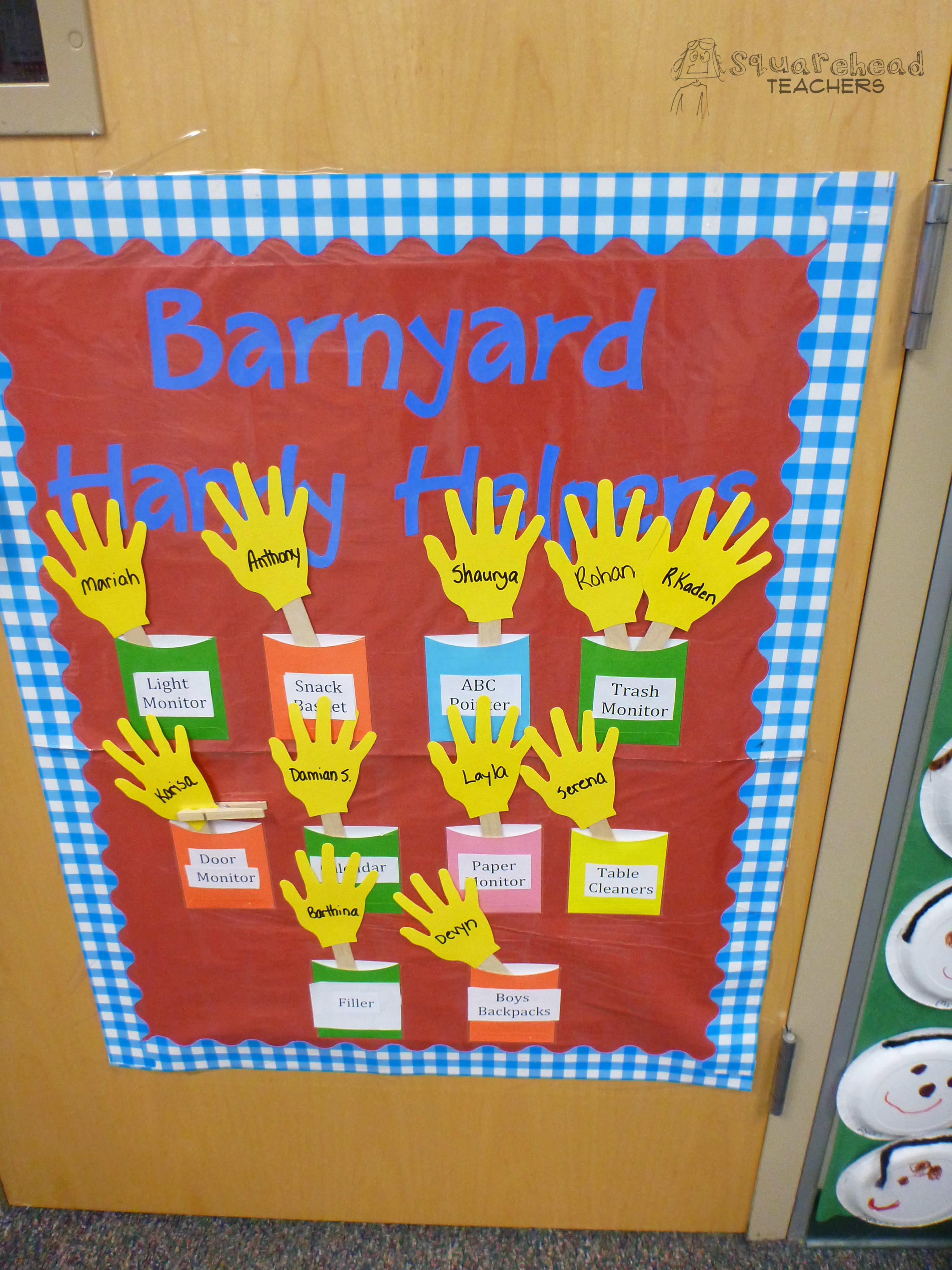
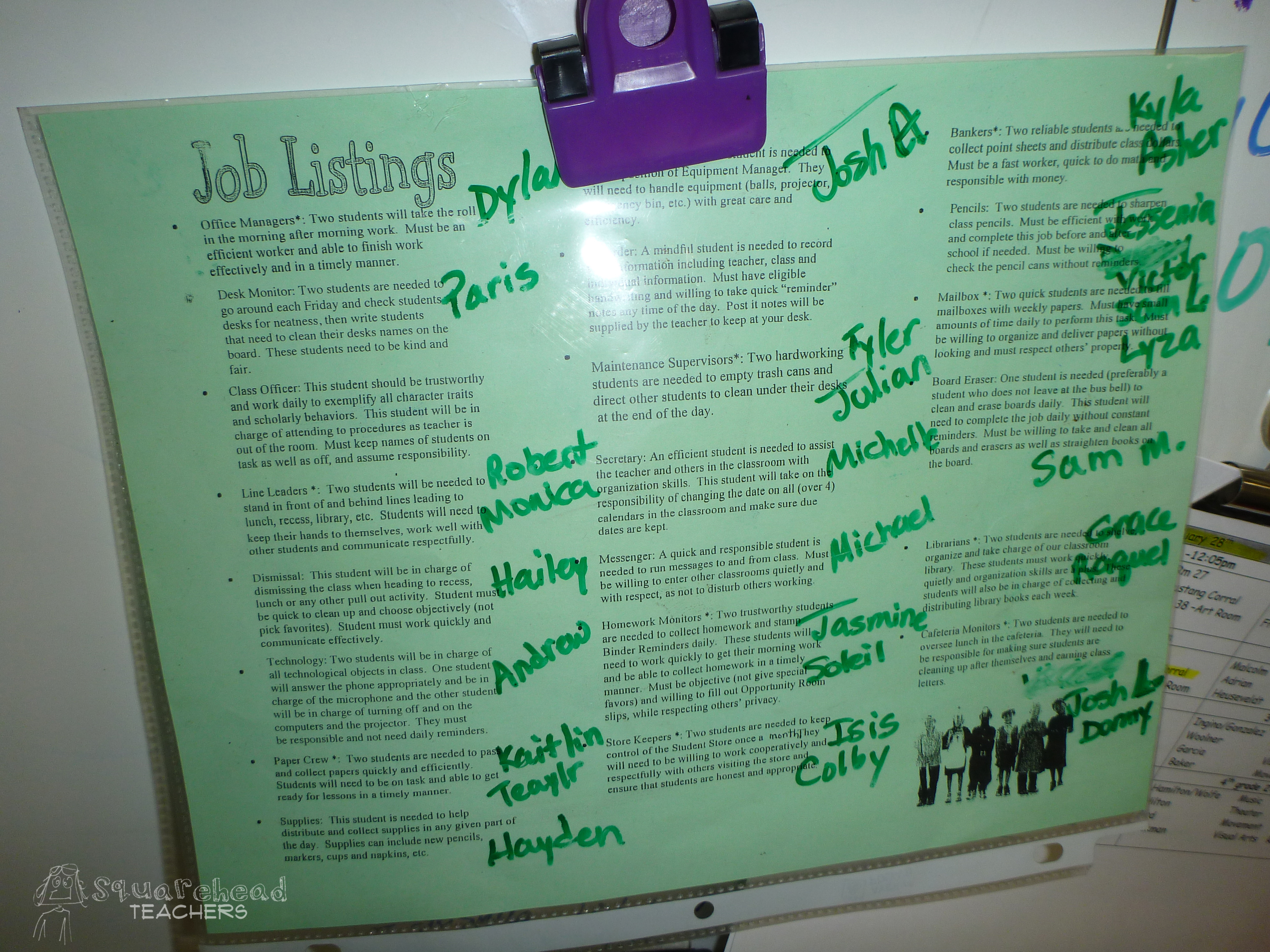
There are many jobs teachers choose for the students in their classroom (depending on the needs of your room).  I always make sure to post a list of jobs with their description to help students remember that their job entails. I made sure to have a system for rotating them, so no student was stuck with the same job for weeks on end and everyone had a chance to contribute. Here are some I’ve used and found helpful (teacher notes in red):
 
Courier – Carries messages to other teachers, office, etc. At the end of the day, help Floor Crew.

Desk Inspector – Checks for dirty desks (and gives students Clorox wipes if needed); assists in cleaning desks. The Desk Inspector was in charge of reminding me to do a random desk inspection. If a student passed an inspection by the Desk Inspector, they got something from the prize box. Sometimes I would do my own inspection at the same time. If a student didn’t pass my inspection, they had to stay in at recess to clean out their desk. 

Equipment Manager – Checks in and out equipment (by writing name, date and equipment) it in the spiral notebook at the back of the room; At the end of the day, help Floor Crew.

Floor Crew – Pick up trash off the floor at the end of the day. Push in all chairs before leaving the room.

Food Dude– Reports the lunch count to the teacher in the morning and carries the lunch pouch to the office. Also makes sure all lunchboxes are returned to students each afternoon (no lunchboxes left behind!)

Librarian – In charge of the class library, makes sure books are organized books (all facing the right direction). Helps students check out books (at the end of the day, call for book checkout. Students who have would like to check out a book will come tell you and you’ll write it down on the clipboard).

Line Monitor – Waits for the line to be ready (1, 2, 3 fingers in the air as the class progresses to be ready). When the class is silent, still and facing forward, the line monitor holds the door for class and turns out the lights. Join the line at the end of the line. At the end of the day, help Floor Crew. This was especially awesome because I could do last minute things while the monitor was watching the line. They were encouraged to give compliments to students who were behaving (I’d let the first 2 students complimented go to the first line stopping point ahead of everyone else, so they ended up getting to go first to lunch or whatever).

Mailman – Passes papers (from the plastic box) back to students’ mailboxes in the back of the room (when done with an assignment or during after-lunch read aloud); makes sure all students empty mailboxes every afternoon. Call students names to remind them if they haven’t emptied their boxes.

Pencil Sharpener – Makes sure the class supply of sharpened pencils is full every afternoon. When it’s time for jobs, sharpen as many pencils from the “broken” box until it’s time to go.

Pocket Master –Reports to the teacher in the morning which students are absent. Make sure all popsicle sticks from the lunch count are moved back to each student’s pocket at end of day.

Secretary – Fills out a “While You Were Out” form and collects worksheets, etc. for each student absent that day. At the end of the day, put form in student’s mailbox.

Time Keeper – Calls time for jobs at the end of the day then reports to the teacher for any special jobs.  If no special jobs, help Floor Crew. I had a special set of bells they rang to signal time for jobs.

Whiteboard Wiz– Erases whiteboards at end of the day. Ask the teacher if there’s anything that should not be erased before you start erasing.

Here are some other ideas I’ve seen for classroom jobs:

P1030323 P1030218

P1030649

This is how one teacher keeps track of who does what each week…

P1030657

That same teacher also does job applications…

 
Have other good classroom jobs ideas? What have you tried that works (or doesn’t!)? Please comment! 

Summer Birthdays

Some teachers celebrate birthdays in their classrooms. There are many different ways to celebrate birthdays that don’t fall during the school year. Here’s how I deal with birthdays as a an upper grade teacher:

I designate one day during the school year to celebrate summer birthdays. This past year, I chose the last day before Christmas break. The day was pretty much wasted anyway, since the kids can’t concentrate right before Christmas and they’re all distracted by the upcoming vacation. I told the students with summer birthdays that they could bring in a birthday treat and we would sing to all of them. So, a midst all the chaos of the holidays (we had a party in the afternoon), all the birthday kids brought out their treats to share and we sang to them. It was nice to combine it with the party because it was less distracting than celebrating summer birthdays on a day we were trying our best to be productive. The kids didn’t seem to notice it was combined with anything else, so they all felt special.