 The California science standards for 1st grade require students to:
1-ESS1-1. Use observations of the sun, moon, and stars to describe patterns that can be predicted. [Clarification Statement: Examples of patterns could include that the sun and moon appear to rise in one part of the sky, move across the sky, and set; and stars other than our sun are visible at night but not during the day.] [Assessment Boundary: Assessment of star patterns is limited to stars being seen at night and not during the day.]
1-ESS1-2. Make observations at different times of year to relate the amount of daylight to the time of year. [Clarification Statement: Emphasis is on relative comparisons of the amount of daylight in the winter to the amount in the spring or fall.] [Assessment Boundary: Assessment is limited to relative amounts of daylight, not quantifying the hours or time of daylight.]
This graphic organizer is one way to start teaching these concepts. Click here to get the free printable PDF: Earth’s Place in the Universe graphic organizer

 The Utah 1st grade Science Standard 2 Indicator 2 reads, “Observe the sun at different times during the day and report observations to peers. Observe and chart the moon when it is visible during the day.” This idea is in most state science cores in one form or another. You can use my sun observation graphic organizer to help students keep track of what they observe.
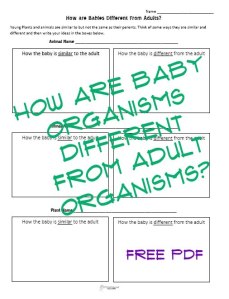 The California Science Standard for 1st grade (1-LS3-1) says “Make observations to construct an evidence-based account that young plants and animals are like, but not exactly like, their parents. [Clarification Statement: Examples of patterns could include features plants or animals share. Examples of observations could include leaves from the same kind of plant are the same shape but can differ in size; and, a particular breed of dog looks like its parents but is not exactly the same.] [Assessment Boundary: Assessment does not include inheritance or animals that undergo metamorphosis or hybrids.]”
 I’ve got another graphic organizer for you! This is my second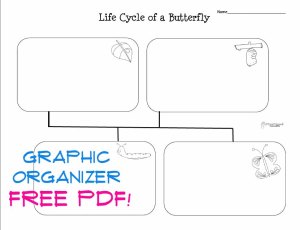
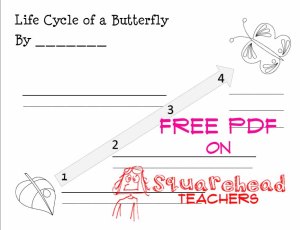
 I’m totally on a graphic organizer kick right now. Here’s my latest: a simple, blank graphic organizer for teaching life cycles. I think the standard idea of drawing a circle is confusing to kids. Somebody’s always bound to think you’re teaching them that the same animal comes to life again (which gets into religion, blah blah blah). So I’ve done mine along a line. As always, there’s space to write words and draw a simple picture.
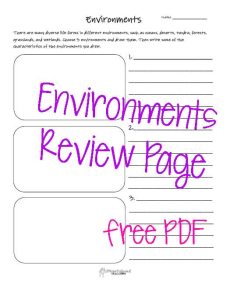 The 3rd grade science standards for the common core include studying environments. I’m going to use this worksheet to help assess student understanding of various environments. After we talk about the commonly found environments (deserts, wetlands, etc.), I’m going to hand this out and see what my kids have retained.
 One of the most important parts of learning is to be able to connect the content to your own life. This is what I’m trying to help my students do with this worksheet on states of matter (3rd grade common core standard for science). When completing this page (identifying states of matter), I encourage the kids to find answers in their own lives: in the classroom, at their house, etc. This page works well as a homework page, so kids can walk around their house looking for states of matter.
 Squarehead Teachers