Integrating Science and Dance (Lesson Plan)

If you look for ways to incorporate movement (and dance) into your lessons, they’ll be a fabulous change of pace from other lessons. It’s not that hard, if you think from a movement point of view. For example…

Lesson Title: Earth’s Rotation
Learning Outcome: Students will demonstrate understanding of the Earth’s rotation by performing the Rotation Dance.
UT Science Standard 1, Objective 2:  Describe the movement of Earth and the moon and the apparent movement of other bodies through the sky. Describe the motions of Earth (i.e., the rotation [spinning] of Earth on its axis, the revolution [orbit] of Earth around the sun).
Grade Level: 3rdor 4th
Length of Lesson: 1-1 ½ hours
Materials: pictures of the earth, ball, music to dance to
Behavior Expectations: Participate in each activity; respond with movement instead of voices.
Instructional Plan:
a.       Experience/Identify
b.      Explore/Investigate
a.       Define the various terms involved by making movements (and using pictures as appropriate):
                                                                          i.      Sphere (like a circle). Have students make a 3D sphere shape with your body
                                                                        ii.      Axis Have students be a narrow shape reaching up and down, legs bending up and down.
                                                                      iii.      Planet (a large body of rock or gas that orbits the sun) – Students make a large shape. (Crossover) There are different size planets. Students show large and small planets.
                                                                       iv.      Earth (shaped like a sphere, or a circle) – Students draw circles with different body parts. (Crossover) Students draw a circle on a low level or a high level.
                                                                         v.      Tilted (The Earth’s axis is tilted or at an angle) – Students shift their weight to tilt to one side.
                                                                       vi.      Rotate (spinning or turning to one side on axis – the Earth rotates on its axis every 24 hours)- Student spin once in each direction.  (Crossover) Some planets spin very fast and some spin slow. Students spin both fast and slow.
                                                                     vii.      Orbit -is the path an object takes as it moves around another object. The Earth’s orbiting pathway is spherical. Students run in a circular pathway and back to their spot.
* use the ball to show terms you might have a hard time explaining with movement.
c.       Create/Perform
a.       Have students demonstrate the various terms as the teacher calls them out.
b.      Have students form small groups. Each student chooses a movement and dances it while the other group members try to identify what term was being demonstrated.
d.      Connect/Analyze
a.       Discussion: what other things rotate?
b.      Discussion: what are the effects of Earth’s rotation? (seasons, day/night, etc…)
Assessment of Learning: While the teacher calls out terms, observe students to check for understanding of concepts.

Why Creative Dance?

Creative dance should be included in elementary school curriculum because of its unique contributions. First, dance helps teach and reinforce culture. Culture encompasses all of the values, themes and activities that are important to a croup of people. By retaining, studying and expressing culture, students can strengthen their core knowledge of who they are. Educators can help children learn about themselves and the world around them by teaching culture through the arts. In addition, creative dance shows students the value of cooperation and collaboration. Collaboration and cooperation help our world problem-solve and improve situations. It is crucial that students learn the value of working as a team to accomplish a single goal. The arts require multiple areas of skill, which come from many people. This requirement to work together to produce a beautiful piece of art, and specifically creative dances, can help teach students that people need each other and that all have something to contribute to life. Teachers have an amazing opportunity to instill in their students life skills that cannot be taught as effectively in many other situations. If teachers use creative dance effectively, students will enjoy learning while they dance.
For more info, see Creating Meaning Through Literature and the Arts by C.Cornett (2007). Columbus, OH: Pearson Education, Inc. 

Developmental Stages of Art

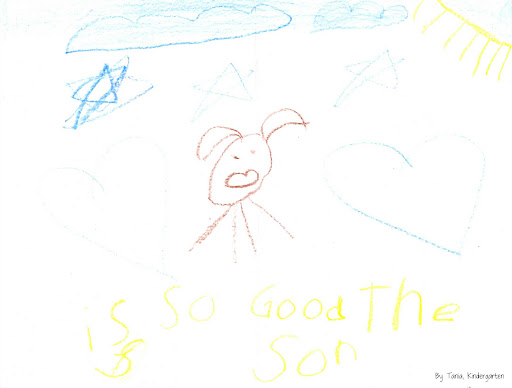
     When young children are given a crayon and paper, they usually scribble in imitation of others. Eventually these “drawings” take on meaning as children develop artistically. There are 3 basic developmental stages of art: scribbles, first representational forms, and more realistic drawings. In the scribble stage, the intent of the drawing is contained in the child’s gestures and explanation, rather than in the actual markings. The article gives the example of an 18-month-old girl who took her crayon and hopped it around the page rather than actually drawing a picture of a bunny hopping. Children are not yet able to draw what they are thinking and often need to explain or demonstrate what they mean to draw.  

The second stage of first representational forms usually starts around age 3, when children’s scribbles become drawings. This often happens when children gesture or scribble something and then realize that it looks similar to a real thing and decide to label it. For example, a child referenced in the article noticed that their scribbles look liked a real object (noodles) and then called his picture chicken pie and noodles. However, very few three year olds draw things that others can tell what their picture stands for. This improves when children hit one of the most important milestones in drawing: using lines to denote boundaries of objects. This leads to the first drawings of people, even though they are the simplest form that still looks like a human. Children’s first representations often contain a circle with lines attached. Four year olds will then add details such as eyes, hands, mouths and feet.

The third stage is more realistic drawings. As fine motor skills improve, children can create more complex drawings. Five and six year olds draw people with distinct arms and legs, rather than the “universal tadpole body” that three and four year olds draw. Older preschool children soon start exploring with depth, proportion, and overlapping objects. As children improve their drawing skills, their creations become more recognizable and teachers can start implementing various art techniques. Understanding the developmental stages children go through is important so that teachers can teach age-appropriate skills and encourage children to enjoy art.


For more info, see Child Development  by Laura Berk (2009) Allyn & Bacon, p 238-239.

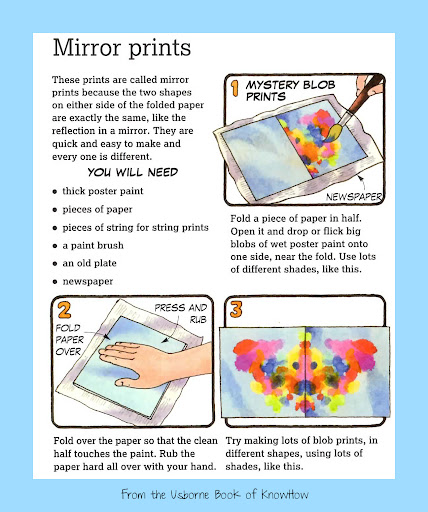
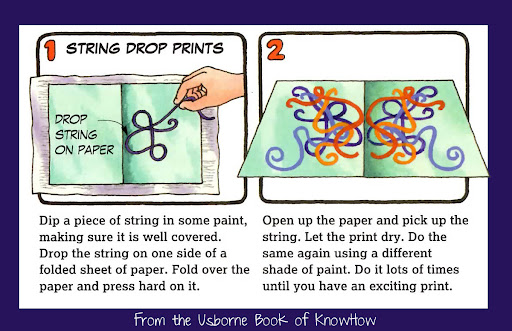
Mirror Prints

This idea seems simple enough for teachers, but entertaining enough for kids. My kind of art project!

Welcome!

Welcome to Squarehead Teachers! This blog is where I post all of my original teaching materials and the resources, ideas and tricks I’ve discovered along the way… and everything’s free! Click one of the menu options on the black bar above to start browsing free teacher stuff! Thanks for stopping by!

SQH generic pin- pinkSQH generic pin- yellow  SQH generic pin- blueSQH generic pin- orangeSQH generic pin- greenSQH generic pin- blueish purpleSQH generic pin- black  SQH generic pin- red

Everyday Writing Project: Story Starters (free!)

My kids love writing and sharing stories, but sometimes they’re missing the basics (setting, conflict, etc.) or they don’t know what to write about. So this helps them stay focused and gets them started if they’re stuck. I have them write a rough draft (and maybe final draft) on another piece of paper. You could easily require the use of vocabulary/spelling words, specific kinds of figurative language, etc. in the story also.

Click here for the free printable PDFs: Story Starters 1-4 PDF   Happy writing!

Story Starter- Misc 1 Story Starter- Misc 2 Story Starter- Misc 3 Story Starter- Misc 4