Bloom’s Taxonomy: Questioning

I know you’ve all learned about Bloom’s Taxonomy. But, if you’re like me, all you remember is that it involves different levels of thinking and questioning. Well, here’s a helpful review if you’re fuzzy on the different questioning types within Bloom’s Taxonomy. 

Discuss the following questions after reading Little Red Riding Hood:

Knowledge
List the items Little Red Riding Hood carries with her.
Name the characters in the story.
Match the character with their items (example: grandma with nightgown, Little Red with basket)

Comprehension 
Explain why the Wolf came to the grandma’s house.
Describe the forest Little Red Riding Hood walked through.
Organize the events of the story to be in order.

Application
Demonstrate how the Wolf would disguise himself if he came to your house.
Model how Little Red Riding Hood responded when she saw the Wolf in the grandma’ s bed.
Translate the wolf’s actions into words. What does he mean when he glares at Little Red Riding Hood?

Analysis 
Compare this story to reality. What events could not really happen?
Diagram the grandma’s house.
Summarize the plot.

Synthesis
Propose how the story would be different if it were Little Red Riding Hood and the Dolphin instead of Little Red Riding Hood and the Wolf.
Elaborate on why Little Red Riding Hood went to visit the grandma.
Design the outside of the grandma’s house

Evaluation
Judge whether the wolf was good or bad. Defend your opinion.
Recommend another way Little Red Riding Hood could have reacted when she met the wolf in the woods.
Defend the wolf’s actions.

Notice how the levels increase in difficulty? Try throwing in some higher levels of Blooms Taxonomy next time you’re creating a test or just discussing your guided reading book.

Teaching PE: Helpful Visuals

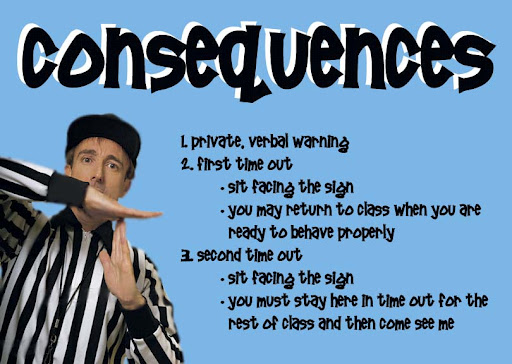
Teaching PE requires a ton of management. You’ve got kids running around, balls flying past you and you’re trying to remain sane. Just as in the regular classroom, it is helpful to have some ground rules and procedures in place. I made these signs, printed them on 11″ x 17″ paper and laminated them. Then I attached a strip of paper (also laminated) to the back so these signs could slip over a big orange cone and be referred to easily. I put the “consequences” sign on a cone in a corner of the gym and used that corner as a time-out spot. (I know may think time-outs are lame, but it’s an effective way to let students know what’s acceptable in your PE class.) Use these or make your own. They really help!

Puppets? In the Classroom?

Although many might only associate puppets with entertainment, puppets can be a great classroom management tool. There are many uses of puppets in elementary school classrooms.  The following are some of the ways puppets can be used in the classroom:

  1. Puppets can ask students questions to check for understanding. The puppet can ask questions that students can answer. The teacher can also ask puppets questions (the puppet will always be wrong) and students can correct the puppet to demonstrate understanding.
  2. Puppets can help shy or timid children participate. A child puppeteer might feel safe “behind” a puppet. The puppet will be one “talking” and the student my feel less scared to share thoughts through a puppet.
  3. Puppets can discuss things in a non-threatening way, since they are a third party. If there are conflicts or intimidating discussion topics, the teacher can use puppets. Puppets are not threatening, so they can help bring down anxiety within students.
  4. Puppets can encourage enthusiasm, or be the class mascot. Puppets can be silly or overly enthusiastic, while still maintaining the dignity of the actual teacher.
  5. Puppets can serve as cheerleaders to encourage students.
  6. Puppets can get student’s attention to make announcements such as homework, changes in daily routine, and birthdays (as well as lead the birthday song!).
  7. Puppets can ask bold questions that the students want answers to, but might not want to ask. For example, an introduction of the class restroom policy might sound like this:
Puppet: What do I do f I have to go to the bathroom?
Teacher: Well you can raise our restroom card quietly and I will see you.
Puppet: Why can’t I just ask you out loud?
Teacher: That can disrupt the class and disturb others who are working. I will nod to let you know you may go.
Puppet: Oh, okay. So I should quietly raise my bathroom card and you’ll see me and nod that I can go?
Teacher: Yup! You got it!
Puppets can be an effective tool to manage a classroom. Puppets can keep students entertained and can take some of the pressure off of the teacher and allow the teacher some room for fun and creativity.

Theater Games!

One of the best ways to break the ice when trying to encourage students to stand up in front of their peers is playing a game first. There are gobs of theater games out there, but this one is one of my favorites…

Theater Game: Who am I?
Description: A student is sent out of the classroom (or at least out of earshot) and when they return, they must interact with other students until they know the famous person or occupation the class has chosen for them.
Connections to other content areas:
History: choose famous people from history
Science: choose scientific careers (doctors, optometrists, field researchers, zoo keepers), or people who have made famous discoveries
English: choose prominent characters from literature (especially books you have read in class)

Teaching Inflection & Voice

One aspect of good reading is inflection. Let’s face it – nobody wants to hear a robot read out loud to them. Selecting the right material is crucial in teaching young readers to read with inflection. This poem provides students the perfect chance to practice using emotion when they read. Try it, it’s fun…

 
At History I’m Hopeless (By Kenn Nesbitt)
 At history I’m hopeless.
At spelling I stink.
In music I’m useless.
From science I shrink.
At art I’m atrocious.
In sports I’m a klutz.
At reading I’m rotten.
And math makes me nuts.
At language I’m lousy.
Computers? I’m cursed.
In drama I’m dreadful.
My writing’s the worst.
There’s only one subject
I’m sure I would pass,
but they don’t teach
video games in my class.


Adding Movement to Your Lesson Plan… Seriously Easy

While studies have shown that involving students in learning and kinesthetic learning is are beneficial for students, many teachers are still hesitant.  Adding movement to your basic lesson plan is seriously easy. Check out this idea I whipped up in about .07 seconds: 
 
Subject: life cycle of a butterfly (egg, caterpillar, pupae, butterfly)
Target grade level: 1st grade
Elements of dance: Motion (axial and locomotor), Space (levels)
The children will demonstrate each of the stages of the cycle:
Egg– taking up small space and staying on the ground, controlling their bodies so that there is no movement.
            Caterpillar– staying low to the ground, move slowly around the room in a non-pedal way
Pupae– use an axial movement to “wrap up in a cocoon”. Then remain still so that you can be transformed into an adult butterfly.
Adult Butterfly– use axial movements to emerge from your cocoon, stretch your new wings, and then use a variety of locomotor movements and levels to fly away. 

Unique Contributions of the Arts

The arts are under fire in our schools. Funding is being cut, and standardized testing is forcing teachers to teach to tests. While it does take time and effort to include the arts in a teacher’s curriculum, it is very worthwhile. Here are just a few contributions from the arts:

  1. Culture –Culture encompasses all of the values, themes and activities that are important to a croup of people. By retaining, studying and expressing culture, students can strengthen their core knowledge of who they are. Educators can help children learn about themselves and the world around them by teaching culture through the arts.
  2. Competence/Control- Being able to control your emotions, thoughts and actions is a crucial skill that children need to succeed and be happy in life. As teachers, we can help students comprehend what is right and wrong in their thoughts, emotions and actions so they can maintain control and enjoy life. The arts teach control in a more effective way than most other disciplines.
  3. Communication-Communication is crucial in today’s society, not only for individuals, but for he world as a whole. The arts help students explore different ways of communicating a message to others, but students can have fun while doing so.
  4. Cooperation/Collaboration- Collaboration and cooperation help our world problem-solve and improve situations. It is crucial that students learn the value of working as a team to accomplish a single goal. The arts require multiple areas of skill, which com from many people. This requirement to work together to produce a beautiful piece of art can help teach students that people need each other and that all have something to contribute to life.
  5. Confidence- Confidence is empowering; it is what tells us we can go on when we get shaky. Confidence helps us accomplish things we thought we could never do. Teachers can instill in children confidence that will then lead them to accomplish great things. The opportunity to give this gift to a children is a blessing and teachers should help students develop self confidence every moment in the classroom.
Have more ideas? Please comment!

Using Dance to Teach Culture (Lesson Plan)

Lesson Title¡Bailamos!
Grade: 6th
Lesson Objective: Explore Mexican culture an learn greater appreciation for cultural differences

Resources:
            Time: 1 hour
           
Space: school cafeteria                                               
           
People: large group (whole class), uneven gender numbers, 6th graders
Materials: cafeteria sound system or portable boom box, map of North America

What Taught: Los Machetes (Page 110 of Creative Dance)


How Taught:

1.ANTICIPATORY:
Be aware of the children who might need extra help.
Review where Mexico is on the map.
Talk about what aspects of Mexican culture the kids understand before the unit.
Try to name things they know that are from Mexicoor that have Mexican influence.
Point out the Jalisco area in Mexico (the dance is from the Jalisco area).
2.MODELING AND INSTRUCTION:
Get in two circles.
Distinguish between the inside and outside circles (don’t say “men” or “women” since the groups may be uneven).
Teach the walk forward and clap.
Teach the walk backward with the hand clap.
Practice from beginning until this point, using correct calling techniques.
Teach the back away, making sure kids dance with correct partners.
Review and add the walk backward and walk forward.
Practice from beginning until this point, using correct calling techniques.
Teach the clap leg, practice multiple times before putting it with the other steps.
Practice from beginning until this point, using correct calling techniques.
Teach the star, sure kids understand how to work with their partner.
Practice entire dance, using correct calling techniques.
3.CHECKING FOR LEARNING:
Make sure kids only touch their partners during the Star.
Make sure all kids start on the left foot.
Call with he music.
Check to see if 75-80% of the kids were successful.
4.INDEPENDENT PRACTICE:
Play the music and have kids practice the dance without teacher calling.
If kids get confused at a certain point, review it and then call it through until they can do it without calling.
5.CLOSURE:
Eat Mexican desserts (churros, empanadas, biscochitos, etc) while listening to some of today’s popular Mexican artists.


HOW LEARNING IS DEMONSTRATED:
Make sure everyone understands the rhythm of the song.
Make sure everyone understands where the Jalisco area is in Mexico.
Make sure everyone understands the sequence of the steps.
Make sure everyone understands how and when to dance with or facing a partner.
EXTENSION AND APPLICATIONOF STUDENT LEARNING:
Read story Uncle Nachos Hatto introduce traditional Mexican clothing.
Read story Friends from the Other Side (by Gloria Anzaldua) (Story of a Mexican boy named Joaquin who crossed the Rio Grande River into Texas with his mom in search for a new life).
Make a Mexican Poncho.
Make a Mexican Pinata.
Make Tacos and discuss the basic foods eaten in Mexico(tortillas, beans, etc.)
Study the life and art of Diego Rivera. Have students discuss aspects of his most famous works.
Use copies of Kids Discover! Magazines to help kid give short oral reports on various aspects of Mexico.
Make Empanadas.
Learn about Dia de los Muertos and the significance it has to the Mexican people.
Make “El Ojo de Dios” (or God’s Eye) using yarn and popsicle sticks (this is an ancient symbol made by the Huichol of Mexico)