Improving Student Motivation

I once had a parent tell me she was having a hard time motivating her child to do homework, etc. and asked if there were any things I could do in the classroom to help. I tried to find something at school, but outside our classroom that might be motivating to the student, (who was on student council) and I tried to find a few things inside the classroom that I could personally be in control of that might help with motivation. Here’s what I wrote to her:

Hi [parent name],

            As far as motivation/consequences for turning in assignments goes, there are a few options that come to mind.
1.      Student council- student council reps must be in high behavioral and academic standing or they’ll be dismissed. I don’t think that will happen, but it might help with motivation…
2.      I use tickets in my classroom and sometimes homework passes. If she’s motivated by that kind of thing, I can use more of them with her.
3.      Also, I could let her choose her classroom job for the following week if she turns everything in on Friday (some kids care what job they have and others don’t)…
I’ll keep thinking about that and let you know if anything better comes to mind.
[My name]


What are other ideas you’ve seen/heard of that have been effective in motivating students? Please comment!


Partnering Students: Neighbors!

Here’s an idea I loved from a classroom in Utah:

The teacher had a sign posted in the front of the room that had the following words on it – “Neighbors: Front door, Back door, Side door, Diagonal.” This sign reminded her to use her established “random” partnering system (when factors like academic level are not needed to pair students). Neighbors was her way of partnering students (they sat in groups of 4 desks). The kids knew who was their front door neighbor, side neighbor, and so on, so all she had to do was call out a neighbor and the kids would instantly pair up. This saved her lots of time paring up, and she changed seats enough that the kids never got too bored with one partner. When she called “meet a new neighbor”, the kids were free to work with any class member. Sometimes, she’d call “block party,” and the entire table would work together. I thought this was a great way to partner students and build community.

Classroom Library Book Check-Out

One thing teachers always worry about when building a classroom library is the possibility that books will get lost, stolen, damaged, eaten, etc. There’s no fool-proof way to protect your books if you put them in a classroom library, but you can try to help students be more responsible with books, and let your students know that you value your books. Here’s a really basic sheet I made for keeping track of books. This sheet was mainly the responsibility of the student with the librarian job for the week.

Click to download the Classroom Library Book Checkout sheet.

If there are other things you’d like to keep track of that aren’t on this sheet, feel free to modify it to fit your needs.

Classroom Jobs

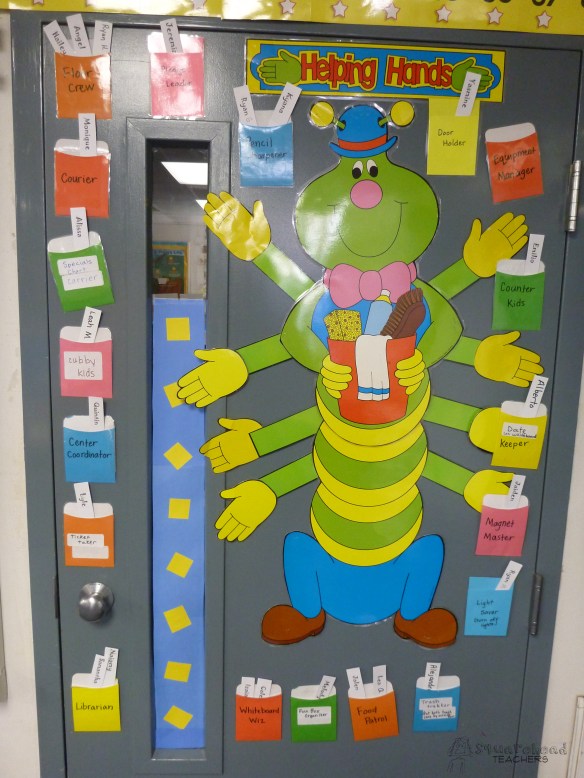
There are many jobs teachers choose for the students in their classroom (depending on the needs of your room).  I always make sure to post a list of jobs with their description to help students remember that their job entails. I made sure to have a system for rotating them, so no student was stuck with the same job for weeks on end and everyone had a chance to contribute. Here are some I’ve used and found helpful (teacher notes in red):
 
Courier – Carries messages to other teachers, office, etc. At the end of the day, help Floor Crew.

Desk Inspector – Checks for dirty desks (and gives students Clorox wipes if needed); assists in cleaning desks. The Desk Inspector was in charge of reminding me to do a random desk inspection. If a student passed an inspection by the Desk Inspector, they got something from the prize box. Sometimes I would do my own inspection at the same time. If a student didn’t pass my inspection, they had to stay in at recess to clean out their desk. 

Equipment Manager – Checks in and out equipment (by writing name, date and equipment) it in the spiral notebook at the back of the room; At the end of the day, help Floor Crew.

Floor Crew – Pick up trash off the floor at the end of the day. Push in all chairs before leaving the room.

Food Dude– Reports the lunch count to the teacher in the morning and carries the lunch pouch to the office. Also makes sure all lunchboxes are returned to students each afternoon (no lunchboxes left behind!)

Librarian – In charge of the class library, makes sure books are organized books (all facing the right direction). Helps students check out books (at the end of the day, call for book checkout. Students who have would like to check out a book will come tell you and you’ll write it down on the clipboard).

Line Monitor – Waits for the line to be ready (1, 2, 3 fingers in the air as the class progresses to be ready). When the class is silent, still and facing forward, the line monitor holds the door for class and turns out the lights. Join the line at the end of the line. At the end of the day, help Floor Crew. This was especially awesome because I could do last minute things while the monitor was watching the line. They were encouraged to give compliments to students who were behaving (I’d let the first 2 students complimented go to the first line stopping point ahead of everyone else, so they ended up getting to go first to lunch or whatever).

Mailman – Passes papers (from the plastic box) back to students’ mailboxes in the back of the room (when done with an assignment or during after-lunch read aloud); makes sure all students empty mailboxes every afternoon. Call students names to remind them if they haven’t emptied their boxes.

Pencil Sharpener – Makes sure the class supply of sharpened pencils is full every afternoon. When it’s time for jobs, sharpen as many pencils from the “broken” box until it’s time to go.

Pocket Master –Reports to the teacher in the morning which students are absent. Make sure all popsicle sticks from the lunch count are moved back to each student’s pocket at end of day.

Secretary – Fills out a “While You Were Out” form and collects worksheets, etc. for each student absent that day. At the end of the day, put form in student’s mailbox.

Time Keeper – Calls time for jobs at the end of the day then reports to the teacher for any special jobs.  If no special jobs, help Floor Crew. I had a special set of bells they rang to signal time for jobs.

Whiteboard Wiz– Erases whiteboards at end of the day. Ask the teacher if there’s anything that should not be erased before you start erasing.

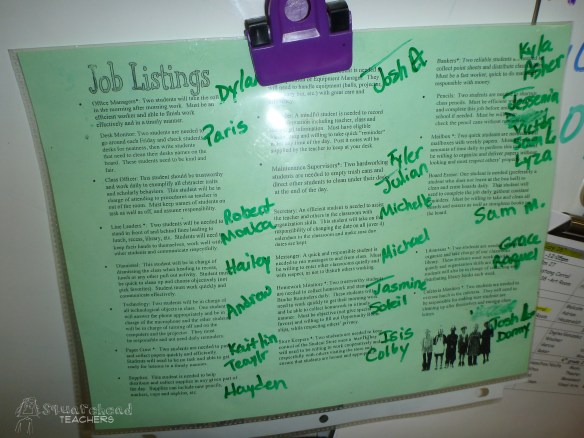
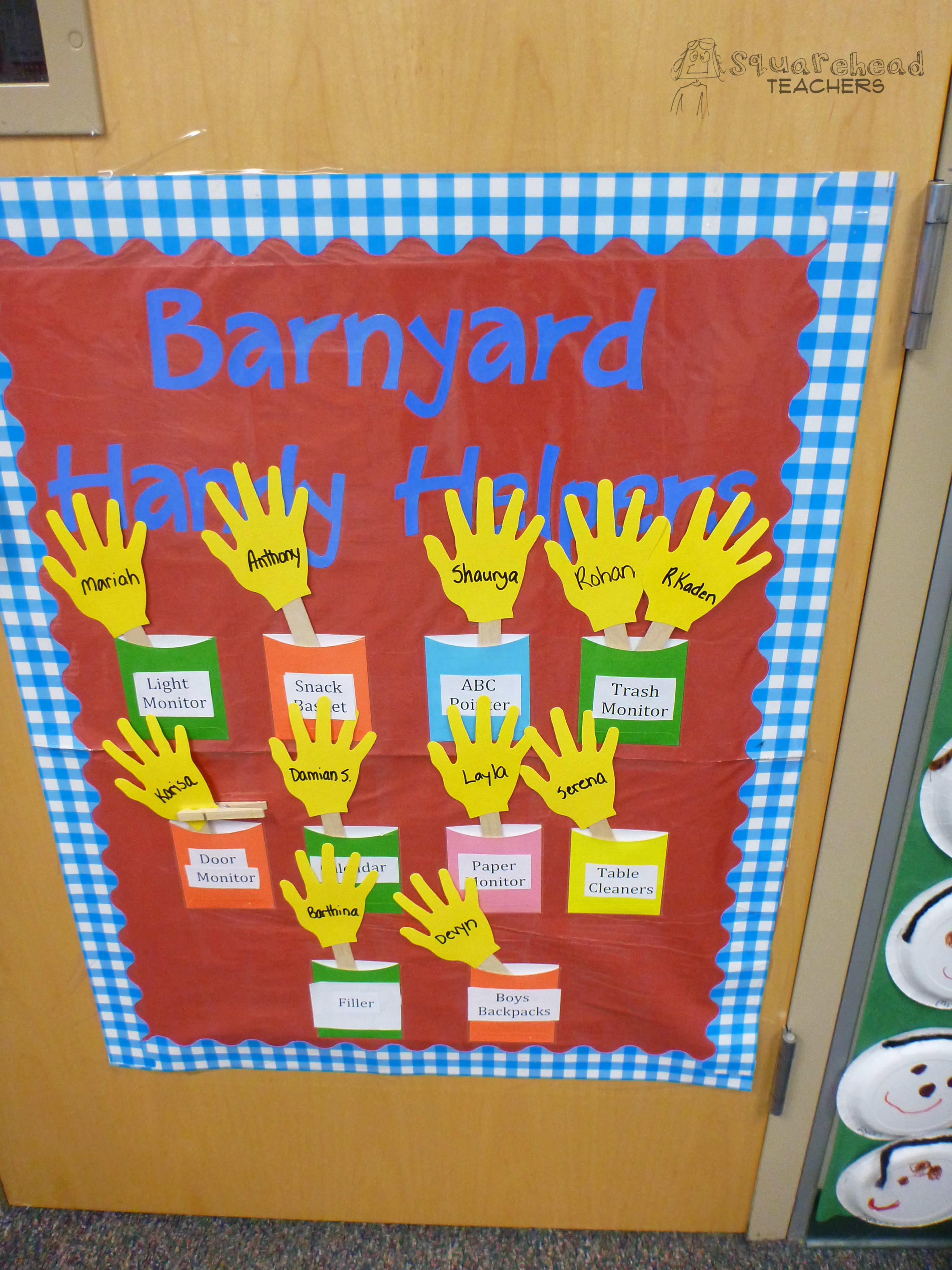
Here are some other ideas I’ve seen for classroom jobs:

P1030323 P1030218

P1030649

This is how one teacher keeps track of who does what each week…

P1030657

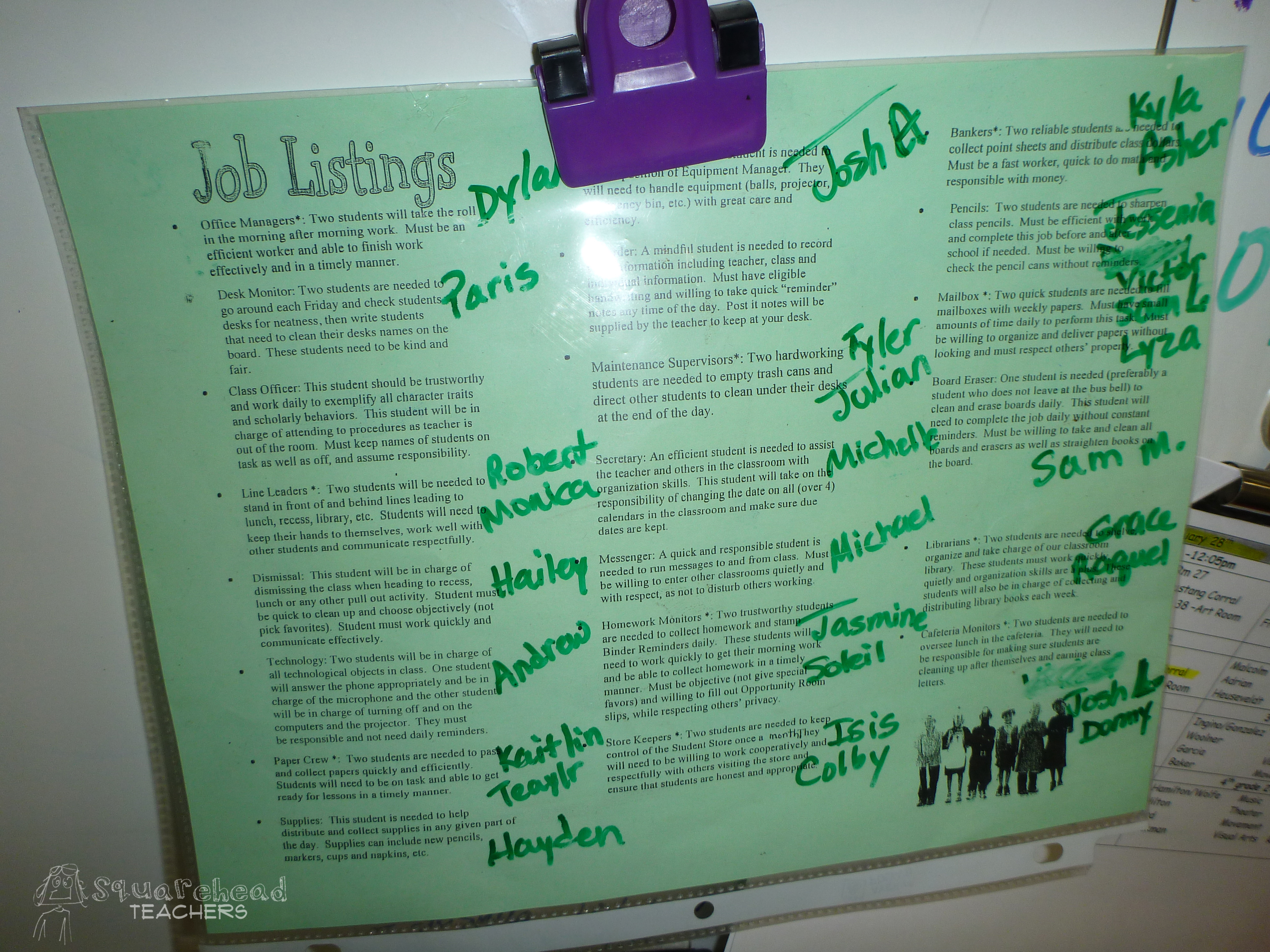
That same teacher also does job applications…

 
Have other good classroom jobs ideas? What have you tried that works (or doesn’t!)? Please comment! 

Summer Birthdays

Some teachers celebrate birthdays in their classrooms. There are many different ways to celebrate birthdays that don’t fall during the school year. Here’s how I deal with birthdays as a an upper grade teacher:

I designate one day during the school year to celebrate summer birthdays. This past year, I chose the last day before Christmas break. The day was pretty much wasted anyway, since the kids can’t concentrate right before Christmas and they’re all distracted by the upcoming vacation. I told the students with summer birthdays that they could bring in a birthday treat and we would sing to all of them. So, a midst all the chaos of the holidays (we had a party in the afternoon), all the birthday kids brought out their treats to share and we sang to them. It was nice to combine it with the party because it was less distracting than celebrating summer birthdays on a day we were trying our best to be productive. The kids didn’t seem to notice it was combined with anything else, so they all felt special.

Parent-Teacher Conferences

As a teacher, it’s super important to communicate with parents. One of the most important communication experiences you will have with the families of your students is during parent-teacher conferences. Many of my students’ parents never visited the school’s website, or ever saw the announcements on the sign outside the school, so I wrote this letter to send home to inform the parents of my interest in meeting with them.  Although the school sent home mass letters telling about the parent-teacher conferences, I wanted the parents to know I was personally interested. Here’s a letter I sent home right before our school’s online scheduler opened. This saves me the headache of tracking down the parents who missed conferences because they didn’t know they were happening. Feel free to copy/paste it and modify it to fit your needs. As with all letters going home, check your principle’s guidelines before distributing.

Parent – Teacher Conferences
Hello Parents,
Parent-teacher conferences are coming up! Please sign up for a time using the online scheduler. You will see that available appointments are Monday through Thursday. These times are a little different than other teachers’ SEP schedules because I am getting married on the Friday after SEP’s (November 12). I have tried to schedule a variety of times to ensure that I can meet with every student and their parents/guardians. It is important to me to meet with every parent so we can together discuss each student’s goals, progress, etc. Thank you for your continued support!
 
(my name) 

Line Up Quietly + Math Practice = Easy!

This was an idea I learned from Miss S. who teaches younger grades:
When the kids are quiet,  I hold up 1 to 10 fingers over my head.  They have to hold up their fingers over their head to make a combination of 10.  For example, if I hold up 2 fingers, they hold up 8 fingers.  If I hold up 6 fingers, they hold up 4.  They cannot talk as we do this.  They are doing this as they are lining up.  In between problems, I say “erase.”  Sometimes I just hold up the fingers, and they start quietly lining up while doing the math combinations. This is a great way for them to learn combinations to 10 AND line up quietly at the same time!

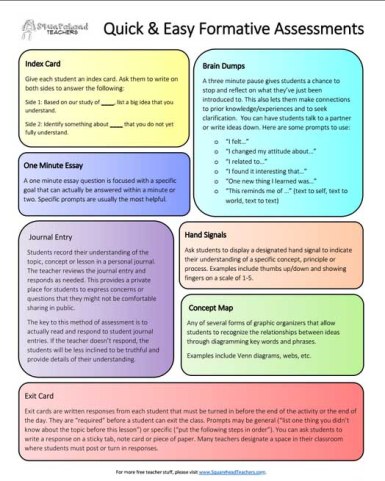
Quick & Easy Formative Assessments UPDATED

Quick and Easy Formative Assessments- LARGE

Sometimes it feels crazy overwhelming to keep assessing students and know exactly what they do/don’t understand. That’s where these quick and easy formative assessment ideas comes in!

My school district sent us a monthly newsletter from the GATE department. This was a particularly helpful chart, so I kept it. But the image was too small, so I’ve remade it into an easier to read version (see below).

Formative Assessments - New STICKERClick here to download the above new version (PDF): Formative Assessments

In case you’re still thirsty for more formative assessment ideas, check out these ideas:
Formative Assessment Ideas on eHow.com
Examples of Formative Assessment from West Virginia Department of Education
A Sampling of Types of Formative Assessment on isbe.net
Formative Assessment Ideas from the Wake County Public School System
21 Ways to Investigate What Students Are Learning by STEMresources.com