End of the Day Review- NO PREP Jeopardy!

Sometimes you have a few minutes left at the end of the day you’d like to use productively.
Sometimes, you’re just an awesome teacher and you plan for an end of the day review on spelling, grammar, social studies, math vocab, etc. Here’s a super easy way to do it:

  1. Draw columns on the white board (1 for each topic you’d like to review)
  2. Title the columns from things you’ve done that day/week
  3. Write the following numbers under each column header: 10, 20, 30, 40, 50
  4. Divide your class into small groups (super easy if you have kids in tables already) and let a team choose a question.
  5. MAKE UP QUESTIONS AS YOU GO! Killer easy right!? Just make the higher point values a little more challenging. You can make any kind of question you want: multiple choice, true/false, fill-in-the-blank. Just do it!
  6. Keep track of points on the whiteboard

Additional rules/notes:

  • Let everyone try to answer so that everyone is part of the review (choose whoever raises their hands, or choose a student number randomly, you choose)
  • More than one team can answer if you make an answer with multiple answers (just day that the first team to raise their hands or whatever gets to choose the next question)
  • Whatever team gets the question right, chooses the next category/point value

Thanksgiving Math Memory Game (free printable)

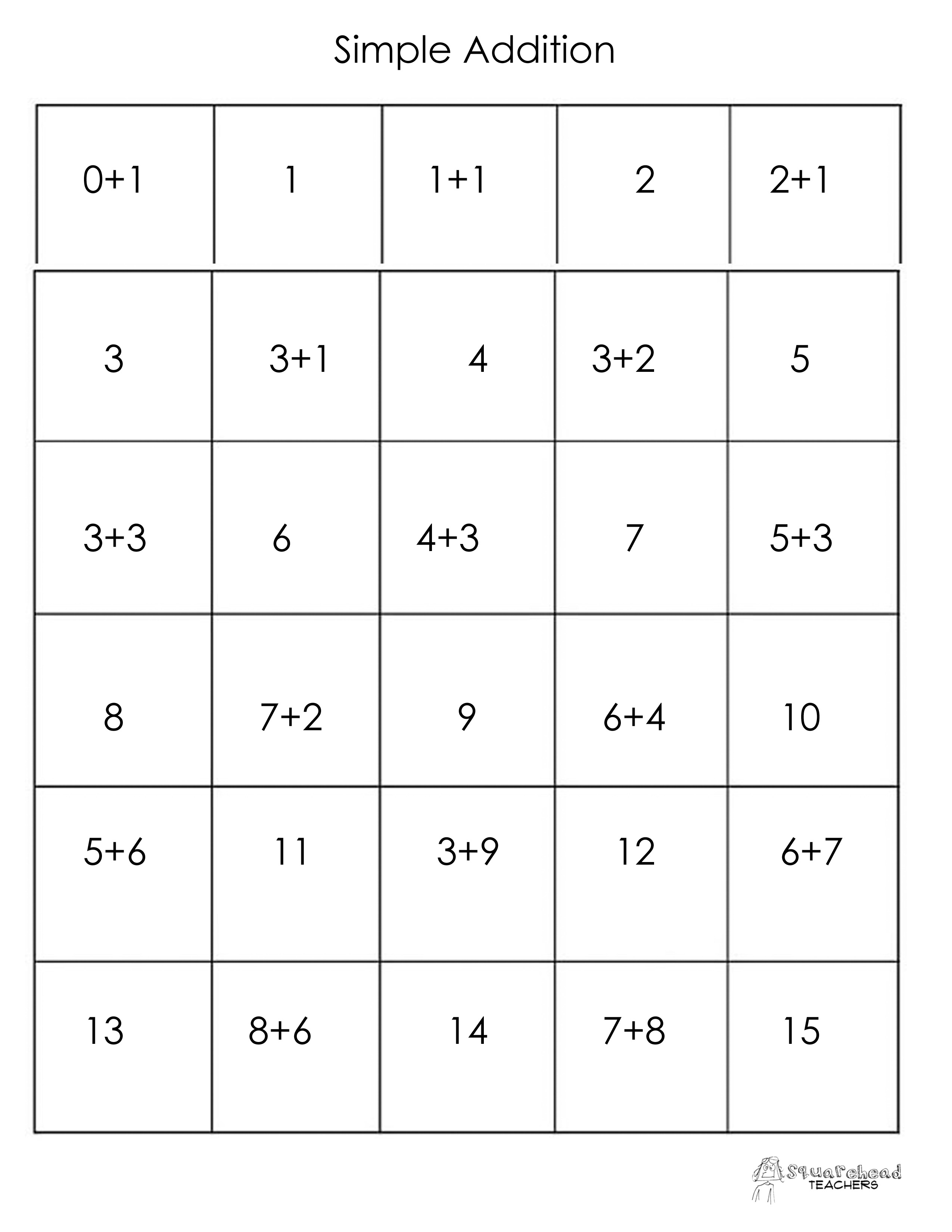
Here’s a great way to tie Thanksgiving into math practice.  I’ve made 2 options for the front of the card (simple addition and basic multiplication), and 1 option for the back of the card (Thanksgiving theme). The addition version is appropriate for kindergarten – second grade and the multiplication is appropriate for 3rd grade and up. Click here for all 3 pages: Thanksgiving math memory cards- add mult   Copy back to back, cut and you’re off! If you’d like to make your own math facts, only run off the back (Thanksgiving theme) and then hand write your own numbers on the other side. Enjoy!


Click here for more fun and free Thanksgiving stuff for kids!  Help support this blog and keep it completely free by sharing it with your friends! Thank you! 

Don’t Eat Pete! (Fun Party Game)

This game is one of my favorite games ever. It’s killer easy and it’s way fun. You can use candy (M&Ms are my favorite) or any other type of marker (I’ve used Cheerios, Goldfish, paper markers, etc.). Here’s how to play:

1. Using a grid game board (here is my Don’t Eat Pete Game Template or click here to download my other free holiday game boards), place one M&M on each square.

2. Send one player away from the board where they can’t see/hear you.

3. The remaining players choose 1 square or candy to be “Pete”. Make sure everyone (except the player sent away) knows what the square is.

4. Invite the player back and they get to take as many candies as they can until they get to Pete. When they touch Pete, everyone says “Don’t eat Pete!”

5. At the end, clear off the board (I give the candy to the kid that just played) and put new candy on for the next kid.

This is especially fun in a group and players who know which one is Pete can trick the guessing player by say “Don’t eat Penelope!” or something just to make them jump! Enjoy!

(You could turn this into a more academic game by requiring the player to answer a question before they get to take a piece of candy…)

Here are some of my favorite treats for this game:

*This post contains affiliate links. Thanks for your support!

Best Ever Games to Review in Any Content Area!

Teachers dread the end of the year tests. Their kids are ready for summer, but it’s the test that reflects the work of the teacher. When I taught 6th grade, this was especially difficult, since my kids thought they were practically in junior high already and were way over the elementary school tests. So I came up with a plan that ROCKED MY WORLD! Here it is:

1. I printed copies of all the unit tests (given to us by the district) in any content area (I used math and science).

2. I cut the tests into pieces with 1 question per piece and put all of them into an envelope along with the answer key to the test.

3. I prepared for the games below and planned to do 1 game using 1 set of questions each day for the 3 weeks leading up to the state tests.

4. Execution was simple! My kids loved these games and the kids were reviewing all the content areas without even realizing it! Some of these got a little wild, but that’s part of the disguise of the review (for some reason kids thing reviewing for tests always has to be ultra boring). Some of these games were so awesome that my kids would even request their favorite game instead of learning a new one!

I’ve still got to write up the rest of the games we used, but I’ll post them when they’re written up. I’ve played them with kids 3rd grade – college and they’ve always been a hit. Here are the games:

*DART BOARD: set up throwing lines different distances from the dart board. Show a question. Teams try to solve it. The team that gets the answer right first may throw from the first line, team 2 gets to throw from 2nd line, etc. Team with the most points wins.

*DICE GAME: Divide into teams. number on the dice represents the number of points for the question solved. Most points wins.

*HUMAN TIC TAC TOE: Set up – 9 chairs in the center of the class in a tic tac toe formation.

XXX
XXX
XXX


Divide into two teams (x’s and o’s). Everyone on each team gets a number (We had 8 on each team so numbered them from 1-8).
Object – your team makes a tic tac toe before the other team.
The teams stand to the sides, x’s on one side of the room and o’s on the other. Call out 3 numbers, (i.e. 1, 5 and 8)(Thus making 6 players, three x’s and three o’s). People with those numbers have to find the SM that I start reading. Once they solve it (you may choose to have them come to you and show you the answer) and run to a chair to start making a tic tac toe. The others join them as they solve it, trying to block the other team and jumping up and moving to try and get their own team into a straight line (3 in a row) (they can switch chairs as they please). Whoever gets the straight line first gets a point. They then go back to the side. Second round starts by calling out another 3 numbers and gives a new question. (keep track of who I had called so that everyone would get a few turns) It took about 20 minutes for everyone to have 4 turns. I let them help each other find the scriptures on the team. My non participators really got into it. Really gets the blood going. I had to make a rule that they couldn’t push someone off of a chair, but after that they were good!

* MOVE ONE GAME: Give each team a set of 10 colored squares (2 of each color, so 5 colors). Place all of the game cards on the board in pairs (either one above the other or side-by-side).  None of the card pairs should be matching colors. Read/show a question. The team that gets the question right first gets to switch 2 color cards (eventually making all color pairs match).

*RACE TO THE CHAIRS. Set up 4 chairs (or one for each team) in the front of the room. Label each chair with a point value (20, 15, 10, 5). Show a question, and have the teams solve it. Once a team has solved it, a player from that team must write down the answer, run up to the chairs and sit in the highest point value chair. Once each team has a player in a chair, show the answers. If correct, the team earns the value of the chair; if incorrect, the team loses the value of the chair. Most points wins. This one was an absolute favorite! I even played this with my students in China and it was a hit!

*CAT’S CLAW:  Prepare 5 cards (3X5 cards work well) each with a different point value (100, 75, 50, 25, &10). (You may also wish to laminate them or do something to make sure they can’t see through the cards.)
• Divide players into several teams (5 teams if possible).
• Physically separate the teams and place a small table in the middle of the room.
• Place these 5 point cards face up on the table.
• Select one player from each team to be the team’s runner for that round.
• The Clue Giver begins by giving a question.
• As soon as the team knows the answer, the team runner must write it down then quickly move to the table and take one of the point cards and return to their team.
The Round ends when all five teams have a point card or forfeit if they don’t know the answer.  The teacher checks to see that answers are correct on each team.
• Points are scored based on the card selected by the team’s runner. (Or subtracted if they lgot the question wrong.)
• The Teacher returns all cards to the table, selects new runners, and begins a new round.
• (Variation: You may choose to play with the point cards placed face down—the first one you touch is your point value)


Fun Group Game- "Rock, Paper, Scissors" Train

“Rock, Paper, Scissors” Train- Fun twist on the classic game. You could maybe incorporate probability into this game for upper grades (probability or winning 2 games in a row, etc). 
Each player finds a partner, and then each partnership plays “rock, paper, scissors” until one person wins two out of three games. The winner becomes the “engine” of a train, and the loser must join the train by placing his or her hands on the engine’s shoulders. The engine then plays “rock, paper, scissors” with another engine. The losers of that game must place their hands on the shoulders of the last person in the winning train.  This pattern continues until all participants are on the same train. The complete train then takes a victory lap by running in a small circle (staying in your area). This game is over quickly and may be played multiple times.

Fun Group Games: Gotcha!

Gotcha! -This is most definitely one of my all-time-favorite games! Fun to play and to watch!
Players stand in a circle, arms out to the side. Their left palm is up with their right index finger pointing down, touching their neighbor’s outstretched palm. When the teacher says “go,” the players in the circle attempt to both grab the finger of the person on their left hand and prevent their right finger from being grabbed by pulling it away (good to demonstrate this first or do a practice round). The teacher counts, saying “1  . . . 2  . . . 3  . . . (add suspense) . . . go!” If their finger is grabbed, they are out. If a player grabs a finger at the same time their finger is grabbed, they are neutral and get to stay in the game. Repeat several times until only two people are remaining (at the same time, the other players can start a new circle). The trick is in building up suspense before “go!” because many players will jump the gun, adding to the fun. 

Fun Group Game: Animal Sounds

Animal Sounds-After we played this game with my 6th graders, we talked about how this might relate to friendship or success in school. My students actually found some really good connections! We also played this in preparation for our Shakespeare play and discussed how, in this game, you have to be confident to get the job done, vocal so people can hear you, and enjoy what you’re doing even if you may feel a bit goofy. Although I played this with my 6th grade class, 4th and 5th graders can play this game successfully too.
Players close their eyes, and then a teacher moves among them whispering the name of an animal to each person. The challenge is to find all the other animals of one’s own kind, and the first group to be completed wins. No one can talk; players can only make animal sounds. Loud chaos ensues, and gradually order and unity emerge as animals find one another. Be prepared to shepherd people from danger, though usually the game is very safe. Many do not move much, but rather focus on listening and calling out to others. animals (aim to have the same number of each animal—around three of each) might include wolf, cat, pig, kangaroo, snake, lion, crow, monkey, frog, elephant, and others. It was fun to make it more challenging at the end, but throwing in choo choo train, pirate, leaky faucet, race car and other wacky sounds like that.

Fun Group Game: I’m Going Hunting

I’m Going Hunting- This one is good memory practice and reinforces the alphabet. You could vary the game, but choosing a theme (things in your bedroom, a classroom, etc.). It may be helpful to modify this for younger kids by drawing a picture for each item, only choosing words from your word wall, etc.
This game is played in a circle. One person in the circle starts the game by saying, “I’m going hunting and I’m taking a(n) __________ (item that begins with the letter “a,” e.g., arrow).” The next person has to repeat what the person next to him or her said and then add something new from the next letter in the alphabet (e.g., “I’m going hunting, and I’m taking an arrow and a bow”). Keep this going around the circle until someone cannot remember everything he or she is to take. That person is out [or you start over, so no students are the loser]; see if the next person can complete the phrase. You do not necessarily have to choose something that you would normally take hunting—it can be funny. This game can also be called something else; you do not necessarily have to go “hunting.” You could call it “I’m going to [name of your school] . . . ,” for example.