The Secret Way to De-clutter your Classroom!

(I wrote about this idea a while ago, but I’ve made some signs to help you execute it, so here’s the idea again…) This idea is PURE GENIUS! I learned this trick from my mentor teacher during student teaching (way back in the day). Designate a tote or box for a super secret purpose: a secret recycle bin! Students don’t work as hard when they know their teacher isn’t going to look at their paper. So use this bin to collect papers you don’t need to look at, but still want kids to work hard on. At the end of the day when all the students are gone, you can recycle the paperwork and keep your students’ desks clutter free!

P1050972

The picture above is from a lower grade classroom that doesn’t have any real turn in bins. I suggested this idea to the teacher and she said it works so well, she’s gotten other teachers at her school to do this trick! She just calls the secret bin the “turn in bin.” But if you have a real turn in bin (for work you actually want to look at, grade, etc.), consider naming this bin the “big turn in bin” or something else to distinguish it from your other trays/bins. I’ve made some signs (1/3 sheet size) for you to print off and label your tote with if you’d like. Your choice of chevron or polka dots.

Turn In Bin signs STICKER


Click here: Turn In Bin signs PDF

Brain Break: The Little Chick Cheep!

The Little Chick Cheep stickerI first heard this song in Spanish, and it CRACKED ME UP! It’s an international sensation, and it’s called “The Little Chick Cheep” (in English). It’s similar to the Old McDonald song in that it uses animal sounds, but it uses sounds of a hen, a rooster, a turkey, a pigeon, a cat, a dog, a goat, a sheep, a cow and a bull (teaching onomatopoeia!). It would make a great brain break, since it’s only 2:47 minutes long and kids everywhere LOVE it! Have your class make up actions to it! You could even use the animals as characters in a shared writing, to teach dialogue, etc. So without further ado, I give you the Little Chick Cheep!

(I kept trying to embed the video, but it wouldn’t show up right, so click here to see the video on YouTube. Sorry!)

Here’s some more information about the song.

Awesome Classroom Ideas!

I absolutely LOVE Pinterest. It’s one of my favorite productive diversions. Here are some cool elementary education ideas I’ve seen recently…

Awesome way to help kids practice tying shoes! (source)

Ticket Out the Door! Have students write their answer to a given problem as they leave the classroom each day. Motivational, and a good way to check who did it and who did not. (source)

Turn in basket sheet reminds students what’s required before they turn it in, and students can’t “peek” at papers turned in before theirs. (source)

Last 20 days of school, each balloon has a special activity. Everyday you pop one balloon to find out what it is! (For example, sit wherever you want for the day. (source)

Math by the Month

The “Math by the Month” activities are designed to engage students to think like mathematicians. The activities allow for students to work individually or in small groups, or they may be used as problems of the week. No solutions are suggested so that students will look to themselves for mathematical justification and authority, thereby developing confidence to validate their work.

This month’s activities are focused on investigating and exploring questions and activities related to using a calendar. Students will explore number sense and operations, logical reasoning, data analysis and probability, and algebra. These activities incorporate not only various Common Core standards but National Mathematics Content and Process Standards as well.

WEEKLY ACTIVITIES

CALENDAR MATH: K-2

7

Who’s here today? Draw a picture of yourself on an index card. As you and your classmates arrive each morning, place your pictures on a large graph. Are there more girls or boys today? How many more girls or boys are there? How many people are absent? What else can you find out from your graph? As a challenge, record the number of people present each day and make a graph at the end of the week. Is there a day of the week when attendance is lower than the rest of the week? What might explain this? Do you think that this will happen next week? Find out.

14

Guess the day. Write a short mathematics story about a day of the week. Give hints in the story about which day you chose, but don’t tell the answer until the end. You could say, “It’s two days before the day we have music,” or “It’s the middle of the week,” or “It’s the day after the fourth day of the week.” Come together as a class, read your stories out loud, and try to guess the days.

21

Today’s date. Hang up a piece of chart paper with the date on it. Keep a list of how many times you encounter that number during the day. For example, on October 15 you might have music at 10:15, 15 people might order school lunches, or you might read page 15 in a book. How many times can you find the number in one day?

28

How many days until…? In the book Only Six More Days by Marisabina Russo, Ben is excited about his approaching birthday. “Only six more days!” he tells his sister. After listening to the story, use the calendar to pose a problem to a friend. For example, say, “Only __more days until the end of the month”Your partner can complete the sentence by looking at the calendar. Take turns posing problems. Make sure you explain out loud how you found the answer. For example, you might explain, “I knew it was eight days because it was a week plus one more day.” Try one problem that begins like this: “Eight days ago, we

CALENDAR MATH: 3-4

7

Did you know? With a partner, choose a day of the month and find as many mathematical facts as possible relating to that date. For example, for the number five you could list things such as: “Penta means five; therefore, a pentathlon is an athletic contest with five events. A pentagon is a figure with five sides and five angles. There are five Olympic rings!

14

Calendars galore! Approximately forty different calendars are used in the world today. The Gregorian calendar is the one most commonly used. Research different calendars and how they compare in terms of the number of days in the year, what they are based on (for example, planning crops, migration cycles, or annual events), whether the total number of days in the year is an odd or even number, and whether the days of the week fall on the same date each year.

21

The “write” date. Countries around the world have different customs when it comes to writing the date. In the United States, a month-day-year format is common: 12/25/1998 or 12-25-1998. Many other countries use a day-month-year format: 25/12/1998 or 25.12.1998. Furthermore, there is a format developed by the International Organization for Standardization in which the year is listed first, followed by the month and day. Create your own way of writing today’s date by using different representations of the numbers or by using pictures. Explain the logic of your method of writing the date and why it might be better than one of the other accepted methods.

28

Calendar patterns. Use this years calendar to count the number of Sundays in each month. Can you find a pattern? Do this with other days of the week. Make a list of the dates. Do you see any patterns? Which months start on the same day of the week? Why does this happen? What effect would a leap year have on this pattern?

CALENDAR MATH: 5-6

7

Today’s date. Using any date on the calendar, work with a partner or team to find different ways to express the number. For example, if today’s date is October 24, how many equations can you write that equal 24? Use more than one operation.

14

Probability. Make a set of number cards from 1-31 (one for each day of October) and place them in a paper bag. Predict the probability that you will pull out an even number, a multiple of five, and a prime number. What is the probability that you will choose a number in which the ones digit is greater than the tens digit? Set up a table to record your results. Conduct three sets of ten trials to test each prediction. What type of number is the rarest or the most common on the calendar? For example, are there more double-digit numbers, single-digit numbers, or square numbers?

21

Mind-reading mathematics. While looking at October’s calendar, tell a friend to choose four days that form a square in which all four numbers are touching. Ask your friend the sum of the four days and then surprise your friend with your mind-reading mathematics skills by guessing the four days. Hint: The first number is n, the second number is n + 1, the third number is n + 7, and the fourth number is n + 8. Therefore, 4n + 16 equals the sum of the four numbers. Using your friend’s number, solve for n. For example, if 20 is the given number, your equation would be 4n + 16 = 20. Once you solve for n, you can find the other three days. Ask your partner how you were able to “read” his or her mind! Give only one or two hints before explaining.

28

Calendar computation. Use the calendar for any month. Choose any three consecutive dates and find the sum. Compare it to 3 times the median in the series. Try comparing the sum of five consecutive numbers to 5 times the median. Try seven consecutive numbers, comparing the sum to 7 times the median. Draw a rectangle on the calendar around a 3-by-3 “square” of nine numbers. Draw several more 3-by-3 squares. Compare the sum of the numbers around the outside of each square with the number in the center. Find the mean of the nine numbers of each 3-by 3-square. What do you notice? Why do you think this happens?

Betsy Shreero, Cindy Sullivan, & Alicia Urbano. (2002). Calendar math. Teaching Children Mathematics, 9(2), 96-97. Retrieved December 15, 2009, from Research Library. (Document ID: 209591161).

Classroom Rules Poster – Owl (DIY)

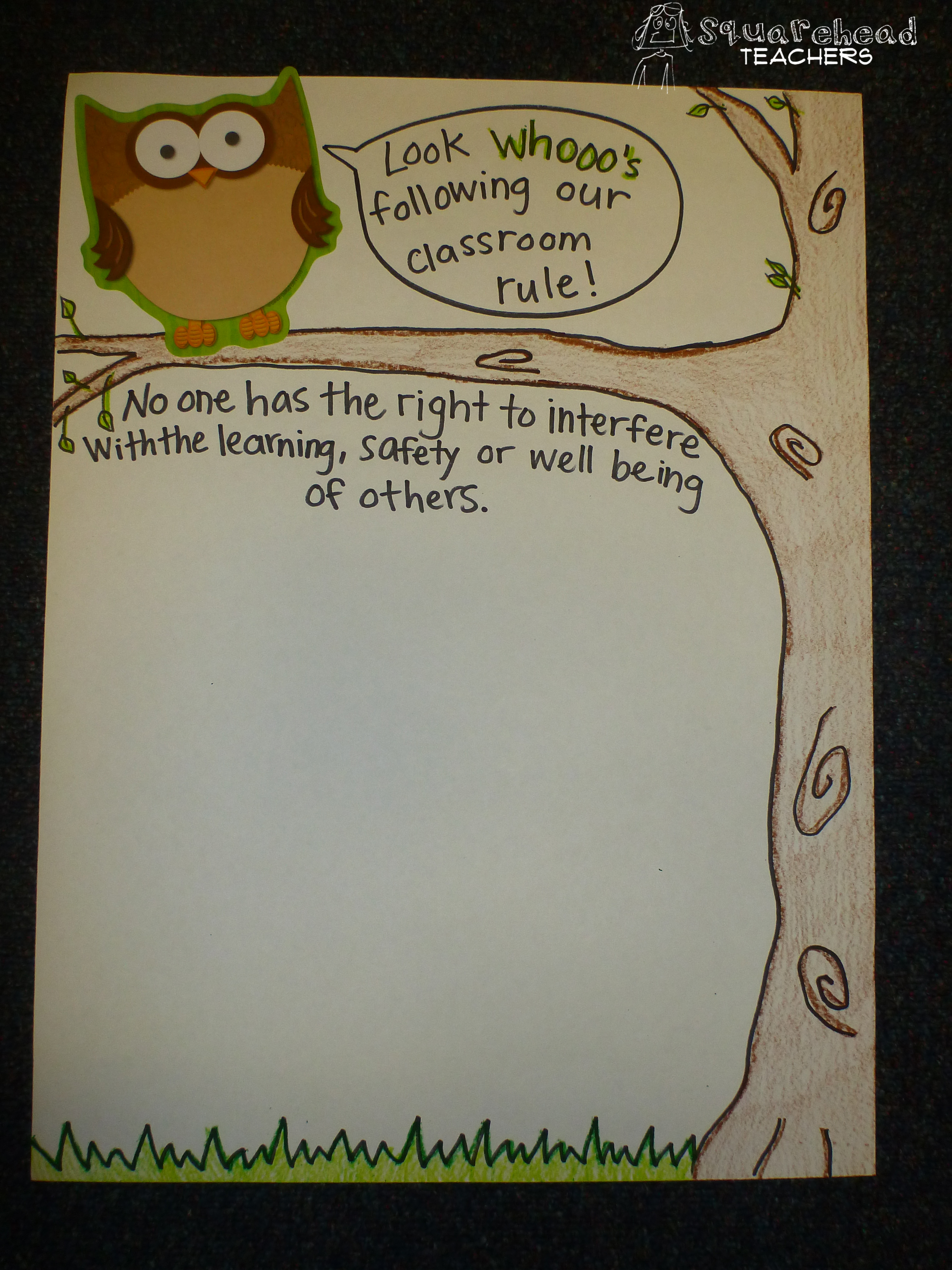
Owls are pretty trendy these days. So when I saw a cute owl-shaped note pad at the dollar store, I just had to buy it (with plans to work it into my classroom somehow). Here’s the poster I came up with (pretty proud of my DIY project!):

owl poster

Our classroom rule is “no one has the right to interfere with the learning, safety or well being of others.” Each student will sign the poster and we’ll put it up on the wall so everyone will remember our classroom behavior expectations.

Rational Numbers

This quick video is a good review of what rational numbers are. Enjoy!

Wrinkled Hearts: Bully Prevention Lesson

Citizenship is crucial to the success of our society. But it’s not part of any standardized test, so sometimes it’s easy to skip over it. I absolutely loved this lesson plan by Character Education Partnership. This lesson, called “Wrinkle on my Heart,” teaches about empathy, taking responsibility for mistakes when they happen and learning from them, and thinking before you speak/act. It’s very simple, but effective, especially when the teacher posts the wrinkled heart somewhere in the classroom as a reminder. Check it out:

Wrinkle on My Heart

Salt Brook Elementary School

Overview

Engage students in a discussion of the power of their words.

Lesson Objectives

Students will learn about empathy.
Students will learn to take responsibility for their mistakes when they happen and to learn from them.
Students will learn to think before they speak and act.

Materials Needed

Red construction paper heart
Black marker

Procedures

Sit with the children and tell them the red construction paper heart represents the heart of a 5th grader (or another grade level). Ask, “How does it look?” Tell them to notice that it is a nice, big, red, happy heart. Say,” When you’re in 5th grade, many things happen each day – some good, some not-so-good. These not-so-good things can really hurt our heart.” Ask the students what someone could say or do to hurt their hearts. As a child gives an example of what could hurt a heart, put one fold in the heart.

Hurtful answers may include: Tease them, call them names, hit them, gossip about them behind their back, ditch them, tell secrets about them

Continue until you have folded the heart up. Then ask the children, “What have our hurtful words and actions done to our classmate’s heart?” Answers typically include destroyed it and broken it. Ask how students think this person feels. Discuss.

Ask students, “Is there anything we can say or do to fix this heart?” As children give an answer unfold one crease in the heart.

Helpful answers may include: Apologize, say something nice, give a compliment, invite them over to play or eat lunch with you, listen to them, talk to them, be a friend to them.

After the heart has unfolded, ask the children, “How did we do? Did we fix this heart?” Usually you’ll hear a yes and then “Well, no, because it’s still kind of wrinkled.” Allow them to discuss this.
Ask how this person feels now. Lead their discussion to the idea that although we have repaired the heart, the scars are still there. Even when we say we’re sorry, people still remember the hurtful things we did. Ask, “Is it ok for people to do this?” Discuss with them that we all make mistakes and sometimes say or do something hurtful that we didn’t mean. Ask, “What can we do to try to prevent saying or doing something hurtful to someone else?” Lead the discussion to the idea that we can think before we speak.

Write on the heart: No one has the right to put a wrinkle on someone else’s heart. Hang the heart in the classroom, therapy room, or send home as a visual reminder to children.

Teachers can review the lesson with students as needed by prompting them to look at the heart displayed in the classroom.

Assessment

Teachers can assess the activity through application of character education principles.

Credit

Erika Ledder, School Counselor, Salt Brook Elementary School
– – – – – – – – – – – – – – – – – – – – – – – – – – – – – – – – – – –
Here are some ideas to help keep this lesson alive in your classroom:
Still looking for more ideas like this? Here’s another idea.

Adjectives Activity Collection

adjectives activityI love adjectives. They’re one of my favorite parts of language arts to teach. But you can’t spend forever on them (or on anything these days), so you’ve got to find an effective activity to teach adjectives without taking too much precious time (to prepare or do in class). Here’s one idea:

As a class, choose something to describe (cats are a good place to start). Discuss what cats look, smell, sound, taste and feel like. (Your kids will get a kick out of “what do cats taste like?”) Then choose a second thing to describe (we chose a hamburger). After discussing how adjectives describe something in a variety of ways, it’s time to let your students try one on their own.

This packet (Adjectives activity PDF) has a picture of something for kids to describe. Let them color in the picture so they can use color words in their description. Then students write down as many adjectives (look, taste, smell, sound, and feel) as they can about the picture. Then they use the blank lines to write sentences about the picture using the adjectives they brainstormed. I have my students circle the adjectives in the sentence. Sometimes I let a few students put their picture under the document camera and read one of their sentences to the class. There are multiple pages in the packet, so once you’ve done this activity as a whole group, you can use the rest as seat work activities to reinforce the concept.

Keep browsing my blog for more fun free worksheets and activities for elementary school kids! Thanks for stopping by!