Student Forms to Give to Parents at Parent-Teacher Conferences

Parent Teacher Conferences -student forms- sticker

It’s always nice to have the student contribute to parent teacher conferences, and have them review their progress and behavior before you sit down with their parents. So I present to you two versions of my “How I Feel About School” student form. Click here for the free printable PDFs:

Parent -Teacher Conference form – lower grades (revised)

Parent Teacher Conferences- student form (upper grades)

Click here to read 25 tips to surviving parent teacher conferences!

25 Parent-Teacher Conference Tips for New Teachers

Parent Teacher Conferences TIPS- stickerParent teacher conferences (PTC) can be intimidating for new teachers. Here are 25 tips to help you survive PTC (and get the most out of it!):

Before PTC:

  • In the weeks prior to PTC Collect samples of student work, record impressions of student progress and behavior.
  • Plan how students will be involved in the conference. If students are presenting work or progress, give them a chance to look over materials and prepare.
  • Contact parents (note, email, etc.) telling them you’re looking forward to meeting them to discuss their child’s progress.
  • Come up with a system for parents to easily schedule a time to see you. (Some schools run their PTC differently, so check with your principal if you’re unsure.)
  • A day before PTC, remind parents about the conference!
  • For parents who are unable to physically attend, arrange for a make-up conference. For tech-savvy parents, consider scheduling a virtual face-to-face meeting using Skype or FaceTime.
  • Brainstorm questions parents might ask and plan your answers. Think about ways parents support their child’s learning outside the classroom. Create a list of educational resources (websites and apps, special programs, books, etc.), then highlight specific ones that are a good fit for each student.
  • If there’s a specific conference you’d like another staff member (your principal, special education teacher, school psychologist, translator, etc.) to be a part of, let them know ahead of time.
  • Look ahead in your schedule for times when you can meet/talk with parents who need additional time with you. Be prepared to suggest these times if a conference goes over time.
  • Bring a notebook or something to write down a post-PTC to-do list (things you’ll need to check on, things to implement with specific students, etc.)
  • Pack snacks for conference days! Bring plenty of water and a non-messy snack to help give you energy. PTC can go fast, but you’ve got a whole class to do, so be prepared!

During PTC:

  • Start and end on time. It shows respect for everyone and will help make sure you’re not there until crazy late.
  • Share a quick agenda at the start of each conference so parents know what you will cover and what the general timing of the conference.
  • Listen to parents! They usually know their kid really well and may have some valuable insight for you!
  • Ask parents how they feel the school year is going and how they feel their child is doing.
  • Be positive. Share several specific examples of the child’s strengths, successful performance on projects and behavior.
  • Share true concerns. Choose one or two opportunities for improvement ties to age appropriate skills and standards. Seek feedback from the parent (and student, if present) to form a plan.
  • Don’t be afraid to ask questions! “Is there anything you think I should know that would help me serve your child better?”
  • Without being nosy, ask parents to keep you informed about home/family situations can affect their child’s learning and school work (e.g. family illness, divorce, job loss).
  • Invite parents to participate! Parents are a great resource with a wide range of experiences and skills. When parents participate in their child’s education, it shows their children that they value education (which helps lead to student success).  Plan ways for parents to participate both at school and from home.
  • Keep a count-down timer handy with a gentle alert 5 or 3 minutes prior to the conference end time.
  • Suggest a time to continue the conference if you start to go over time. Politely assure parents that you are very interested in discussing the issue further, but that you need to meet with the next family.
  • Thank parents for attending and be genuine about it. Without their support, students in their class would have a really tough time succeeding!
    Give parents a small sheet with your contact information on it (and any other important resources, like school website, class blog, etc.). This will ensure continued communication.

After PTC:

  • Follow through on any action items you discussed with parents (check your to-do list). Let them know the outcome.
  • Tell your principal or administrator any concerns you have regarding the conference.
  • (Bonus tip: BREATHE! and congratulate yourself and your fellow teachers for surviving! Take yourself out to dinner or take a warm bubble bath. You deserve it!)

For administrator looking to give their faculty some tips and ideas, here’s a great 8 page printable packet from the Harvard Family Research Project or a 3 page printable packet from Washoe County School District (NV).

Rectangle Riddles (Multiplication & Array Practice)

Rectangle Riddles sticker

Here’s a fun, simple activity for kids learning multiplication facts or learning simple arrays. Use color tiles (or little square pieces of construction paper) to make the rectangles described in the riddle. Then draw your answer on the page (and write the multiplication fact is represents). Enjoy!

I made 2 versions using the same riddles. One is a half sheet with 2 questions on it (since sometimes kids get overwhelmed with a full sheet). Click here for the free worksheet PDFs: Rectangle Riddles- half sheets            Rectangle Riddles- set of 4 pages

Fly Swatter Game (Sight Words/Spelling Words)

Fly Swatter game sticker

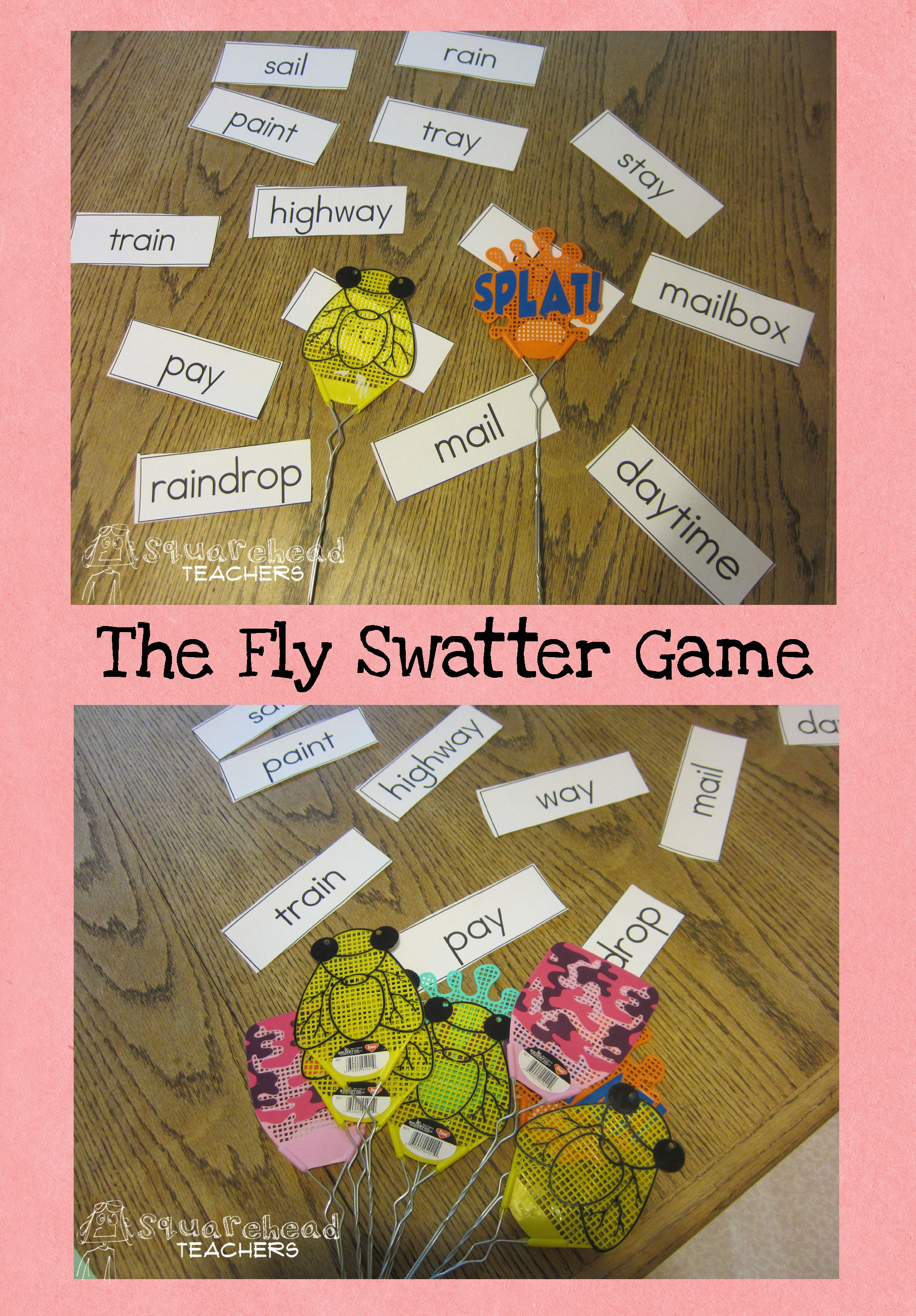
This is one of my favorite games.  This works for reading, math or anything you can write on a card with an answer (great for spelling words, sight words, letter sounds, math facts, states/capitals, etc).

The pictures are of our spelling words for the week.  Kids get in groups of three or four.  One student does not have a fly swatter, while the others each have one.  The student without a fly swatter is the reader.  Spread the words (or math fact cards, or whatever) on the ground.  The reader  reads any word.  The other kids try to be the first to swat the word.  Whoever swats the word first keeps the word.  After the words are gone, the fly swatters get passed to the left.  If you don’t have the fly swatter, you become the reader.  Be sure to set up rules before the game that if someone intentionally swats another student with the fly swatter they sit out a round, or whatever your class rule would be.  For a whole class experience put the words on the board and give each team one fly swatter. Kids love this game!

My friend over at Cultivating Questioners had this to say about the fly swatter game: “I divide my whiteboard into two sections and write words or numbers on the board randomly. I then divide the students into two teams. I have one person from each team step forward with the fly swatter in hand. I then call out a problem or word and the students run to the front of the room and slap the correct answer in their team’s section. They love it!”

Halloween Pumpkin Graphing Worksheet

Halloween Jack-o-lantern Graphing sticker

My previous graphing worksheet was so well received, that I decided to make another one! This one deals with the weight of pumpkins, presented in a bar graph. It’s got questions that require addition and subtraction, and have students identify the largest and smallest data entries. Here’s the free printable PDF:  Halloween Jack-o-lantern Graphing

Click here for more fun FREE Halloween stuff!

Halloween Patterns Worksheet (free!)

Halloween Patterns- to draw sticker

I’m a bit OCD. That means I love patterns, and things being organized. Maybe that’s why I like making pattern worksheets. Here’s a fun draw-in-the-missing-piece Halloween pattern worksheet for kids. Click here to see the free printable PDF: Halloween Patterns- to draw (with answer key).

Like what you see? Click here for more fun and FREE Halloween activities for kids!

Guest Post: Exam Time – What it Lets Teachers and Students Do

During the exams, the teachers help the students prepare for their exams. Here are some of the ways the teacher may assist the students in preparation of the exam:

  • Incorporation of videos in the class. It is said that students retain 10% of what they read, 20% of what they hear 20% of what they see. That means when using the videos the students will be able to retain 50% and this will go a long way in helping them in memory during exams.
  • Incorporation of computer or video games into the class. It is believed that people are able to retain 80% of what they experience. The games help the students develop skills such as teamwork, problem solving, calculations, and negotiations and even increase their motivation. Biologically it has been proven that it helps in creation of attention which becomes very helpful when preparing for an exam.
  • The teachers design study to make it simple for the students by using Technology. Instead of a teacher giving students the whole chapter for assignments, the teacher may decide to take a different route and break down the assignments into small bits that will be easy for the students to understand and also would encourage the students to read at any time they could read when traveling or in bed just before they retire this makes studies become easier and helps students pass their exams.
  • The teachers may decide to flip their classroom and make it more interactive by this the teachers may share videos at home. This helps strengthen the teacher-student relationship as a result creates a conducive atmosphere for learning in class. It also helps the teacher and students to interact one on one enabling the teacher to know the students weakness and help them. The students master their courses at their own time and are free to ask the teachers questions that may assist them during their exam.

Some of the problems a teacher may face when preparing the students for the exams may include:

  • It gets to be so stressful for students and this affects the teachers.
  • The preparation classes can become very boring.
  • Sometimes the time is not enough for preparation of the exam.
  • Teachers may also find it hard to get the materials for preparation of the exam.

Yet in many ways the preparation class can be seen as a positive thing;

  • At that time the students are all working towards the same goal.
  • The students are motivated to pass their exams.
  • It also justifies that what teachers teach in class is useful.
  • Both the teachers and students are challenged alike.
  • The results of the exams also encourages both the students and the teachers and helps them know they are doing well.

About the Author: Joana Armie is a blogger from London, UK. She has interest in reading and writing articles. As of now she is busy doing a research work on UK passport, which explains about procedure for applying for a passport.

Halloween Graphing Practice

Halloween Graphing sticker

A free printable Halloween bar graph practice page (worksheet) for you! After all, kids always need practice reading and analyzing graphs. Click here for the PDF: Halloween GraphingHappy Halloween!