ABC Fitness Activities for Kids

ABCs fitness activities stickerKids need physical fitness incorporated into their everyday activities. I recently saw an idea to come up with a physical activity for each letter of the alphabet. For older kids, it might be fun to have them help you come up with ideas. Then when you need a quick break or an activity idea, look to your list and start checking them off. Soon you’ll have completed 26 + different physical activities! Here are some ideas to get you started:

Alphabet Exercises

– Act like a cat

– Bend at the knees, bike ride, balance beam (or walk on a curb)

– Chair pose, crab walk

– Dance, duck walk

– Elephant steps

F – Fly like a bird

– Gallop

H – Hugs, hop on one foot

– Itsy bitsy steps

J – Jump, jump squats

K – Kick

L – Leg lifts, leap frog

M – March

N – Noisy steps

O – Open and shut arms

P – Pop up, push ups

Q -Quiet hops, quick steps

R – Run, race, relay race

S -Side steps, shoot hoops, shuttle run

T – Turns, throw a ball

U – Under momma’s legs

V – Vacuum, V sits

W – Wiggles, wall sits

X – “X” jumping jacks

Y – Yoga (downward dog)

Z – Zig zag steps


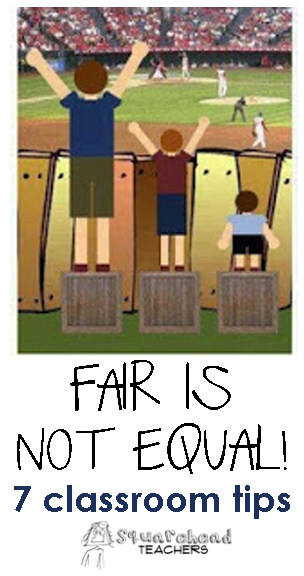
Fair Isn’t Equal (7 Classroom Tips)

Fair is not equalHere are some excerpts from an article by Dr. Richard Curwin of David Yellin College describes how “fair” in a classroom doesn’t mean equal. He gives seven valuable tips for teachers. Click here for the original article.

There are two skills that separate great teachers from good ones. I explained that the first skill is the ability to reframe student behavior, to see it in new ways. Today I want to discuss the second skill: knowing how to treat students fairly by not treating them the same.

If you ask students what are the most important qualities they like in teachers, one of the universally top-mentioned is fairness. Teachers and schools strive to be fair and build programs and polices based on this value.

But what is fair? Many define it as treating everyone the same, but I would argue that doing so is the most unfair way to treat students. Students are not the same. They have different motivations for their choices, different needs, different causes for misbehavior and different goals.

Here’s how to put this concept into practice (*Read the original article for more detail on applying these ideas):

1. Everyone has the same rules.

2. Consequences are flexible.

3. Equal isn’t always fair.

4. Teach the concept of fair vs. equal to your class before implementing it.

5. Follow the basic tenets of great discipline.

6. Be willing to discuss your strategy with students.

7. Be willing to discuss your strategy with parents.

Being truly fair is harder and requires more work in the short run that just treating everyone the same. In the long run, it saves time and is more effective. And when it comes to treating everyone the same, every child deserves a lot better than that.

Tape and Canvas Art Project for Kids

I LOVE this tape and canvas art project for kids. And it turns out SO COOL! Click here for the tutorial.

5 Quick (Yet Essential) Classroom Management Tips

5 essential classroom mgmt tipsThis is a great list of tips for new teachers. It’s written by Rebecca Alber and it’s very helpful for those seeking to improve their classroom management. Click here to see the original article.

I made a good number of blunders my first year teaching that still make me cringe. I learned though. And it’s fair to say, when it comes to managing a classroom, most of what we learn as new teachers is trial by fire. It’s also smart to heed the advice of those who have walked — and stumbled — before you. If you are struggling with discipline, here are five tips that you can start using right away:

#1) Use a normal, natural voice

Are you teaching in your normal voice? Every teacher can remember this from the first year in the classroom: spending those first months talking at an above-normal range until one day, you lose your voice.

Raising our voice to get students’ attention is not the best approach, and the stress it causes and the vibe it puts in the room just isn’t worth it. The students will mirror your voice level, so avoid using that semi-shouting voice. If we want kids to talk at a normal, pleasant volume, we must do the same.

You want to also differentiate your tone. If you are asking students to put away their notebooks and get into their groups, be sure to use a declarative, matter-of-fact tone. If you are asking a question about a character in a short story, or about contributions made by the Roman Empire, use an inviting, conversational tone.

#2) Speak only when students are quiet and ready

This golden nugget was given to me by a 20-year veteran my first year. She told me that I should just wait. And wait, and then wait some more until all students were quiet.

So I tried it; I fought the temptation to talk. Sometimes I’d wait much longer than I thought I could hold out for. Slowly but surely, the students would cue each other: “sshh, she’s trying to tell us something,” “come on, stop talking,” and “hey guys, be quiet.” (They did all the work for me!)

My patience paid off. Yours will too. And you’ll get to keep your voice.

#3) Use hand signals and other non-verbal communication

Holding one hand in the air, and making eye contact with students is a great way to quiet the class and get their attention on you. It takes awhile for students to get used to this as a routine, but it works wonderfully. Have them raise their hand along with you until all are up. Then lower yours and talk.

Flicking the lights off and on once to get the attention is an oldie but goodie. It could also be something you do routinely to let them know they have 3 minutes to finish an assignment or clean up, etc.

With younger students, try clapping your hands three times and teaching the children to quickly clap back twice. This is a fun and active way to get their attention and all eyes on you.

#4) Address behavior issues quickly and wisely

Be sure to address an issue between you and a student or between two students as quickly as possible. Bad feelings — on your part or the students — can so quickly grow from molehills into mountains.

Now, for handling those conflicts wisely, you and the student should step away from the other students, just in the doorway of the classroom perhaps. Wait until after instruction if possible, avoiding interruption of the lesson. Ask naive questions such as, “How might I help you?” Don’t accuse the child of anything. Act as if you do care, even if you have the opposite feeling at that moment. The student will usually become disarmed because she might be expecting you to be angry and confrontational.

And, if you must address bad behavior during your instruction, always take a positive approach. Say, “It looks like you have a question” rather than, “Why are you off task and talking?”

When students have conflicts with each other, arrange for the students to meet with you at lunch, after or before school. Use neutral language as you act as a mediator, helping them resolve the problem peacefully, or at least reach an agreeable truce.

#5) Always have a well-designed, engaging lesson

This tip is most important of all. Perhaps you’ve heard the saying, if you don’t have a plan for them, they’ll have one for you. Always over plan. It’s better to run out of time than to run short on a lesson.

From my own first-hand experience and after many classrooms observations, something that I know for sure: Bored students equal trouble! If the lesson is poorly planned, there is often way too much talking and telling from the teacher and not enough hands-on learning and discovery by the students. We all know engaging lessons take both serious mind and time to plan. And they are certainly worth it — for many reasons.


Funny Stuff Kids Say & Do

I’m going to start collecting funny things kids say and do at school. If you have a funny experience, let me know and I’ll post it here! Thanks!

This past week, and next week, we have to do lots of testing, so we do lots of busy work.  We have been doing science (the seasons) and social studies (patriotic symbols).  One of my kids came to me and said, “Mrs. W., when are we going to do some real science?”  I asked her what she meant.  She said, “You know, dissecting frogs.”  I told her that is a middle school or high school thing.  She then told me that her sister had done it in second grade!  I think she is misinformed!  Can you imagine – dissecting a frog in second grade?! – Diane, 2nd grade teacher

On my first day of teaching, I ate lunch with my students. One of my students asked me if I had ever tried his mother’s sloppy joes! –  Cultivating Questioners, 2nd grade teacher

So I used to sweat…a lot…during my first year of teaching. I guess it was a combination of nerves and a warm classroom. One day, a student raised his hand after seeing my large sweat rings on my shirt and says, “Mrs. Shook, yo underpits is wet!” I just about died laughing at that one!  – Kayla, 4th grade teacher

I was in an elementary school nurse’s office today. I tiny little girl (must have been a kindergartner) standing against the wall accidentally scooted under the automatic hand sanitizer dispenser… yup. The machine squirted foam on her head! I was trying SO hard not to crack up laughing!!! -Mindy, Squarehead Teachers

Fiction vs. Nonfiction Anchor Chart

This language arts anchor chart seems so easy, yet so effective in displaying the differences between fiction and nonfiction. The teacher even included a picture of fiction vs. nonfiction to help younger learners the two. It could be a good assignment to have each student create a personal anchor chart like this, especially using pictures from old magazines, etc.

P1050903

Metrics Chart

This gives a couple basic measurement questions for kids ( involving length and perimeter) and a chart of the Metric System. It would be a good whole class activity to create a chart like this (in math journals, on an anchor chart, etc.).

Click on picture to enlarge.

Teaching Roman Numerals

P1030589

Roman numerals are hard for most Americans… mostly because we don’t use them very often. So here’s one way to help get your kids used to Roman numerals, and hopefully teach them a few: Refer to your tables using Roman numerals! If you were really excited about it, you could have each student learn their number in Roman numerals and have them write it as part of their heading on papers. In case you forgot Roman numerals yourself, here’s a nice chart to help you keep Roman numerals straight.