Bio Poetry For Kids

Bio Poems can be written by students to describe the lives of real people as creative writing exercise, or fictional characters to demonstrate reading comprehension. Bio Poems could even be written about inanimate objects. There are a variety of formulas for writing a bio poem. Here are 2 of the most common formulas:


Your name

Child of…

Who loves…

Who hates…

Who wants to go to…

Who wishes he/she could’ve met…

Who is scared of…

Who dreams of…

Who is determined to…

Who values…

Who is proud of…

Who graduated from…

Who lives…

Your name again

Source

  P1030367

First name

Three or four adjectives that describe the person

Important relationship (daughter of . . . , mother of . . . , etc)

Two or three things, people, or ideas that the person loved

Three feelings the person experienced

Three fears the person experienced

Accomplishments (who composed . . . , who discovered . . . , etc.)

Two or three things the person wanted to see happen or wanted to experience

His or her residence

Last name

Source

P1030368

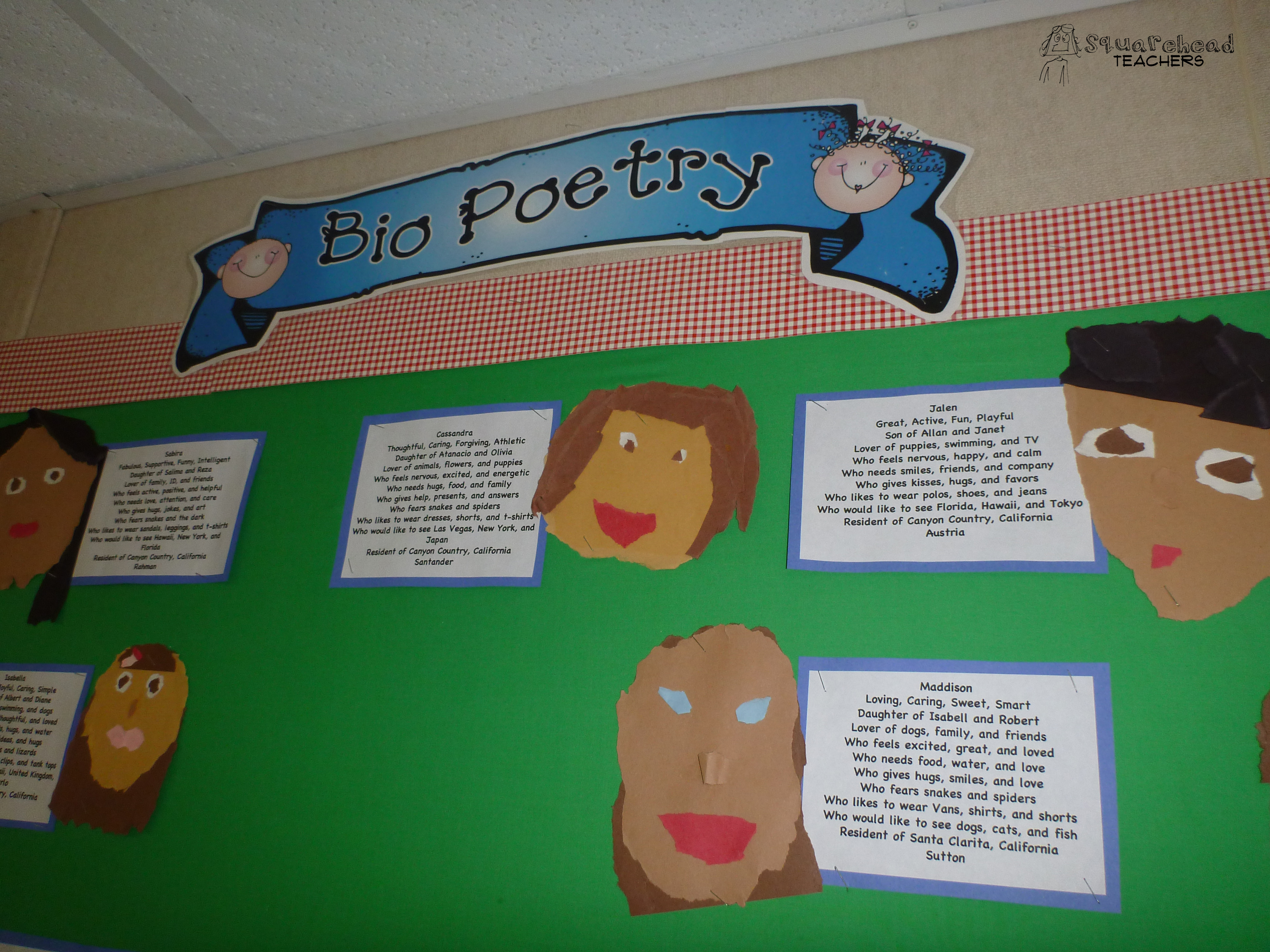
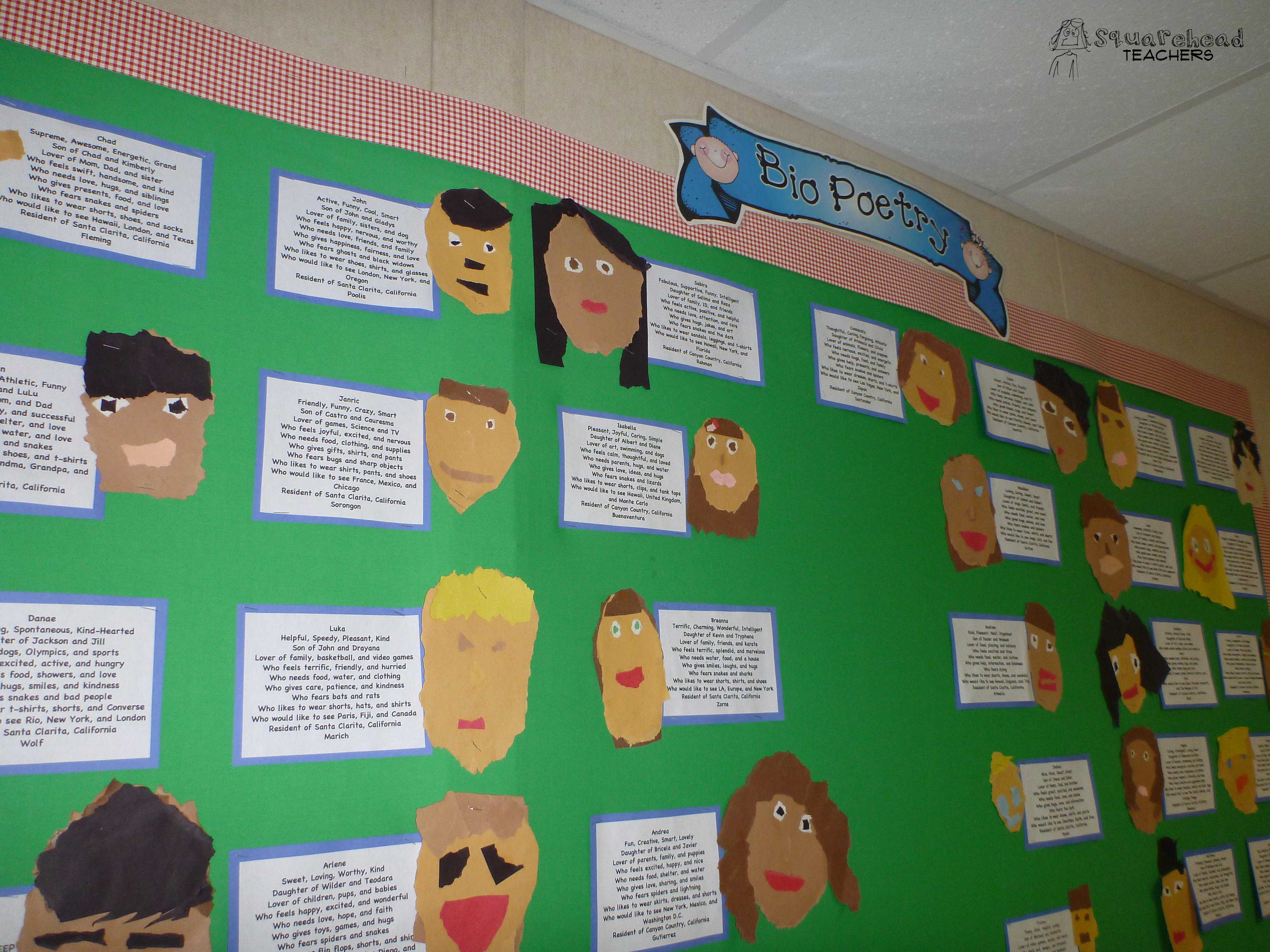
It’s always fun to share or display the bio poems. One teacher had her students tear pieces of construction paper to create artwork of their face to put up next to the student’s bio poem. You could easily adapt this project to describe historical figures, events, etc. by changing the formula.

Math Key Word Group Project

I recently posted my addition and subtraction key words posters. Then I saw this in one upper grade teacher’s room and had an idea for a group project to review these concepts at the beginning of the year.

P1030365

Pass out a large sheet of paper to groups of 2-4 students. Then have them create a poster that shows what key words are associated with each of the 4 basic math operations: addition, subtraction, multiplication and division. Then post them on the wall as a reminder throughout the year. If you don’t have enough space to display them all, designate one spot for a poster and rotate through them throughout the year. When you switch posters to display a new group’s poster, have the group members review the key words with the whole class.

Kindergarten Sight Words List (Updated)

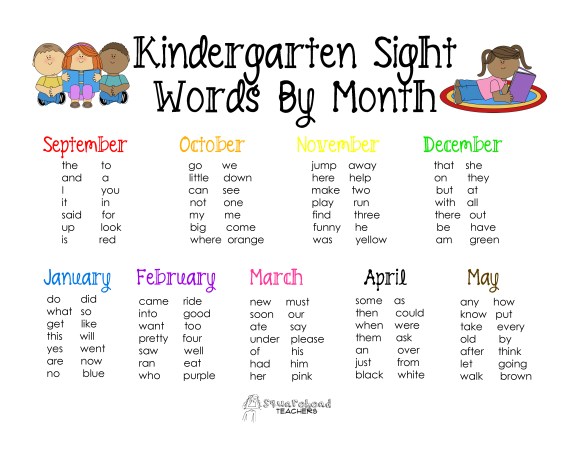
Here’s my list of kindergarten sight words. They’re organized by month of the school year, and each month includes a color word to focus on. This would also be a great list of words to start working on with your preschooler if you’re looking to get a jump on literacy!

Click here for the free printable PDF: Kinder Sight Words by Month

kindergarten sight words by month

Like what you see? Tell your friends about this blog and check out my TPT store!

Visit my store button

Online Dance Resources

Dance resources stickerTeaching elementary school kids a dance lesson can be painful. It can be super fun, but it can also be painful. Here are some online resources to help make your dance lesson a little more fun:

Creative dance lesson plans from Go Bookee  

More ideas about elementary school dance.

The Sprinkler Surprise (grammar worksheet)

Here’s a free grammar worksheet that’s aligned with the Common Core (for example, grades 3 and up work on punctuation, correct verb usage and spelling). Enjoy!

Sprinkler surprise grammar worksheet

Number of the Day (worksheet collection)

As far as educational worksheets go, I’m really picky with what I’ll spend money on. I searched and searched for a number of the day packet I liked, but I couldn’t find any that I was completely jazzed about (or was willing to pay the listed price). So I made my own. They’re aligned with the Common Core (for example, 2nd grade works on “100 more than” and “100 less than”) and best of all, they’re FREE!

Click here for the collection: number of the day collection

4th worksheet in the collection

4th worksheet in the collection

* Be sure you know what’s on each worksheet before choosing a number for the day. Some worksheets ask for “100 less than” and it would confuse younger grades if the number of the day was 17.

* The PDF presents the pages in order of difficulty, starting with the easiest. I didn’t number them, because I was afraid a student would think the worksheet number was the number of the day. I suggest printing them all off and labeling them with a sticky tab so you know what order they go in.

*Number 6 and 7 aren’t all that different. The only difference is one question clearly asks for multiplication, where as the previous 5 worksheets allow the option for repeated addition (double or triple the number).

I’ve also seen teachers do a number of the day on the whiteboard to help reinforce it even more:

P1030597

It’s Not Just “Red”… It’s “Vermilion!” (Synonyms Group Activity)

synonyms- redTeaching kids to use “good words” in their writing is hard. It’s not always easy to find a good synonym for “red” but this activity should help broaden their diction horizons. Divide your class into 10 groups. Pass out one color synonym sheet and a thesaurus to each group. Instruct each group to find as many synonyms for their color as possible. Then have them draw a border around their sheet using the color they searched. Post these somewhere in the room for a few days so students can browse the synonyms.

Click here for the PDF: synonyms- color collection

This same idea can be done with common nouns and adjectives such as “big,” “said,” “like,” “fast,” etc. Here are some photos of this idea being used in a classroom…

P1030364 P1030363 P1030362 P1030361 P1030360 P1030359 P1030358

Top 10 Things New Teachers Should Know

top 10 things every new teacher should know stickerNew teachers are often overwhelmed at the insane amount of things to balance and teach effectively. Here’s an article by Catherine Wilcoxson, Ph.D. of Northern Arizona University that helps new teachers stay focused on the important things.

Here are the main ideas:

  1. Don’t worry so much about doing the right thing.
  2. Relax.
  3. Teaching is hard work.
  4. Standards cannot be ignored and should not be feared.
  5. Write objectives that focus on student learning, not on today’s task.
  6. Smile, and do so frequently
  7. Respect your students.
  8. Believe in your students even if they don’t believe in themselves.
  9. Don’t isolate yourself.
  10. It is not appropriate to teach the way we were taught

The whole article is a good read. It’ll take you 10 minutes or less to read, but it’s worth the time. Dr. Wilcoxson’s conclusion is that, “Effective teachers are constantly learning from their successes and failures. To be effective, teachers must look back on their practices and assess what works well, what doesn’t, and how they might improve as teachers. Keeping a journal is an excellent means of keeping track of your performance, and it can provide valuable information for your own professional development.”