10 Tips for Keepin’ up on Math Skills over Winter or Summer Break

Encouraging Math STICKERHere’s a fun list of ideas to encourage math during the Christmas or Summer Break:

  • Challenge others or challenge yourself. Online math strategy games at Calculation Nation provide a safe environment for elementary and middle school students to challenge themselves and challenge others. Games involve fractions, factoring, symmetry and comparing perimeter and area! Give your kids graph paper and tell them to create a dream house up to X square feet. To be extra challenging, limit the square footage of a single room.
  • Play strategy games with friends and family. A great way to spend quality time. Games such as Contig, and other free board games. Play as teams while learning so you can talk about strategy and then move playing individually. Try something like Scrabble, but skip the calculator when totaling each player’s score.
  • Talk to your children’s teachers before the break. Ask questions that show you are concerned about their development and maintenance of mathematics skills and fluency. For example, ask, “What do you see as my child’s strengths and weaknesses in math? What could we do while at home to develop or improve his/her weakest areas?” There are probably fun class activities or games that you could replicate a home.
  • Read books that contain mathematics content with your children. There are books at every grade level that can engage students in thinking about math! Some suggestions include Ten Apples Up On Top! (elementary) or The Great Number Rumble: A Story of Math in Surprising Places (middle grades). Want classroom activities to support math and literature? Check out Exploring Mathematics through Literature: Articles and Lessons for Prekindergarten through Grade 8. Head to your local public library and challenge your kids to find 3 or 4 books with math concepts (and ask them to defend their choices).
  • Create a number book with your child. Use this template with your preschooler or kindergartner and have them decorate each page with pictures, stickers or stamps (or even glue beads or macaroni) that show the number on the page. For more advanced students, ask them to write expressions that equal the target number. For example, for the number 6, they could write 3X2, 10-4 and 2+2+1+1. Also consider having them write and illustrate a story that deals with math or numbers.
  • Do projects with your child. Bake cookies or work on a home improvement project. Real-world applications of mathematical ideas, especially measurement, are everywhere! If you are stringing up lights, work with them to estimate how many sets you will need and calculate the total number of lights used. If you are baking cookies, have them figure out what is needed to make a double batch. Asking your child what they’d like to cook or build; they’ll have more buy-in on the activity that way.
  • Exercise your body; MATHercise your mind! Take in a sporting event, even if it’s only on TV. Keep track of yards gained and lost from running versus passing plays of their favorite football team or the shooting percentage of their favorite basketball player. Work with them to make comparisons between two of their favorite players and display it graphically. Check out the lesson connecting rate of movement to football on Illuminations, appropriate for middle and high school students. If you’ve got kids playing on a sports team, consider having siblings keep the stats on their sibling or sibling’s team.
  • Have a problem of the day. Work through one new problem before or after dinner each night. Figure This! has an awesome assortment of interesting problems with hints and solutions, so you don’t have to be a math wizard to facilitate! Let older siblings write the problem of the day for younger siblings. Be sure to have them teach their younger siblings how to find the answer.
  • As a family, track your calorie intake or your finances. Are you consuming more food during the holiday season than you would otherwise? Are you spending money on gifts? Becoming aware is important in establishing control. You may also consider how much time each day you spend on each activity such as watching television, eating, sleeping. Ask your kids to predict how much time is spent on each activity. Make a graph. Ask neighbors or cousins to track their time on each activity as well. Then compare both family’s experiences. Finally, brainstorm how you can manage to fit in alternative activities to maintain a healthy lifestyle.
  • Seek out a volunteer opportunity that appeals to both you and your child. From cooking for a shelter, to collecting food for a food drive, to collecting coats for the needy, there are lots of opportunities to estimate and use math to project how much your efforts mean to others. Ask your child to look for math in the activity. Write about it in a journal or draw a picture.

(Many ideas in this article from are from NCTM) Share your ideas by commenting below!

Number Chat (Number Study)

Number Chat preview

You’ve probably seen those pages where the teacher chooses a number and the students do a bunch of stuff with it. That’s exactly what I made (FOR YOU FOR FREE!) over at We Are Teachers! Click here to check it out!

Pirate Treasure 1 (Counting Coins)

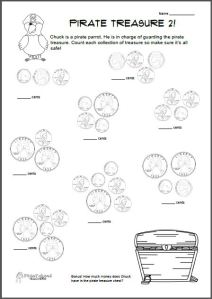
Pirates collect treasure… especially money. So naturally, they have to learn to count it! This free printable is a simple page where students count pirate treasure (coins). Super easy. I’ve even made you an answer key this time. 🙂

Pirate Treasure 1 STICKER

If my blog helps you out, help me out! Please check out my sponsors!

Click here for the free printable PDFs:  Pirate Treasure 1 and Pirate Treasure 1 – Answer Key

Looking for more freebies about money? Try out this Matching & Counting Money Puzzles printable!

Matching & Counting Money Puzzles

Money! So much fun to have, but so much work to teach little minds about! Check out my recent matching game for learning money. I’ve got two sets: one for matching the words to the coin and another for also adding up the coins to find the total amount. These would probably be most appropriate for second grade.

Money match Sticker

Click here to download the matching-only puzzle:  Money Match

Money match and count

Click here to download the money match and countingpuzzle: Money Match and Count

“May the 4th Be With You!” Activity

Calling all geeks! It’s May 4th, so you’ve probably already bid your friends farewell by saying “May the fourth be with you!” I probably should celebrate (or at least acknowledge) May 4th at school. I know this next idea is a little late…hindsight is 20/20. I’ll have to do this next year. (Ta-da! Now I’m prepped a year ahead!)

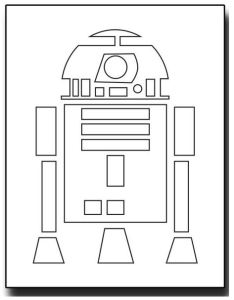
I just saw this free coloring page over at Homeschool Encouragement and thought of a math connection!
Star Wars - Homeschool Encouragement

Print one of these for each student. Then make up a key that might look something like this (choose your own colors if you want):

  • circles = red
  • trapezoids = green
  • rectangles = blue
  • squares = yellow
  • everything else = orange

This way, you’re practicing shapes while you celebrate May the Fourth! If you’re looking to be more interactive, consider having your students create the image above with tangrams.

Here are some other Star Wars themed coloring pages for you to be creative with!

But no matter what you do, may the fourth be with you! 🙂

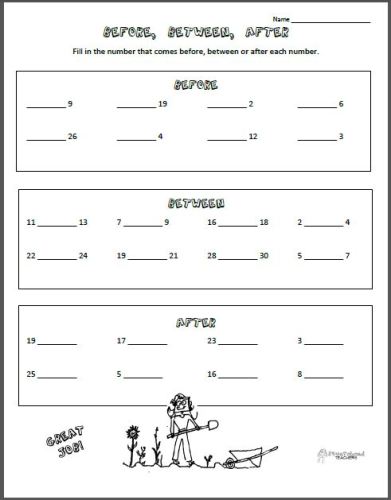
Before, Between, After – Numbers Worksheet

Counting and number sequences can be tough for kids, but knowing numbers backwards and forwards is what allows them to do more complex number tasks. I saw this idea of “before, between and after” and thought it was valuable. So, here’s my take on that concept. This would be great for kindergarten or first grade, depending on your students.
Before between after - numbers STICKER

Kids must write in the numbers so that the sequence is complete. Click here for the free printable PDF: Before Between After – Numbers

Shape Fractions (Introduction to Fractions)

Shape fractions STICKER

There are tons of ways to introduce fractions. But no matter how you do it, you need to help students understand that you’re looking at part of a whole. Here’s a page I’ve used with my class (focusing on the numerator). I do this type of activity before I ask kids to draw both parts (numerator and denominator). Hope you’re having a fabulous school year!

Click here for the free printable PDF: Shape Fractions

Pi Day Activities!

Be sure to check out my book giveaway happening this week (ends March 14, 2015)!

As Pi Day (3/14) approaches, you may be wondering, how can I celebrate this goofy holiday with as little preparation as possible. Well the answer is simple: borrow a genius idea from another teacher! Here are some ideas to get you started:

Zero Effort Ideas: Pi Day jokes. Just say ’em! (make sure they’re not above your students’ heads!)

Little Effort:

  • Make a pie (or buy moon pies) and serve them to your class! (check your school’s policy on bring in food)
  • Read Sir Cumference and the Dragon of Pi. (click here for printables to go along with the book)

Some More Effort:

  • Do art based on the numerals on Pi (source)
  • Find a fun printable (source)
  • Or do one of these Pi Day activities (source)

But whatever you do, have a happy Pi Day!