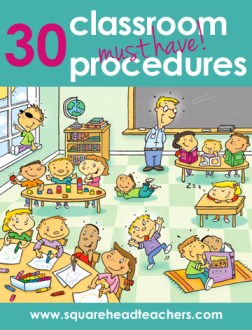
 The key to getting your classroom to run smoothly and minimize behavior issues is to establish procedures and routines. This takes significant work and practice in the beginning but is well worth the effort! The following procedures are key to a successful teaching experience:
Beginning the day — Enter the room politely; put away your backpack, lunch, and coat; turn in your homework; sit at your desk and read alone or do before-school work silently.
Classroom helpers; learning a classroom job — If you get a job on Monday, see the person who did the job last week during silent reading time, ask him or her for the job description card, and have him or her help you on the first day. For the rest of the week, it is your responsibility to remember to do your job.
Classroom library — When I am not teaching the whole group, you may check out a book. To do so, select a book (you only have three minutes at the class library) and sign out the book on the sign-out sheet. Take good care of the book; when you are finished, return the book to the basket and check it off the list.
End of the day — Clean off your desk; leave out your work notebook; pick up any trash within three feet of your desk; stack your chair; collect your mail; wait quietly to be dismissed.
Entering the classroom — Enter quietly and politely; remove your hat if you’re wearing one; don’t interrupt other students; follow the appropriate procedures for each time of day (e.g., morning, after lunch, after a special class).
Exiting the room — Tell me where you are going; take the correct hall pass; do not run or play in the hallways or restrooms.
Finding lost items — Ask the people around you if they found the item you lost; if not, check the Lost and Found box; if it is not there, ask me at a time when I’m not teaching the class; if you find it, thank the person who turned it in; next time, try to take care of your things. Consider going through the Lost and Found box at the end of each month with the whole class. If an item remains unclaimed, give it to the person who turned it in.
Fire drill — Stop everything; stand up and head for the door quickly, but without running or pushing; do not cover your ears; do not make any side trips; the classroom “fire chief” takes the fire drill packet and leads the line outside; the second person in line holds the classroom door for the rest of the class; the third person in line holds the outside door only for our class, then becomes the last person in line; wait patiently, calmly, and quietly in line outside until we are allowed to go back to what we were doing.
Getting help with assignments — Quietly ask the students at your table for help with directions if you need it; if you are working alone, raise your hand to get help from me; if you are working with a group, ask them for help in understanding how you do the assignment.
Getting into work groups — Take all the materials you will need; greet each other; complete the task doing your personal best; make sure each person signs the project; thank the others in your group.
Getting tissues — You may get a tissue from the closest of the four tissue boxes whenever you need one; you don’t even have to ask; throw the used tissue away immediately; make sure it lands in the trash can; get right back to work.
Guests in the classroom — When guests enter the room, let the designated classroom “host” or “hostess” greet them; when the host or hostess rings the chimes, get ready to listen to and look at the visitor — a smile is great!; when the host or hostess introduces the visitor, say, “Welcome to our class, __________”; remember, most guests are here to watch you learn, so be ready to explain what you are working on; treat guests respectfully.
Handling seatwork pages — As soon as you get a paper, print your first name and last initial at the top on the right-hand side and today’s date at the top on the left-hand side.
Helping other students — In a cooperative classroom, it is good to help one another; if someone needs help with directions or reading an assignment, help him or her if you are able; if someone needs help with understanding the problem, tell him or her to ask me for help; never put down another student who asks for help.
Lining up — Stand up quietly; push in your chair; take all necessary items; line up without touching others or talking; face the front of the line; watch where you are going.
Lunch count/attendance — “Hot lunch” means you are having school lunch; “cold lunch” means you brought a lunch from home; move your attendance tag/magnet/clothes pin to the “hot lunch” or “cold lunch” sign/spot; wait patiently for your turn.
Organizing your desk — Remove all loose papers; decide if they should go home or stay at school; put papers that should stay at school in the front pocket of your work notebook; put pencil or art supplies in your school box; put your folders and work notebook on the left side of your desk tray; everything else goes on the right side; pick up your trash.
Participating in group lessons — Do not bring anything with you unless I ask you to; politely find a place to sit where you can do your best learning; sit flat, not on your knees; listen carefully for new information; raise your hand to speak; do not speak when someone else is speaking.
Pledge — When you hear/see the signal, stop what you’re doing immediately and stand up; place your right hand over your heart; say the Pledge of Allegiance respectfully; during the 30 seconds of silence, quietly think about the things you want to learn today and how you will act in class and on the playground.
Preparing for lunch — Wait quietly at your desk; when your lunch number is called, get your lunch or lunch money and line up in order; take everything with you, as you will not be allowed to come back to the classroom after we leave for lunch; while you’re waiting in line, think about the way you need to behave in the lunchroom and on the playground; while you’re at lunch and at recess, find one person who is behaving responsibly and be prepared to tell the class what you noticed.
Signals for attention — When I need your attention, I will ring the chimes (or sound the rain stick, open the music box, etc.); as soon as you hear the signal, stop what you are doing, look at me, and listen for directions.
Taking out/putting away/caring for supplies — Share group supplies; recap markers and glue; check the number written on the supplies to make sure they belong in your group basket; if something belongs to another group, return it to them quietly.
Throwing away trash — You may throw away trash whenever you need to if I am not teaching the whole group; do not play basketball with your trash; make sure all trash lands in the can; pick up trash even if it isn’t yours.
Turning in finished work/homework — Make sure your name is on your paper; place your paper upside down in the “finished work” or “homework” basket.
Turning in lost items — Ask the people around you if they lost the item you found; if not, write your name and the date on a slip of paper and tape the item to it; if it is money or something valuable, put the item and slip on my desk for safekeeping; if not, put it in the Lost and Found box; give yourself a “pat on the back” for being honest.
Using the drinking fountain or sink — When I am not teaching the whole group, you may get a drink; take only a three-second drink; you may bring a water bottle to keep on your desk; if you need to wash your hands, use only a little soap; wipe up any water you spill.
Using the pencil sharpener — At the beginning of each assignment, the person I’ve chosen to be the “Pencil Sharpener” will invite you to have him or her sharpen your pencil; if your pencil breaks during an assignment, use a community pencil; only the “Pencil Sharpener” can run the sharpener and empty it.
Using the school bathroom — If I am not teaching the whole group, stand by the classroom door with your hand raised; if I say “no,” wait for a better class time to go; if I nod, leave the room quietly; do not play in the restroom; return to class before two minutes have passed (promptly).
What to do during free time — If you finish an assignment, first work on any unfinished assignments that are in the front pocket of your work notebook; when you finish those, you may choose to do your classroom job, read a book, write a story, illustrate a book, make up math problems, work on a research project, peer-tutor someone who needs your help, or create a song about what the class is studying.
What to do with unfinished work — If I ask for work to be turned in, let me know if it isn’t finished; if I ask you to keep an unfinished project, put it in your class work notebook.
SOURCE: The New Teacher’s Complete Sourcebook: Grades K–4 by Bonnie P. Murray
Here’s my biggest piece of advice about all of this: If something’s not working, change it. Keep changing it until it works. When I was a first year teacher, I thought I had to decide on everything and get it set in stone before school started. I thought that changing things up mid-year meant that I had been wrong or weak or didn’t know what I was doing. WRONG! Even if you don’t know what you’re doing at the start, the important thing is to find what works for you and your class for that year. Everyone’s different and there’s no use sticking with a procedure, system, or routine that doesn’t work. Try your own version of each of these procedures and tweak it until you find something golden!
Like what you see? Help support this blog of completely free stuff for teachers by sharing it with your friends! Thanks!



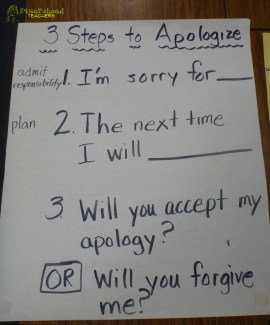 I don’t know about you, but I think there’s more to an apology than a sneering “sorry!” I tell ya, kids these days don’t know how to apologize… and it drives me nuts! Here’s a poster I recently saw in a lower grade classroom that I thought NAILED the issue. Although it’s not the most glamorous, it serves the purpose.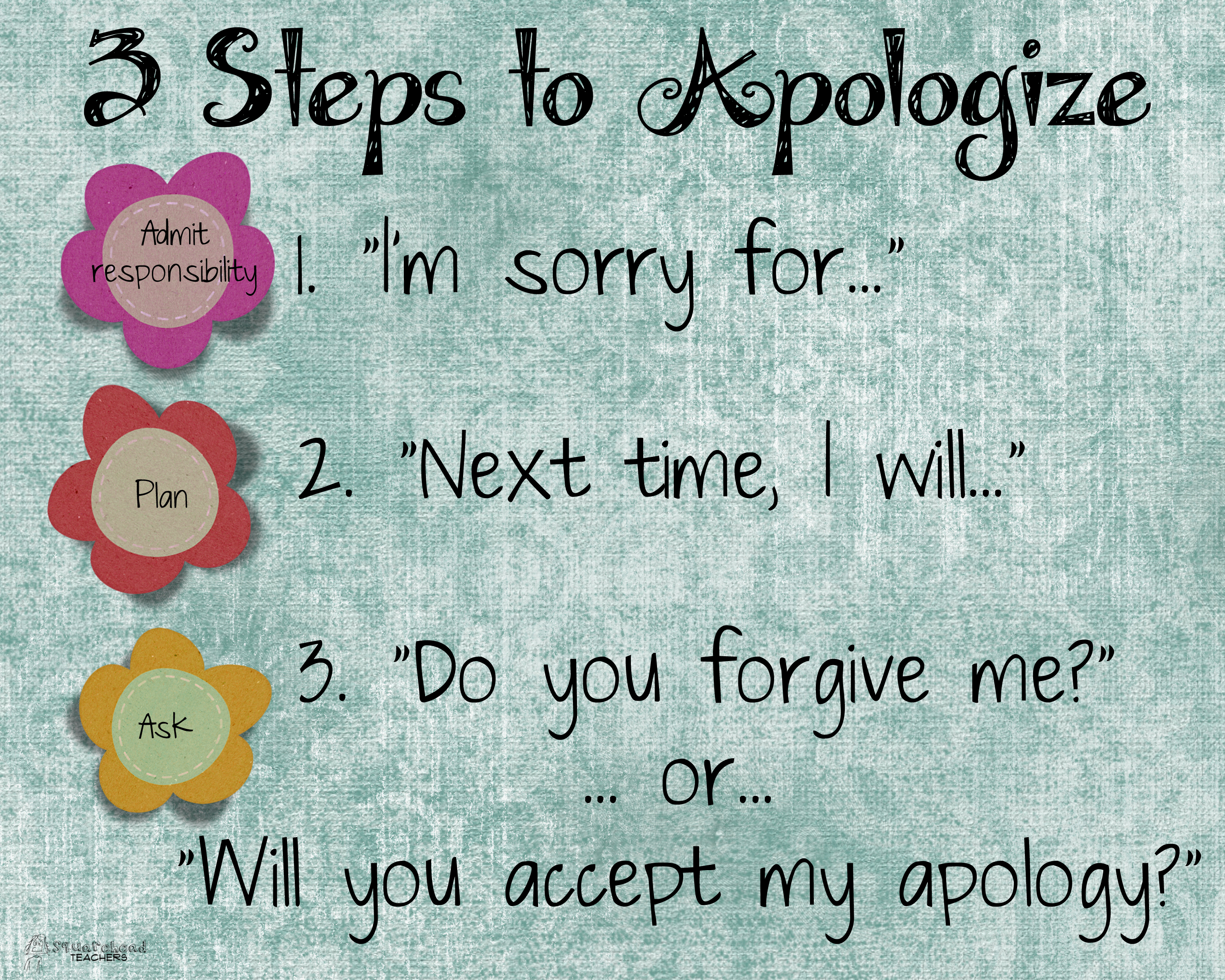

 What kid doesn’t love Legos? I mean seriously, there are infinite possibilities in those tiny little bricks! So naturally, I needed a way to bring Legos into my classroom… and this is what I came up with! Enjoy some simple addition and subtraction practice!


 Squarehead Teachers