
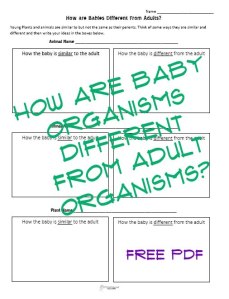
 The California Science Standard for 1st grade (1-LS3-1) says “Make observations to construct an evidence-based account that young plants and animals are like, but not exactly like, their parents. [Clarification Statement: Examples of patterns could include features plants or animals share. Examples of observations could include leaves from the same kind of plant are the same shape but can differ in size; and, a particular breed of dog looks like its parents but is not exactly the same.] [Assessment Boundary: Assessment does not include inheritance or animals that undergo metamorphosis or hybrids.]”
This seemed like a perfect concept to make a graphic organizer for! I’ve also uploaded the pictures you can use to help your students think of examples.
Click here for the free printable PDF: How are Babies Different From Adults Graphic Organizer
Click here for the example pictures: Plants and Animals – baby and adult pictures
 Yay for graphic organizers! I’m getting good at them. I’m finding that the key is to make them simple so that the format doesn’t distract kids. Anyway, here’s my newest social studies graphic organizer. It’s about the causes of World War 1. It’s similar to the other social studies graphic organizers I’ve made.
 I’ve got another graphic organizer for you! This is my second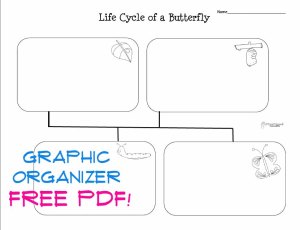
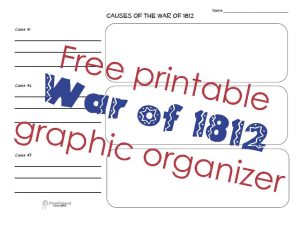 I’ve had the most success teaching social studies when I let my students take notes and draw pictures of the event we’re learning about. I’ve made a simple graphic organizer to teach/summarize causes of the War of 1812 (just like I made a

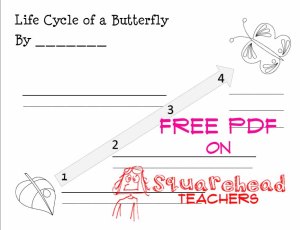
 I’m totally on a graphic organizer kick right now. Here’s my latest: a simple, blank graphic organizer for teaching life cycles. I think the standard idea of drawing a circle is confusing to kids. Somebody’s always bound to think you’re teaching them that the same animal comes to life again (which gets into religion, blah blah blah). So I’ve done mine along a line. As always, there’s space to write words and draw a simple picture.
 Squarehead Teachers