
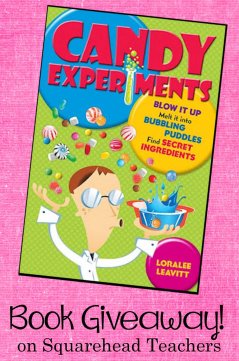
Giveaway coming later this week!
With summertime fun and sugary snacks providing so many distractions, can your children actually learn anything over the summer? Yes, they can, if you sneak in some science with fun activities like candy experiments.
Our family created candy experiments when my oldest daughter was four, and wanted to put Nerds in water. Since her first experiment, we have destroyed candy in dozens of ways and learned about chemistry, physics, and nutrition along the way. Here are a few of our favorites.
Melting: If summertime heat makes your kids complain that they’re going to melt, try melting candy to see what’s inside. If you microwave Starbursts, you’ll see shiny spots of oil that separate out from the candy. If you microwave chocolate, you might start the blooming process, in which unstable chocolate crystals start to move and separate, causing white cocoa butter “bloom” to form on the outside of the bar.
Cotton Candy Experiments: Some candy experiments use cotton candy, a summertime staple. To make cotton candy vanish, dip a puff of cotton candy in water. As capillary action carries water up the network of tiny candy strands, the water dissolves the candy from the bottom up. You can also weigh cotton candy to see how much sugar it really contains–you might be surprised to see that cotton candy is mostly air!
Find Hidden Candy: You’ll find hidden sugar in all sorts of summer snacks, from popsicles and ice cream bars to “healthy” power bars and sports drinks. To help your kids see how much “hidden candy” they’re eating, read the snack’s nutrition label to see how much sugar it contains. Then weigh candy on a kitchen scale until it matches the weight of the sugar on the label. Eating the snack would be like eating that amount of candy.
You’ll find more summer learning experiments in our book, Candy Experiments, or at www.candyexperiments.com. Enjoy summer learning!
Loralee Leavitt is the author of Candy Experiments, Road Tripping, and Candy Experiments 2 (coming in January 2015). Follow her candy adventures at www.candyexperiments.com

 Here’s a friendly letter template I put together recently. It would be perfect to use for Grandparents Day, Mother’s Day or Father’s Day. This could be nice final copy paper for your students’ letters. Or it could be for any letter… a thank you letter, a pen pal letter, you name it. It’s pretty basic. Enjoy!
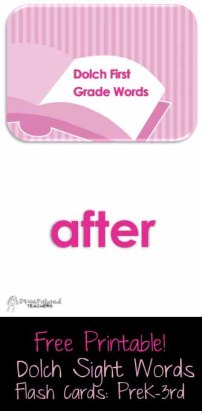 I recently made these Dolch sight words flash cards for pre-K, kindergarten, first grade, second grade and third grade all using Microsoft Word 2013. It’s my new favorite thing! Click below for the front and back to the set you want to download:

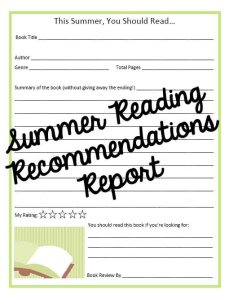 Teachers are always looking to motivate kids to continue reading throughout the summer. I was pondering this challenge, and the following idea just popped into my head.. so I ran with it. The intention is to have each kid choose a book they read that year and write a “recommendation report” about it. Then they can share their report with the class and try to persuade others to read the book. Hopefully a few kids will be inspired and read something over the summer. But at bare minimum, students can identify classmates who share their same taste in books.
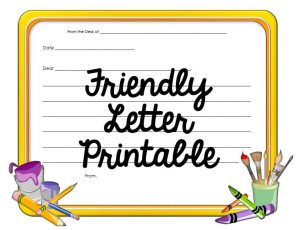 Sometimes publishing a writing assignment on a special piece of paper adds some extra incentive and interest. Here’s a simple printable you can use for the final publishing step of a friendly letter assignment. Or if your kids like the idea of “from the desk of” letterhead, have them design their own.
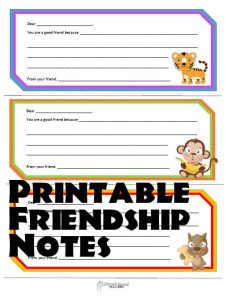 I’m a firm believer in teaching kids to thank others and give compliments. This printable is intended to give kids a space to write a short friendship note to 3 classmates. You can do this activity for Valentine’s Day, the end of the year, or whenever your class needs some bonding. I recommend printing one page for each kid so they can write 3. You may even consider assigning one or all of the recipients to ensure everyone gets one. In addition, It may be a good idea to read them before they’re distributed just in case…
 The end of the year can be such a fun time… testing is over and summer is near! Thank heavens! But how to keep your students learning when they’d rather be at the beach? Here are some of my favorite ideas:
